June 27, 2011
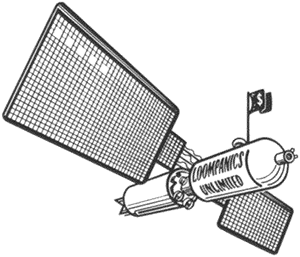
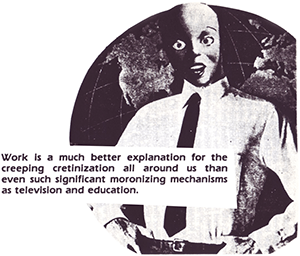
‘The Abolition of Work‘ is an essay written by American anarchist, Bob Black in 1985. The essay was part of an anthology of essays entitled ‘The Abolition of Work and Other Essays’ published by Loompanics (a publisher specializing in nonfiction on generally unconventional or controversial topics).
It is an exposition of Black’s ‘type 3 anarchism’ – a blend of post-Situationist theory and individualist anarchism – focusing on a critique of the work ethic. He adopted Situationist tropes that had recently been re-popularized (or recuperated) by pop bands of the time (Bow Wow Wow in particular having earlier featured ‘demolition of the work ethic’ and ‘there’s no need to work ever’ among similar lines in their lyrics).
read more »
Posted in Money, Philosophy, Politics |
Leave a Comment »
June 27, 2011


A flat tax is a tax system with a constant tax rate. A flat tax may also be called a tax in rem (‘against the thing’), such as an excise tax on gasoline of three cents per gallon. Usually the term flat tax refers to household income (and sometimes corporate profits) being taxed at one marginal rate, in contrast with progressive or regressive taxes that vary according to parameters such as income or usage levels. Flat taxes offer simplicity in the tax code, which has been reported to increase compliance and decrease administration costs. Proposals differ in how they define and measure what is subject to tax. A ‘true flat rate tax’ is a system of taxation where one tax rate is applied to all income with no exceptions.
Critics of the flat tax argue that the marginal dollar to low income individuals is vastly more vital than that of the high income earner, especially around the poverty level. In their view this justifies a progressive taxation system as the added income gained from a flat tax rate to the rich would not be spent on vital goods and services for survival as they might at the poverty level with reduced taxation. However, true Flat tax proponents necessarily contest the concept of the diminishing marginal utility of money and that a marginal dollar should be taxed differently.
read more »
Posted in Money, Politics, World |
Leave a Comment »
June 27, 2011
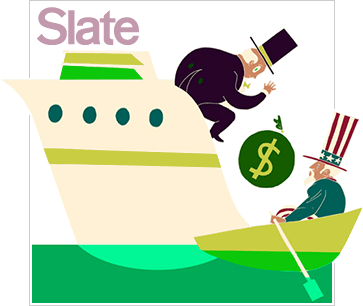
A consumption tax is a tax on spending on goods and services. Consumption taxes are usually indirect, such as a sales tax or a value added tax. However, a consumption tax can also be structured as a form of direct, personal taxation, such as an expenditure tax (a tax levied on the total consumption expenditure of an individual).
Consumption taxes do not tax savings, which allows invested assets to grow more quickly. Although personal and corporate income taxes provide the bulk of revenue to the federal government, consumption taxes continue to be a primary source of income for state and local governments.
read more »
Posted in Money, Politics |
Leave a Comment »
June 24, 2011
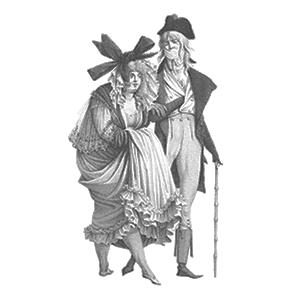
The Incroyables (Incredibles) and their female counterparts, the Merveilleuses (Marvelous), were a name for the fashionable subcultures living in France in the Directoire era (late 18th century). The exhibition of products of national industry, organized in 1798, testified to their infatuation with luxury.
The names are sometimes spelled and were pronounced ‘incoyables’ and ‘meveilleuses’ without the letter R, in reaction against the Revolution, which begins with an R, in which so many had suffered and lost relatives, the letter R was banished. Divorce became legal under the Directoire and morals tended to be looser than in the past. Many Incroyables were ‘nouveaux riches,’ gaining their wealth from selling arms and lending money (usury). When the Directoire period ended, society took a more sober and modest turn.
read more »
Posted in Art, Money, World |
Leave a Comment »
June 24, 2011


This Is Your Life is an American television documentary series broadcast on NBC, originally hosted by its producer, Ralph Edwards from 1952 to 1961. In the show, the host surprises a guest, and proceeds to take them through their life in front of an audience including friends and family. The format originated as a radio show on NBC Radio airing from 1948 to 1952.
The idea for ‘This Is Your Life’ arose while Edwards was working on ‘Truth or Consequences.’ He had been asked by the U.S. Army to ‘do something’ for paraplegic soldiers at a California Army rehabilitation hospital. Edwards chose a ‘particularly despondent young soldier and hit on the idea of presenting his life on the air, in order to integrate the wreckage of the present with his happier past and the promise of a hopeful future.’
read more »
Posted in Art, Money |
1 Comment »
June 23, 2011

Net cafe refugees (also known as cyber-homeless) is a term for a growing class of homeless people in Japan who do not own or rent a residence and thus have no permanent address and sleep in 24 hour Internet cafés or manga cafés. Some internet cafes offer free showers and sell underwear and other personal items, enabling net cafe refugees to use the internet cafes like a hotel or hostel.
A Japanese government study estimated that over 5,400 people are spending at least half of their week staying in net cafes. It has been alleged that this phenomenon is part of an increasing wealth gap in Japan, which has historically been a very economically equal society. Another word for Net cafe refugees is Cyber-homeless, a Japanese word based on English. Typically, the cyber-homeless are unemployed or underemployed and cannot afford to rent even the cheapest apartment, which is more than the cost per month to rent an internet booth daily. The cyber-homeless may use the address of the internet cafe on resumes.
Posted in Money, Technology, World |
Leave a Comment »
June 21, 2011

Commercial graffiti (also known as aerosol advertising or graffiti for hire) is the commercial practice of graffiti artists being paid for their work. In New York City in particular, commercial graffiti is big business and since the 1980s has manifested itself in many of the major cities of Europe such as London, Paris and Berlin.
Increasingly it has been used to promote video games and even feature prominently within them, reflecting a real life struggle between street artists and the law. Commercial graffiti has created significant controversy between those who view it as an effective medium of advertising amongst specific target audiences and those who believe that legal graffiti and advertising using it encourages illegal graffiti and crime.
read more »
Posted in Art, Money |
Leave a Comment »
June 21, 2011


Mr. Brainwash (‘MBW’) is a pseudonym for Thierry Guetta in the film ‘Exit Through the Gift Shop,’ directed by Banksy. Guetta is presented in the 2010 film as a French citizen who now lives in Los Angeles, having been a proprietor of a clothing store and videographer who evolved into a street artist and gallery artist, influenced by the street artists he documented through video over the years.
According to the film, Guetta was first introduced to street art by his cousin, the French street artist, Invader. The film includes authentic documentation of Space Invader, Shepard Fairey, Banksy, and other well-known street artists at work on the streets, and is directed by Banksy with significant participation from Fairey.
read more »
Posted in Art, Money |
1 Comment »
June 21, 2011

The Wall of Sound was an enormous public address system designed specifically for the Grateful Dead’s live performances by audio engineer Owsley ‘Bear’ Stanley. Used in 1974, the Wall of Sound fulfilled the band’s desire for a distortion-free sound system that could also serve as its own monitoring system. The Wall of Sound was the largest concert sound system built at that time.
As Stanley described it, ‘The Wall of Sound is the name some people gave to a super powerful, extremely accurate PA system that I designed and supervised the building of in 1973 for the Grateful Dead. It was a massive wall of speaker arrays set behind the musicians, which they themselves controlled without a front of house mixer. It did not need any delay towers to reach a distance of half a mile from the stage without degradation.’
read more »
Posted in Art, Money, Technology |
Leave a Comment »
June 21, 2011
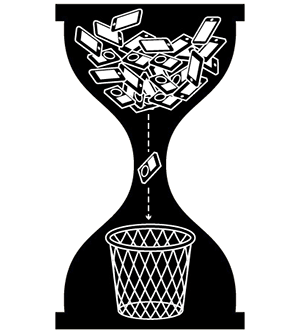
Planned obsolescence in industrial design is a policy of deliberately planning a product with a limited useful life, so it will become obsolete or nonfunctional after a certain period of time. Planned obsolescence has potential benefits for a producer because to obtain continuing use of the product the consumer is under pressure to purchase again, whether from the same manufacturer (a replacement part or a newer model), or from a competitor.
For an industry, planned obsolescence stimulates demand by encouraging purchasers to buy sooner if they still want a functioning product. Built-in obsolescence is used in many different products. There is, however, the potential backlash of consumers who learn that the manufacturer invested money to make the product obsolete faster; such consumers might turn to a producer (if any exists) that offers a more durable alternative.
read more »
Posted in Money, Technology |
1 Comment »
June 21, 2011

A false economy refers to an action which saves money at the beginning but which, over a longer period of time, results in more money being wasted than being saved. For example, if a city government decided to purchase the least expensive automobiles for use by city workers, it might be termed false economy, as cheap automobiles have a record of traditionally needing more frequent repairs in the long term and the repair costs will eradicate any initial savings garnered.
The concept is similar to planned obsolescence, whereby the lower initial cost of a false economy attracts buyers mostly on the basis of low cost, who may later be at a disadvantage.
read more »
Posted in Money |
Leave a Comment »
June 16, 2011
Barry Lyndon is a 1975 period film directed by Stanley Kubrick based on the 1844 novel ‘The Luck of Barry Lyndon’ by William Makepeace Thackeray which recounts the exploits of an 18th century a man of the Irish gentry trying to become a member of the English aristocracy.
The film is divided into two halves each headed with a title card: ‘I. By What Means Redmond Barry Acquired the Style and Title of Barry Lyndon.’ ‘II. Containing an Account of the Misfortunes and Disasters Which Befell Barry Lyndon.’ The epilogue read: ‘It was in the reign of King George III that the aforesaid personages lived and quarreled; good or bad, handsome or ugly, rich or poor, they are all equal now.’
read more »
Posted in Art, Money |
Leave a Comment »



