February 7, 2026

The Hedgehog and the Fox is an essay by philosopher Isaiah Berlin that was published as a book in 1953. It was one of his most popular essays with the public. However, Berlin said, ‘I meant it as a kind of enjoyable intellectual game, but it was taken seriously. Every classification throws light on something.’ It has been compared to ‘an intellectual’s cocktail-party game.’
The title is a reference to a fragment attributed to the Ancient Greek poet Archilochus: ‘a fox knows many things, but a hedgehog knows one big thing.’ The fable of ‘The Fox and the Cat’ embodies the a related idea: having one simple, reliable skill is better than boasting many clever but useless plans.
read more »
Posted in Language, Philosophy |
Leave a Comment »
December 17, 2025
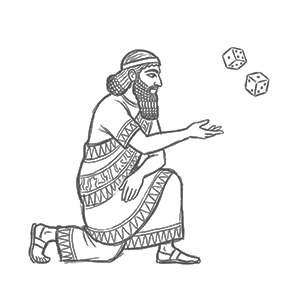
‘The Lottery in Babylon’ (‘La lotería en Babilonia’) is a fantasy short story by Argentine writer Jorge Luis Borges. It first appeared in 1941 in the literary magazine ‘Sur,’ and was then included in the 1941 collection ‘The Garden of Forking Paths’ (‘El jardín de los senderos que se bifurcan’), which in turn became the part one of ‘Ficciones’ (1944). Translated into English by John M. Fein, it was published in ‘Prairie Schooner’ (1959), and in ‘Labyrinths’ (1962).
The story describes a mythical Babylon in which all activities are dictated by an all-encompassing lottery, which people must live by, and has full control over many’s lives, a metaphor for the role of chance in one’s life.
read more »
Posted in Art, Philosophy |
Leave a Comment »
November 8, 2025
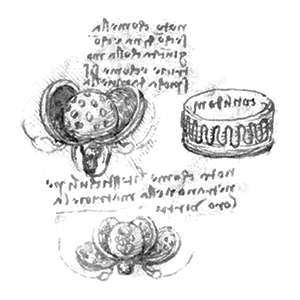
Commonplace books (or commonplaces) are personal notebooks used to compile any information the owner finds interesting or useful. They can variously contain notes, proverbs, adages, aphorisms, maxims, recipes, quotes, letters, poems, tables of weights and measures, prayers, legal formulas, and other professional references. They have been kept from antiquity, and were kept particularly during the Renaissance and in the nineteenth century.
Entries are most often organized under systematic subject headings and differ functionally from journals or diaries, which are chronological and introspective.
read more »
Posted in Language, Philosophy, Science |
Leave a Comment »
March 19, 2025
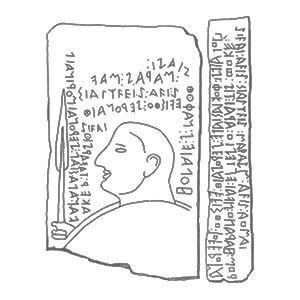
A stele [stee-lee] or stela [stee-lah] is a stone or wooden slab, generally taller than it is wide, erected in the ancient world as a monument. The surface of the stele often has text, ornamentation, or both. These may be inscribed, carved in relief, or painted.
Steles have also been used to publish laws and decrees, to record a ruler’s exploits and honors, to mark sacred territories or mortgaged properties, as territorial markers, as the boundary steles of Akhenaton at Amarna, or to commemorate military victories. They were widely used in the ancient Near East, Mesopotamia, Greece, Egypt, Somalia, Eritrea, Ethiopia, and, most likely independently, in China and elsewhere in the Far East, and, independently, by Mesoamerican civilizations, notably the Olmec and Maya.
read more »
Posted in Philosophy, Politics, World |
Leave a Comment »
June 25, 2024

Quis custodiet ipsos custodes? is a Latin phrase found in the ‘Satires,’ a work of the 1st–2nd century Roman poet Juvenal. It may be translated as ‘Who will guard the guards themselves?’ or ‘Who will watch the watchmen?”.
The original context deals with the problem of ensuring marital fidelity, though the phrase is now commonly used more generally to refer to the problem of controlling the actions of persons in positions of power, an issue discussed by Plato in the ‘Republic.’ It is not clear whether the phrase was written by Juvenal, or whether the passage in which it appears was interpolated into his works.
read more »
Posted in Philosophy, Politics |
Leave a Comment »
May 2, 2024

The B-theory of time, also called the ‘tenseless theory of time,’ is one of two positions regarding the temporal ordering of events in the philosophy of time. B-theorists argue that the flow of time is only a subjective illusion of human consciousness, that the past, present, and future are equally real, and that time is tenseless: temporal becoming is not an objective feature of reality. Therefore, there is nothing privileged about the present, ontologically speaking.
The B-theory is derived from a distinction drawn by English idealist metaphysician J. M. E. McTaggart between A series and B series. The B-theory is often drawn upon in theoretical physics, and is seen in theories such as eternalism (the view that all existence in time is equally real, as opposed to presentism or the growing block universe theory of time, in which at least the future is not the same as any other time).
read more »
Posted in Philosophy |
Leave a Comment »
April 20, 2024

Killing baby Hitler is a thought experiment in ethics and theoretical physics which poses the question of using time travel to assassinate an infant Adolf Hitler. It presents an ethical dilemma in both the action and its consequences, as well as a temporal paradox in the logical consistency of time. Killing baby Hitler first became a literary trope of science fiction during World War II and has since been used to explore these ethical and metaphysical debates.
Public debate around the question of killing baby Hitler reached its height in late 2015, after ‘The New York Times’ published a poll asking its readers the question. 42% said they would kill baby Hitler, 30% said they would not and 28% were undecided. Advocates of killing baby Hitler included Florida governor Jeb Bush and film actor Tom Hanks, while comedian Stephen Colbert and pundit Ben Shapiro were counted among the opponents of the policy.
read more »
Posted in Philosophy, Politics |
Leave a Comment »
February 28, 2024

The mango cult was the worship of mangoes in China after Mao gave a box of mangoes, given to him by the Pakistani Foreign Minister, to workers at Tsinghua University in 1968. Instead of being eaten, the mangoes were preserved in formaldehyde, or sealed in wax for veneration.
One dentist from Fulin, Dr. Han Guangdi, saw the mango and said it was nothing special and looked just like sweet potato. He was put on trial for malicious slander, found guilty, paraded publicly throughout the town, and then executed with one shot to the head. Mangoes are now common in China, and are seen as a common consumer good.
read more »
Posted in Philosophy, Politics, World |
Leave a Comment »
November 26, 2023

Roko’s basilisk [bas-uh-lisk] is a thought experiment which states that an otherwise benevolent artificial superintelligence (AI) in the future would be incentivized to create a virtual reality simulation to torture anyone who knew of its potential existence but did not directly contribute to its advancement or development, in order to incentivize said advancement.
It originated in a 2010 post at discussion board LessWrong, a technical forum focused on analytical rational enquiry. The thought experiment’s name derives from the poster of the article (Roko) and the basilisk, a mythical creature capable of destroying enemies with its stare.
read more »
Posted in Philosophy, Technology |
Leave a Comment »
August 6, 2023

The Jewish-American patronage of Chinese restaurants became prominent in the 20th century, especially among Jewish New Yorkers. It has received attention as a paradoxical form of assimilation by embracing an unfamiliar cuisine that eased the consumption of non-kosher foods.
Factors include the relative absence of dairy products compared to European cuisines, concern over German and Italian antisemitic regimes in the 1930s and the proximity of Jewish and Chinese immigrants to each other in New York City.
read more »
Posted in Food, Philosophy, World |
Leave a Comment »
December 18, 2022

A mumpsimus [muhmp-suh-muhs] is a ‘traditional custom obstinately adhered to however unreasonable it may be,’ or ‘someone who obstinately clings to an error, bad habit or prejudice, even after the foible has been exposed and the person humiliated; also, any error, bad habit, or prejudice clung to in this fashion.’
The term originates in the story of a priest using the nonsense Latin word ‘mumpsimus’ instead of ‘sumpsimus’ (lit. ‘we have taken’) when giving mass, and refusing to be corrected on the matter. The word may refer to either the speaker or their habit.
read more »
Posted in Language, Philosophy |
Leave a Comment »
January 3, 2022

In 19th-century English maritime folklore, Fiddler’s Green was an afterlife for sailors who had served at least fifty years at sea.
They were rewarded with perpetual mirth, a fiddle that never stopped playing, and dancers who never tired.
read more »
Posted in Philosophy, World |
1 Comment »


 The Daily Omnivore