July 15, 2014


Antireductionism [an-tee-ri-duhk-shuh-niz-uhm] is a reaction against reductionism (the idea that a system can be totally determined by understanding its components), which instead advocates holism (sometimes called ‘whole to parts,’ in which a contextual overview precedes analysis of constituent parts).
Although ‘breaking complex phenomena into parts, is a key method in science,’ there are those complex phenomena (e.g. in psychology, sociology, ecology) where some resistance to or rebellion against this approach arises, primarily due to the perceived shortcomings of the reductionist approach. Holism is touted as an effective antidote against reductionism, psychiatric hubris, and scientism, a belief in the universal applicability of the scientific method. Arguments against reductionism therefore implicitly carry a critique of the scientific method itself, which engenders suspicion among scientists.
read more »
Posted in Philosophy, Science |
Leave a Comment »
June 17, 2014


The letter of the law versus the spirit of the law is an idiomatic antithesis (a common expression where two opposites are introduced for contrasting effect): When one obeys the letter of the law but not the spirit, one is obeying the literal interpretation of the words (the ‘letter’) of the law, but not the intent of those who wrote the law. Conversely, when one obeys the spirit of the law but not the letter, one is doing what the authors of the law intended, though not necessarily adhering to the literal wording.
‘Law’ originally referred to legislative statute, but in the idiom may refer to any kind of rule. Intentionally following the letter of the law but not the spirit may be accomplished through exploiting technicalities, loopholes, and ambiguous language.
read more »
Posted in Language, Philosophy, Politics |
Leave a Comment »
June 13, 2014

Chronocentrism has been defined as ‘the egotism that one’s own generation is poised on the very cusp of history.’ The term had been used earlier in a study about attitudes to ageing in the workplace. Chronocentricity (‘only seeing the value of one’s own age cohort’) described the tendency for younger managers to hold negative perceptions of the abilities or other work-related competencies of older employees. This type of discrimination is a form of ageism.
Another usage is related to ethnocentrism (judging another culture solely by the values and standards of one’s own culture). By comparison, chronocentrism is perceiving and judging a culture’s historical values in terms of contemporary standards. An example of this usage is racism. In times prior to the advances of the civil rights movement, racist views and public expression were much more acceptable than they are today. This results in a tendency to judge those then making such statements in a harsher light.
Posted in Language, Philosophy, Politics |
1 Comment »
June 11, 2014

The Lindy Effect is a theory of the permanence of non-perishable things. Unlike biological organisms, the life expectancy of an idea or technology increases as it ages. The origin of the concept can be traced to biographer Albert Goldman and a 1964 article he wrote for ‘The New Republic’ titled ‘Lindy’s Law.’ In it he stated that ‘the future career expectations of a television comedian is proportional to the total amount of his past exposure on the medium.’ The term refers to a NY deli known as a hangout for comedians; they would ‘foregather every night at Lindy’s, where… they conduct post-mortems on recent show biz ‘action.’
Mathematician Benoit Mandelbrot formally coined the term ‘Lindy Effect’ in his 1984 book ‘The Fractal Geometry of Nature.’ Mandelbrot expressed mathematically that for certain things bounded by the life of the producer, like human promise, future life expectancy is proportional to the past: ‘However long a person’s past collected works, it will on the average continue for an equal additional amount. When it eventually stops, it breaks off at precisely half of its promise.’
read more »
Posted in Philosophy, Science, Technology |
1 Comment »
June 3, 2014

‘The Machine Stops’ is a science fiction short story written in 1909 by E. M. Forster, who known for his ironic and well-plotted novels examining class difference and hypocrisy in early 20th-century British society. After initial publication in ‘The Oxford and Cambridge Review,’ the story was republished in Forster’s ‘The Eternal Moment and Other Stories’ in 1928. It is particularly notable for predicting new technologies such as instant messaging and the Internet.
Forster describes a world in which most of the human population has lost the ability to live on the surface of the Earth. Individuals lives in isolation below ground in a standard ‘cell,’ with all bodily and spiritual needs met by the omnipotent, global ‘Machine.’ Travel is permitted but unpopular and rarely necessary. Communication is made via a kind of instant messaging/video conferencing machine called the speaking apparatus, with which people conduct their only activity: the sharing of ideas and what passes for knowledge.
read more »
Posted in Language, Philosophy, Technology |
1 Comment »
June 2, 2014

Because of the complexity and sophistication of its narrative structure, H.G. Wells’s 1905 novel ‘A Modern Utopia‘ (1905) has been called ‘not so much a modern as a postmodern utopia.’ The book is best known for its notion that a voluntary order of nobility known as the Samurai could effectively rule a ‘kinetic and not static’ world state so as to solve ‘the problem of combining progress with political stability.’
In terms of Northrop Frye’s classification of literary genres, ‘A Modern Utopia’ is not a novel but an anatomy, a book that divides a topic into parts for detailed examination or analysis. Frye, narrowed the definition of the word to mean a work resembling a ‘Menippean satire,’ which ridicules foolish or undisciplined mental attitudes instead of specific individuals.
read more »
Posted in Language, Philosophy |
Leave a Comment »
June 1, 2014

Baby jumping (‘El Colacho’) is a traditional Spanish holiday dating back to 1620 that takes place annually to celebrate the Catholic feast of Corpus Christi in the village of Castrillo de Murcia in northern Spain. During the act, known as ‘El Salto del Colacho’ (‘the devil’s jump’), men dressed as the Devil (the Colacho) jump over babies born during the previous twelve months of the year who lie on mattresses in the street. The Brotherhood of Santísimo Sacramento de Minerva organizes the week-long festivities which culminate on Sunday when the Colacho jumps over the babies on the mattresses placed on the procession route traversing the town.
The festival has been rated as one of the most dangerous in the world. The origins of the tradition are unknown but it is said to cleanse the babies of original sin, ensure them safe passage through life and guard against illness and evil spirits. In recent years, Pope Benedict has asked Spanish priests to distance themselves from El Colacho, and to downplay the tradition’s connection with Catholicism. The Church still teaches that it is baptism by water, not a giant leap by an airborne devil, which cleanses the soul of original sin.
Posted in Games, Philosophy, World |
Leave a Comment »
May 20, 2014


Otherkin is a description applicable to people who believe themselves to be partially or entirely non-human. They consider themselves to be other creatures (real, fictitious, or mythological) in spirit if not in body. This is explained by some members of the otherkin community as possible through reincarnation, having a nonhuman soul, ancestry, or symbolic metaphor. According to Joseph Laycock (who wrote a book about contemporary vampire culture), ‘scholarship has framed this claim as religious because it is frequently supported by a framework of metaphysical beliefs.’ Not all otherkin necessarily share these beliefs; some may simply prefer to identify as non-human.
Otherkin largely identify as mythical creatures, with others identifying as real-life creatures or creatures from fantasy or popular culture. Examples include: angels, demons, dragons, elves, fairies, sprites, and plants. Many otherkin believe in the existence of a multitude of parallel/alternative universes, which would explain the existence and the possibility to relate to fantastical beings and even fictional characters.
read more »
Posted in Health, Philosophy |
Leave a Comment »
May 16, 2014

The Ortega hypothesis holds that average or mediocre scientists contribute substantially to the advancement of science. According to this hypothesis, scientific progress occurs mainly by the accumulation of a mass of modest, narrowly specialized intellectual contributions. On this view, major breakthroughs draw heavily upon a large body of minor and little-known work, without which the major advances could not happen.
The Ortega hypothesis is widely held, but a number of systematic studies of scientific citations have favored the opposing ‘Newton hypothesis,’ which says that scientific progress is mostly the work of a relatively small number of great scientists (after Isaac Newton’s statement that he ‘stood on the shoulders of giants’).
read more »
Posted in Philosophy, Science |
Leave a Comment »
May 13, 2014


Wisdom literature is a genre of literature common to the Ancient Near East characterized by sayings of wisdom intended to teach about divinity and about virtue. While techniques of traditional storytelling are used, books also presume to offer insight and wisdom about nature and reality.
The genre of ‘mirrors for princes’ (textbooks which directly instruct monarchs on certain aspects of rule and behavior), which has a long history in Islamic and Western Renaissance literature, represents a secular cognate of biblical wisdom literature. In Classical Antiquity, the advice poetry of Hesiod, particularly his ‘Works and Days’ (ca. 700 BCE, a farmer’s almanac in which Hesiod instructs his brother Perses in the agricultural arts) has been seen as a like-genre to Near Eastern wisdom literature.
read more »
Posted in Language, Philosophy |
1 Comment »
May 12, 2014


The Christ myth theory (also known as ‘Jesus mythicism’) is the proposition that Jesus of Nazareth as described in the New Testament was mythical, although others define it more strictly that Jesus never existed in any form. The thesis that Jesus was invented by the Christian community after 100 CE was first put forward in the late 18th century and then popularized in the 19th century by German philosopher Bruno Bauer who proposed a three-fold argument still used by many myth proponents today: the New Testament has no historical value, non-Christian writers of the first century failed to mention Jesus, and Christianity had pagan and mythical beginnings.
Despite the debate in popular culture and on the Internet, the position that Jesus did not exist is not held by most professional historians, nor the vast majority of New Testament scholars. Classical historian Michael Grant states that, ‘Modern critical methods fail to support the Christ myth theory…[It has] again and again been answered and annihilated by first rank scholars.’ Other scholars, mostly based in Europe, however, argue their colleagues should remain more open to this possibility and that the debate on the historicity of Jesus is not over.
read more »
Posted in Philosophy, World |
Leave a Comment »
May 9, 2014
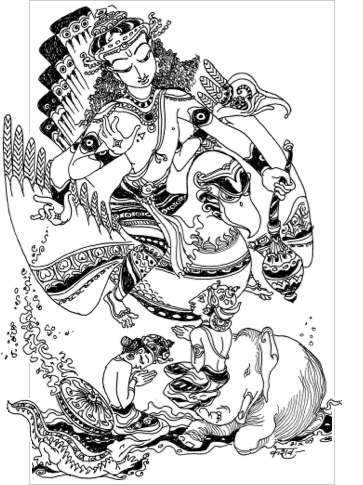
Moksha [mohk-shuh] (Sanskrit: ‘freedom’) is the ultimate goal of personal spiritual development in Hinduism. According to Vedanta (an orthodox school of Hindu philosophy), life is a endless cycle of birth, death, and rebirth into a physical universe that is actually an illusion. Hindu scriptures describe Moksha as the spiritual liberation from this cycle and the achievement of an eternal and blissful emptiness that transcends all of the joys, pain, and sorrow of the physical body or corporeal life. It is the goal of Hindu practitioners to achieve Moksha through the practice of Yoga (physical, mental, and spiritual disciplines), such as Jnana Yoga (knowledge), Karma Yoga (work), and Bhakti Yoga (reciting prayers and worshiping God).
Moksha is a Vedic term, dating to 1750-500 BCE, a period in Indian history during which the Indo-Aryans settled into northern India. Scholars disagree about the precise relationship between the Moksha of Vedanta Hinduism and the Nirvana of Buddhism, but there is agreement that they are closely related historically and philosophically. Similarities can be found between Moksha and some concepts found in the Upanishads, a collection of Vedic texts which contain the earliest emergence of some of the central religious concepts of Hinduism, Buddhism, and Jainism.
Posted in Philosophy, World |
Leave a Comment »


 The Daily Omnivore