May 8, 2014

Soteriology [suh-teer-ee-ol-uh-jee] is the branch of theology dealing with Salvation. Buddhist salvation (called nirvana) is liberation from suffering, ignorance, and rebirth. Hindu salvation (called moksha) is similarly characterized by emancipation from the cycle of reincarnation. Mainstream Christian soteriology is the study of how God reconciles the separation between man and God due to sin. Christians believe individuals are miraculously saved by divine grace through faith in Jesus Christ, and reconciled to God.
Islamic soteriology focuses on how humans can repent of and atone for their sins so as not to occupy a state of loss. In Islam, it is believed that everyone is responsible for his own action. So even though Muslims believe that their father of humanity, Adam, committed a sin by eating from the forbidden tree and thus disobeying his Lord, they believe that humankind is not responsible for such an action. The major Jewish denominations emphasize prayer and morality in this life over concern with the afterlife.
read more »
Posted in Education, Philosophy |
Leave a Comment »
May 5, 2014


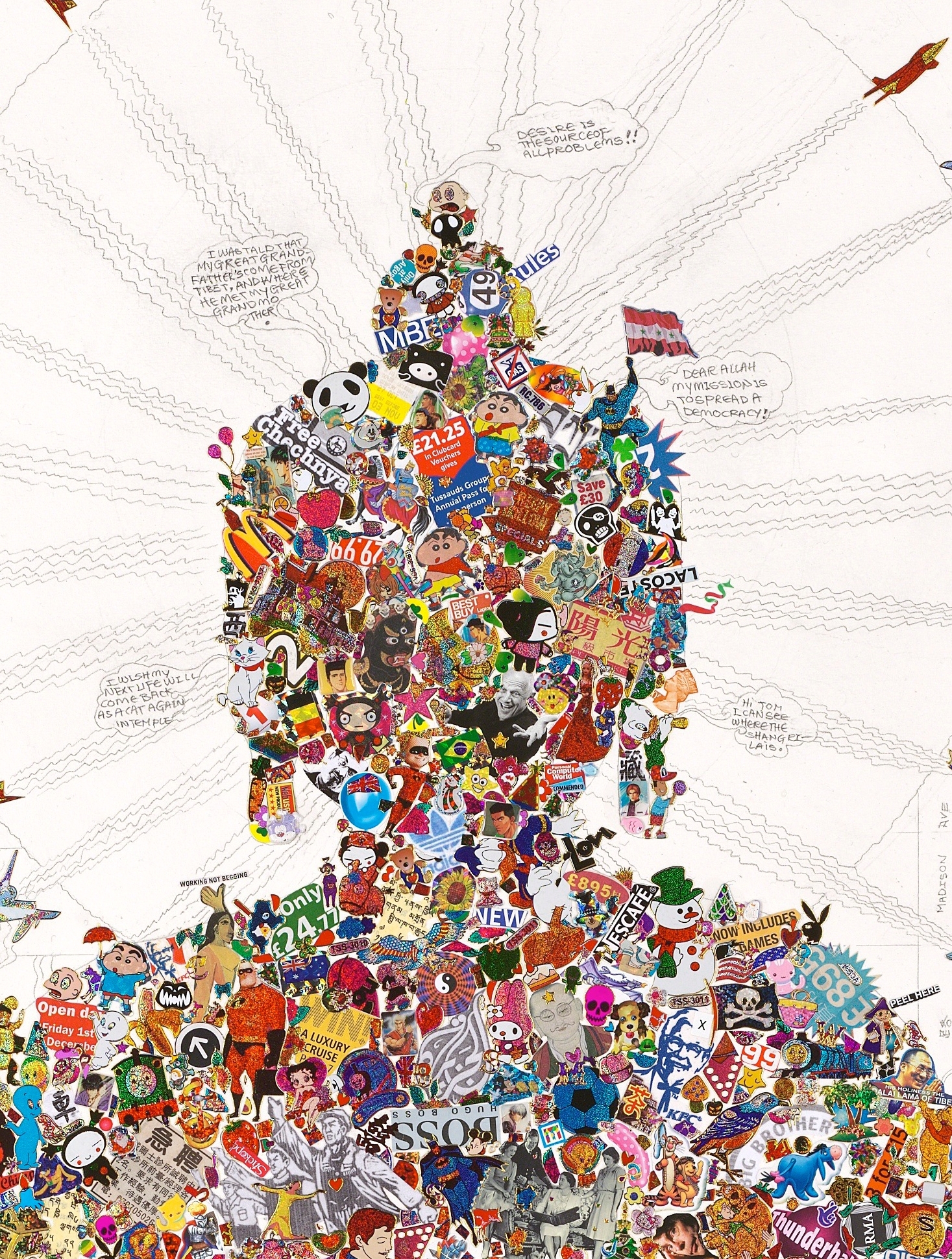
Secular Buddhism is a broad term for an emerging form of Buddhism that is based on humanist, naturalist, and/or agnostic values and pragmatism rather than religious – or more specifically supernatural – beliefs. Secular Buddhists interpret the teachings of the Buddha and the Buddhist texts in a rationalist and often evidentialist manner, considering the historical and cultural contexts of the times in which they were written and the period in which the Buddha lived.
Secular Buddhists eschew mythological and superstitious elements of traditional Buddhism such as supernatural beings (devas, bodhisattvas, nāgas, pretas, Buddhas), merit (an accumulation of good deeds which carries over to subsequent incarnations), supernatural karma (actions, both good and bad, come back to us in the future), rebirth, Buddhist cosmology (including the existence of pure lands and hells). Some of traditional Buddhism’s secular ethics have also been called into questions such as conservative stances on abortion and homosexuality
read more »
Posted in Philosophy, World |
Leave a Comment »
April 24, 2014

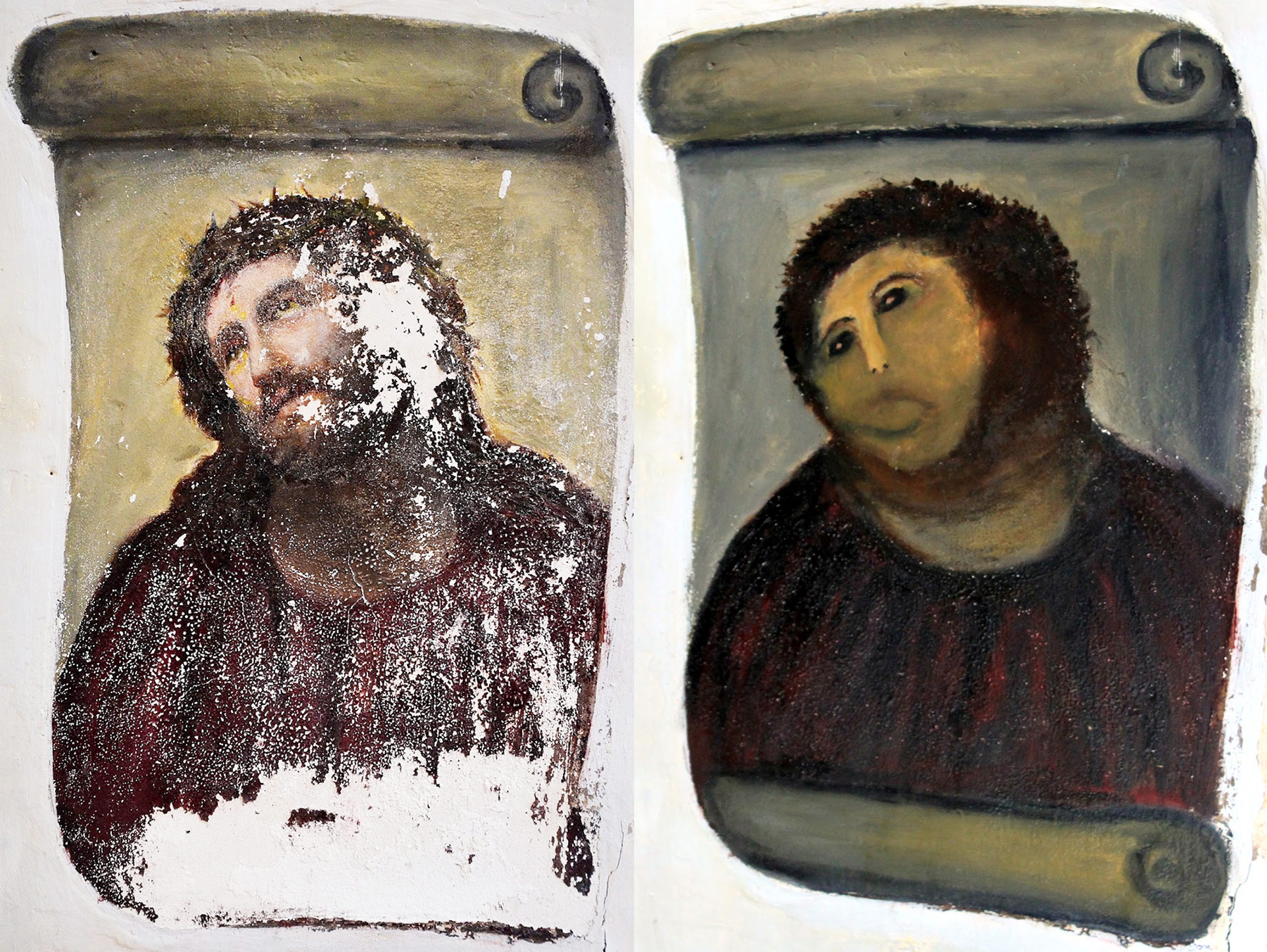
The ‘Ecce Homo‘ [ech-ey hoh-moh] (‘Behold the Man’) in the Sanctuary of Mercy church of Borja, Zaragoza is a fresco of about 1930 by the Spanish painter Elías García Martínez depicting Jesus crowned with thorns. Both the subject and style are typical of traditional Catholic art.
Press accounts agree that the original painting was of little artistic importance, and its fame derives from a botched attempt at restoration.
read more »
Posted in Art, Humor, Philosophy |
Leave a Comment »
April 22, 2014

Religious satire is a form of satire (humor that points out the shortcomings of institutions of power) targeted at religious beliefs. From the earliest times, at least since the plays of Aristophanes in the fourth century BCE, religion has been one of the three primary topics of literary satire, along with politics and sex.
Satire which targets the clergy is a type of political satire, while religious satire is that which targets religious beliefs. It can be the result of agnosticism or atheism, but it can also have its roots in belief itself. According to religious theorist Robert Kantra, in religious satire, man attempts to violate the divine—it is an effort to play God, in whole or in part—whether under the banner of religion or of humanity. Religious satire surfaced during the Renaissance, with works by Chaucer, Erasmus, and Durer.
read more »
Posted in Art, Humor, Philosophy |
Leave a Comment »
April 17, 2014

Narcissistic supply is a concept in some psychoanalytic theories which describes a type of admiration, interpersonal support, or sustenance drawn by an individual from his or her environment (especially from careers, codependents and others). The term is typically used in a negative sense, describing a pathological or excessive need for attention or admiration that does not take into account the feelings, opinions or preferences of other people.
The term ‘narcissistic supply’ was used by psychoanalyst Otto Fenichel in 1938 in describing the way in which a narcissistic individual ‘requires a ‘narcissistic supply’ from the environment in the same way as the infant requires an external supply of food.’ Building on Freud’s concept of ‘narcissistic satisfaction’ and on psychoanalyst Karl Abraham’s work in ‘Short Study of the Development of the Libido,’ Fenichel highlighted the ‘narcissistic need’ in early development. He noted that ‘it has been stated repeatedly that small children need some kind of narcissistic supplies for maintaining their equilibrium.’
read more »
Posted in Health, Philosophy |
Leave a Comment »
April 16, 2014

In decision theory and general systems theory, a mindset is a set of assumptions, methods, or notations held by one or more people or groups of people that is so established that it creates a powerful incentive within these people or groups to continue to adopt or accept prior behaviors, choices, or tools. This phenomenon is also sometimes described as mental inertia, ‘groupthink,’ or a ‘paradigm,’ and it is often difficult to counteract its effects upon analysis and decision making processes.
A mindset can also be seen as incident of a person’s Weltanschauung or philosophy of life. For example there has been quite some interest in the typical mindset of both individual entrepreneurs and their organizations. An institution with an entrepreneurial philosophy will set entrepreneurial goals and strategies as a whole, but maybe even more importantly, it will foster an entrepreneurial milieu, allowing each entity to pursue emergent opportunities. In short, a philosophical stance codified in the mind, hence as mindset, lead to a climate that in turn causes values that lead to practice.
read more »
Posted in Education, Health, Philosophy |
1 Comment »
April 14, 2014

The concept of ego reduction is predicated on the use of Sigmund Freud’s concept of the ego to describe the conscious adult self; and broadly describes the deflating of an over-inflated or egotistical sense of oneself – a curtailment of what Irish philosopher Iris Murdoch called ‘the anxious avaricious tentacles of the self.’
Among other contexts, ego reduction has been seen as a goal in Alcoholics Anonymous; as a part of BDSM play, providing a means of entering ‘subspace’ (a state of submissiveness); and as a way of attaining religious humility and freedom from desire in Buddhism.
read more »
Posted in Health, Philosophy |
Leave a Comment »
April 5, 2014

What social psychologists call ‘The principle of superficiality versus depth’ has pervaded Western culture since at least the time of Plato. Socrates sought to convince his debaters to turn from the superficiality of a worldview based on the acceptance of convention to the examined life of philosophy, founded (as Plato at least considered) upon the underlying Ideas (the belief that non-material abstract ideas, and not the material world of change known to us through sensation, possess the highest and most fundamental kind of reality).
For more than two millennia, there was in the Platonic wake a general valorization of critical thought over the superficial subjectivity that refused deep analysis. The salon style of the Précieuses (a 17th century French literary movement characterized by wit and wordplay) might for a time affect superficiality, and advance the treatment of serious topics in a light-hearted fashion; but the prevailing western consensus firmly rejected elements such as everyday chatter or the changing vagaries of fashion as superficial distractions from a deeper reality.
read more »
Posted in Philosophy |
Leave a Comment »
April 2, 2014
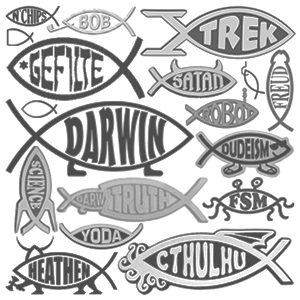
Ichthys [ik-thees], from the Koine Greek word for fish, is a symbol consisting of two intersecting arcs, the ends of the right side extending beyond the meeting point so as to resemble the profile of a fish, used by early Christians as a secret Christian symbol and now known colloquially as the ‘sign of the fish’ or the ‘Jesus fish.’
It is sometimes a subject of satire, especially when adorning the bumpers or trunks of automobiles. The most notable is the ‘Darwin Fish,’ an ichthys symbol with ‘evolved’ legs and feet attached. Rhetorical scholar Thomas Lessl conducted a survey of users of the Darwin fish emblem. Based on their responses, he interprets the symbol as scientific ‘blackface,’ a parody that is one part mockery and one part imitation. While users frequently explain the symbol as a rebuke against Creationism, Lessl suggests that the emblem represents a metaphor for cultural progress.
read more »
Posted in Humor, Philosophy |
1 Comment »
March 27, 2014

Out of hacker culture, and especially the artificial intelligence community at MIT, there have sprung a number of humorous short stories about computer science dubbed hacker koans [koh-ahns]; most of these are recorded in an appendix to the Jargon File (a glossary of computer programmer slang). Most do not fit the usual pattern of koans, but they do tend to follow the form of being short, enigmatic, and often revealing an epiphany.
One notable example, titled ‘Uncarved block,’ describes an exchange between professor Marvin Minsky and student Jerry Sussman: ‘In the days when Sussman was a novice, Minsky once came to him as he sat hacking at the PDP-6. ‘What are you doing?’, asked Minsky. ‘I am training a randomly wired neural net to play Tic-tac-toe,’ Sussman replied. ‘Why is the net wired randomly?’, asked Minsky. ‘I do not want it to have any preconceptions of how to play,’ Sussman said. Minsky then shut his eyes. ‘Why do you close your eyes?’ Sussman asked his teacher. ‘So that the room will be empty.’ At that moment, Sussman was enlightened.’
read more »
Posted in Humor, Philosophy, Technology |
Leave a Comment »
March 26, 2014
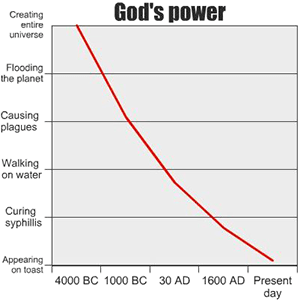
God of the gaps is a theological perspective in which gaps in scientific knowledge are taken to be evidence or proof of God’s existence. The term was invented by Christian theologians not to discredit theism but rather to point out the fallacy of relying on teleological arguments (argument from design) for God’s existence. Some use the phrase to refer to a form of the argument from ignorance fallacy (in which ignorance stands for ‘lack of evidence to the contrary’).
The concept, although not the exact wording, goes back to Henry Drummond, a 19th-century evangelist lecturer, from his Lowell Lectures on ‘The Ascent of Man.’ He chastises those Christians who point to the things that science cannot yet explain—’gaps which they will fill up with God’—and urges them to embrace all nature as God’s, as the work of ‘… an immanent God, which is the God of Evolution, is infinitely grander than the occasional wonder-worker, who is the God of an old theology.’ (Immanence here is related to pantheism, the belief that God and the universe are equivalent.)
read more »
Posted in Philosophy, Science |
3 Comments »
March 25, 2014

Ietsism [eets-iz-uhm] (Dutch: ‘somethingism’) is an unspecified belief in some higher force. In some Eastern European censuses (Albanian, for example), those having ietsistic beliefs are counted as believers without religion. An opinion poll conducted by the Dutch daily newspaper ‘Trouw’ in 2004 indicated that some 40% of its readership felt broadly this way.
It indicates a range of beliefs held by people who, on the one hand, inwardly suspect – or indeed believe – that there is ‘More between Heaven and Earth’ than we know about, but on the other hand do not necessarily accept or subscribe to the established belief system, dogma or view of the nature of God offered by any particular religion. Some of the English language equivalent terms are agnostic theism (the belief that one or more gods exist, but that a person cannot know that god or those gods) and deism (the belief that while a higher being exists, people should rely on logic and reason and not religious traditions).
read more »
Posted in Language, Philosophy, World |
Leave a Comment »


 The Daily Omnivore