March 19, 2014
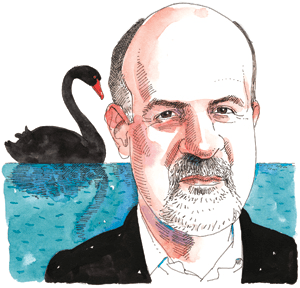
The black swan theory or theory of black swan events is a metaphor that describes an event that comes as a surprise, has a major effect, and is often inappropriately rationalized after the fact with the benefit of hindsight.
The theory was developed by Lebanese American statistician Nassim Nicholas Taleb to explain the disproportionate role of high-profile, hard-to-predict, and rare events that are beyond the realm of normal expectations in history, science, finance, and technology. It further examined the non-computability of the probability of the consequential rare events using scientific methods (owing to the very nature of small probabilities), and the psychological biases that make people individually and collectively blind to uncertainty and unaware of the massive role of the rare event in historical affairs.
read more »
Posted in Money, Philosophy, Science |
Leave a Comment »
March 18, 2014
‘Here be dragons‘ means dangerous or unexplored territories, in imitation of the medieval practice of putting dragons, sea serpents and other mythological creatures in uncharted areas of maps. There are just two known historical use of this phrase in the Latin form ‘HC SVNT DRACONES.’ The term appeared on the 16th century Lenox Globe around the east coast of Asia, and might be related to the Komodo dragons in the Indonesian islands, tales of which were quite common throughout East Asia.
It also appeared on another globe of that era engraved on two conjoined halves of ostrich eggs. Earlier maps contain a variety of references to mythical and real creatures, but the Lenox Globe and the egg globe are the only known surviving maps to bear this phrase. An investigation of the egg globe performed by collector Stefaan Missinne concluded that the Hunt-Lenox Globe is a cast of the egg globe.
read more »
Posted in Language, Philosophy, World |
Leave a Comment »
March 6, 2014

Beyond the Black Rainbow is a 2010 Canadian science fiction film written and directed by Panos Cosmatos in his feature film debut. The films begins in the 1960s, as Dr. Arboria founds the Arboria Institute, a New Age research facility dedicated to finding a reconciliation between science and spirituality, allowing human beings to move into a new age of perpetual happiness.
In the 1980s, Arboria’s work has been taken over by his protégé, Dr. Barry Nyle. Outwardly a charming, handsome scientist, Nyle is in fact a psychopath who has been keeping Elena, a teenage girl, captive in an elaborate prison/hospital beneath the Institute. Elena demonstrates psychic capabilities, which Nyle can suppress, using a glowing, prism-like device.
read more »
Posted in Art, Drugs, Philosophy |
Leave a Comment »
March 6, 2014

Hard to be a God is a 1964 science fiction novel by Arkady and Boris Strugatsky set in their ‘Noon Universe (a fictional setting in the 22nd century). The novel follows Anton, an undercover operative from the future planet Earth, in his mission on an alien planet, that is populated by human beings, whose society has not advanced beyond the Middle Ages. The novel’s core idea is that human progress throughout the centuries is often cruel and bloody, and that religion and blind faith can be effective tools of oppression, working to destroy the emerging scientific disciplines and enlightenment.
The title ‘Hard to be a God’ refers to Anton’s (known by his alias ‘don Rumata’ throughout the book) perception of his precarious role as an observer on the planet, for while he has far more advance knowledge than the people around him, he is forbidden to assist too actively, as it would interfere with the natural progress of history. The book pays a lot of attention to the internal world of the main character, showing his own evolution from an emotionally uninvolved ‘observer’ to the person who rejects the blind belief in theory when confronted with the cruelty of real events.
read more »
Posted in Language, Philosophy, Science |
Leave a Comment »
March 3, 2014

Human nature refers to the distinguishing characteristics, including ways of thinking, feeling and acting, that humans tend to have naturally, independently of the influence of culture. The questions of what these characteristics are, what causes them, and how fixed human nature is, are amongst the oldest and most important questions in western philosophy. They have particularly important implications in ethics, politics, and theology. This is partly because human nature can be regarded as both a source of norms of conduct or ways of life, as well as presenting obstacles or constraints on living a good life.
The complex implications of such questions are also dealt with in art and literature, while the multiple branches of the aptly named Humanities (e.g. history, law, religion) together form an important domain of inquiry into human nature, and the question of what it is to be human. The branches of contemporary science associated with the study of human nature include anthropology, sociology, sociobiology, and psychology (particularly in evolutionary or developmental subfields). The nature versus nurture debate is a broadly inclusive and well-known instance of a discussion about human nature in the natural sciences.
read more »
Posted in Philosophy |
Leave a Comment »
February 7, 2014
In psychology, sublimation [suhb-luh-mey-shuhn] is a mature type of defense mechanism where socially unacceptable impulses or idealizations are consciously transformed into socially acceptable actions or behavior, possibly resulting in a long-term conversion of the initial impulse. Sigmund Freud believed that sublimation was a sign of maturity (indeed, of civilization), allowing people to function normally in culturally acceptable ways.
He defined sublimation as the process of deflecting sexual instincts into acts of higher social valuation, being ‘an especially conspicuous feature of cultural development; it is what makes it possible for higher psychical activities, scientific, artistic or ideological, to play such an important part in civilised life.’ Sublimation is when displacement ‘serves a higher cultural or socially useful purpose, as in the creation of art or inventions.’ Psychoanalysts often refer to it as the only truly successful defense mechanism.
read more »
Posted in Health, Philosophy, Sex |
1 Comment »
February 4, 2014


A temporal paradox is a thought experiment where a time traveler goes to the past, and does something that would prevent him from time travel in the first place. If he does not go back in time, he does not do anything that would prevent his traveling to the past, so time travel would be possible for him. However, if he goes back in time and does something that would cause him/her to not make a time machine he would not travel back in the first place causing him to make one then go back and not make one.
A typical example of this kind is the grandfather paradox, where a person goes back in time to kill his grandfather before he had any biological descendant. If they succeed, one of their parents would never exist and they themselves would never exist either. This would make it impossible for them to go back in time in the first place, making them unable to kill their grandfather, who would continue to produce offspring and restart the situation. But if they fail, their grandfather would live and produce offspring. This has the same affect as prevailing.
read more »
Posted in Philosophy, Science |
Leave a Comment »
January 10, 2014

The Guardian of the Threshold is a menacing figure that is described by a number of esoteric schools of thought. Also called ‘dweller on the threshold,’ the term indicates a spectral image which is supposed to manifest itself as soon as ‘the student of the spirit ascends upon the path into the higher worlds of knowledge.’
read more »
Posted in Philosophy |
Leave a Comment »
January 8, 2014

Fiat justitia ruat caelum is a Latin legal phrase, meaning ‘Let justice be done though the heavens fall.’ The maxim signifies the belief that justice must be realized regardless of consequences. In ‘De Ira (On Anger),’ Seneca tells of Gnaeus Calpurnius Piso, a Roman governor and lawmaker who ordered the execution of a soldier that had returned from a leave of absence without his comrade, on the grounds that he had presumably killed the latter. As the condemned man was presenting his neck to the executioner’s sword, there suddenly appeared the very comrade who was supposedly murdered.
The centurion overseeing the execution halted the proceedings and led the condemned man back to Piso, expecting a reprieve. But Piso mounted the tribunal in a rage, and ordered the three soldiers to be executed. He ordered the death of the man who was to have been executed, because the sentence had already been passed; he also ordered the death of the centurion who was in charge of the original execution, for failing to perform his duty; and finally, he ordered the death of the man who had been supposed to have been murdered, because he had been the cause of the death of two innocent men.
read more »
Posted in Philosophy, Politics |
Leave a Comment »
December 6, 2013

Black Pete (‘Zwarte Piet‘) is the companion of Saint Nicholas (‘Sinterklaas,’ from which the English term ‘Santa Claus’ is derived) in the folklore of the Low Countries (primarily Belgium and the Netherlands). Like Santa Claus, Zwarte Piet is a hybrid stock character of pagan origin.
The characters of Zwarte Pieten appear only in the weeks before Saint Nicholas’s feast, first when the saint is welcomed with a parade as he arrives in the country (generally by boat, having traveled from Madrid, Spain). The tasks of the Zwarte Pieten are mostly to amuse children, and to scatter pepernoten, kruidnoten and strooigoed (special sinterklaas candies) for those who come to meet the saint as he visits stores, schools, and other places.
read more »
Posted in Philosophy, Politics, World |
3 Comments »
November 11, 2013
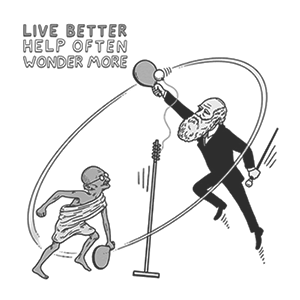
The Sunday Assembly is a syncretistic, non-religious gathering co-founded by stand-up comedians Sanderson Jones and Pippa Evans in early 2013 in London. The bimonthly gathering is designed to bring together non-religious people who want a similar communal experience to a religious church. Satellite assemblies have been established in over 30 cities including New York, San Diego, and Dublin. During Sunday Assembly gatherings attendees listen to talks by speakers such as Danish/British comedian Sandi Toksvig, socialize, and sing songs by artists such as Stevie Wonder and Queen.
Jones originally stated that he did not, ‘expect much objection from religious communities. They are happy for us to use their church model.’ However, he suspected that there may be ‘more aggressive atheists who will have an issue with it.’ Religious organizations also criticized criticized the group calling it ‘highly inappropriate.’ Jones replied to criticism by stating: ‘I don’t [think] there’s anything that’s inherently elite about people getting together to sing songs and think about themselves and improve their community. But we can’t wait to see people doing it in all manner of different places in all manner of different ways, that appeal to all manner of different people.’
Posted in Humor, Philosophy |
Leave a Comment »
November 7, 2013

Hawala [ha-wah-lah] (Arabic: ‘transfer’) is an informal value transfer system based on the performance and honor of a huge network of money brokers, primarily located in the Middle East, North Africa, the Horn of Africa, and the Indian subcontinent, operating outside of, or parallel to, traditional banking, financial channels, and remittance systems.
The system is believed to have arisen in the financing of long-distance trade around the emerging capital trade centers in the early medieval period. In South Asia, it appears to have developed into a fully-fledged money market instrument, which was only gradually replaced by the instruments of the formal banking system in the first half of the 20th century. Today, hawala is probably used mostly for migrant workers’ remittances to their countries of origin.
read more »
Posted in Money, Philosophy, World |
Leave a Comment »


 The Daily Omnivore