June 10, 2013
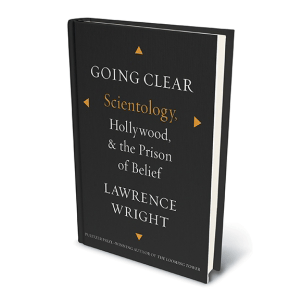
Recruiting Scientologist celebrities and getting them to endorse Scientology to the public at large has always been very important to the Church of Scientology. According to founder L. Ron Hubbard: ‘Celebrities are very Special people and have a very distinct line of dissemination. They have comm[unication] lines that others do not have and many medias [sic] to get their dissemination through.’
Scientology has had a written program governing celebrity recruitment since at least 1955, when Hubbard created ‘Project Celebrity,’ offering rewards to Scientologists who recruited targeted celebrities. Early interested parties included former silent-screen star Gloria Swanson and jazz pianist Dave Brubeck. A Scientology policy letter of 1976 states that ‘rehabilitation of celebrities who are just beyond or just approaching their prime’ enables the ‘rapid dissemination’ of Scientology.
read more »
Posted in Money, Philosophy |
1 Comment »
June 10, 2013

Celebrity Centres are Church of Scientology facilities that are open to the public but serve mostly artists and celebrities and other ‘professionals, leaders and promising new-comers in the fields of the arts, sports, management and government,’ as ‘those are the people who are sculpting the present into the future.’ The Celebrity Centre International was established in Hollywood, California, in 1969 by Yvonne Gillham, a Sea Org member who worked with L. Ron Hubbard. Since then, other centres have been established in New York, London, Paris and a number of other cities across the world.
The Church often quotes L. Ron Hubbard saying that, ‘A culture is only as great as its dreams and its dreams are dreamed by artists,’ citing this as the reason that Celebrity Centres were established — to create a good environment for ‘artists.’ Critics of Scientology point to Hubbard’s launch of ‘Project Celebrity’ in 1955 to recruit celebrities into the church, and that the centres were established as an extension of this initial purpose. The church denies the existence of policy to actively recruit high-ranking celebrities.
Posted in Health, Money, Philosophy |
Leave a Comment »
June 8, 2013
A granfalloon, in the fictional religion of Bokononism (created by Kurt Vonnegut in his 1963 novel ‘Cat’s Cradle’), is defined as a ‘false karass.’ That is, it is a group of people who outwardly choose or claim to have a shared identity or purpose, but whose mutual association is actually meaningless. ‘If you wish to examine a granfalloon, just remove the skin of a toy balloon.’ — Bokonon
The most commonly purported granfalloons are associations and societies based on a shared but ultimately fabricated premise. As examples, Vonnegut cites: ‘the Communist Party, the Daughters of the American Revolution, the General Electric Company —and any nation, anytime, anywhere.’ A more general and oft-cited quote defines a granfalloon as ‘a proud and meaningless association of human beings.’ Another granfalloon example illustrated in the book were Hoosiers, of which the narrator (and Vonnegut himself) was a member.
read more »
Posted in Humor, Philosophy |
Leave a Comment »
June 6, 2013

Inscape, in visual art, is a term especially associated with certain works of Chilean artist Roberto Matta, but it is also used in other senses within the visual arts. Though the term has been applied to stylistically diverse artworks, it usually conveys some notion of representing the artist’s psyche as a kind of interior landscape. The word inscape can therefore be read as a kind of portmanteau, combining interior (or inward) with landscape.
According to Professor Claude Cernuschi, Matta’s use of the term inscape for a series of landscape-like abstract or surrealist paintings reflects ‘the psychoanalytic view of the mind as a three-dimensional space: the ‘inscape.” The ‘inscape’ concept is particularly apt for Matta’s works of the late 1930s. As art historian Dawn Ades writes, ‘A series of brilliant oil paintings done during the years of his [Matta’s] first association with the Surrealists explore visual metaphors for the mental landscape.’
read more »
Posted in Art, Language, Philosophy |
Leave a Comment »
May 29, 2013
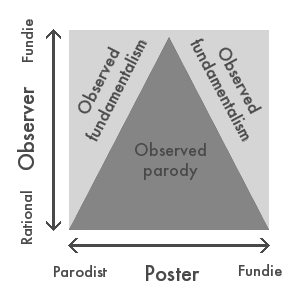
Poe’s law is an Internet adage reflecting the idea that without a clear indication of the author’s intent, it is difficult or impossible to tell the difference between an expression of sincere extremism and a parody of extremism. A corollary of Poe’s law is the reverse phenomenon: sincere fundamentalist beliefs can be mistaken for a parody of those beliefs.
The statement was formulated in 2005 by Nathan Poe on the website christianforums.com in a debate about creationism. The original sentence read: ‘Without a winking smiley or other blatant display of humor, it is utterly impossible to parody a Creationist in such a way that someone won’t mistake [it] for the genuine article.’
read more »
Posted in Humor, Language, Philosophy |
Leave a Comment »
May 23, 2013

A false dilemma (also called the fallacy of the false alternative, false dichotomy, the either-or fallacy, fallacy of the excluded middle, fallacy of false choice, black-and/or-white thinking, or the fallacy of exhaustive hypotheses) is a type of informal fallacy that involves a situation in which limited alternatives are considered, when in fact there is at least one additional option. The options may be a position that is between two extremes (such as when there are shades of grey) or may be completely different alternatives. The opposite of this fallacy is ‘argument to moderation.’
False dilemma can arise intentionally, when fallacy is used in an attempt to force a choice (such as, in some contexts, the assertion that ‘if you are not with us, you are against us’). But the fallacy can also arise simply by accidental omission of additional options rather than by deliberate deception.
read more »
Posted in Language, Philosophy |
1 Comment »
May 23, 2013

The nirvana fallacy is the informal fallacy of comparing actual things with unrealistic, idealized alternatives. It can also refer to the tendency to assume that there is a perfect solution to a particular problem. A closely related concept is the perfect solution fallacy.
By creating a false dichotomy that presents one option which is obviously advantageous—while at the same time being completely implausible—a person using the nirvana fallacy can attack any opposing idea because it is imperfect. The choice is not between real world solutions and utopia; it is, rather, a choice between one realistic possibility and another which is merely better.
read more »
Posted in Language, Philosophy |
Leave a Comment »
May 21, 2013

‘Praise the Lord and Pass the Ammunition‘ is an American patriotic song written by Frank Loesser and published as sheet music in 1942 by Famous Music Corp. The song was a response to the attack on Pearl Harbor that marked United States involvement in World War II.
The song describes a chaplain (‘sky pilot’) being with some fighting men who are under attack from an enemy. He is asked to say a prayer for the men who were engaged in firing at the oncoming planes. The chaplain puts down his Bible, mans one of the ship’s gun turrets and begins firing back, saying, ‘Praise the Lord and pass the ammunition.’
read more »
Posted in Philosophy, War |
Leave a Comment »
May 21, 2013
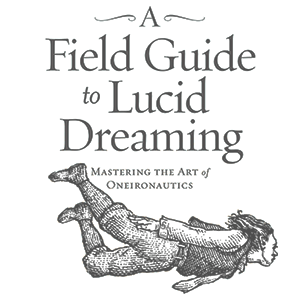
Oneironautics [oh-nahy-ruh-naw-tiks] refers to the ability to travel within a dream, usually on a conscious basis. A traveler in a dream may be called an oneironaut.
The idea of one person being able to consciously travel or interact within the dream of another person, known variously as ‘dream telepathy,’ ‘telepathic lucid dreaming,’ or ‘telepathic dreaming,’ has been explored in the realms of science and fantasy fiction; in recent works, such an interaction is often depicted as a computer-mediated psychotherapeutic action, as is the case in ‘The Cell,’ and ‘Paprika,’ as well as through the direct intervention of another sleeping person, as in ‘Inception,’ or ‘Dreamscape.’ The concept is also included in the fantasy series ‘The Wheel of Time’ as an ability ‘dreamwalkers’ are able to use.
read more »
Posted in Health, Philosophy |
1 Comment »
May 9, 2013

Lilith is a female demon in Jewish legends, found first in the Dead Sea scrolls (the earliest known copy of the old testament, discovered in 1947 and written between 408 BCE and 318 CE). The legend is related both to a Hebrew language term ‘lilith’ which appears in a list of wilderness animals and birds in the ‘Book of Isaiah,’ and also is linked to beliefs about demons called ‘lili’ (‘spirit,’ associated with the night, wind, and owls.) in ancient Babylon.
Evidence in later Jewish materials is plentiful, but little information has been found relating to the original Akkadian and Babylonian view of these demons. The relevance of two sources previously used to connect the Jewish ‘Lilith’ to an Akkadian ‘Lilitu’ – the ‘Gilgamesh’ appendix and the Arslan Tash amulets – are now both disputed by recent scholarship.
read more »
Posted in Philosophy |
Leave a Comment »
May 8, 2013

‘Colorless green ideas sleep furiously‘ is a sentence composed by linguist Noam Chomsky in his 1957 book ‘Syntactic Structures’ as an example of a sentence that is grammatically correct, but semantically nonsensical. The term was originally used in his 1955 thesis ‘Logical Structures of Linguistic Theory.’
Although the sentence is grammatically correct, no obvious understandable meaning can be derived from it, and thus it demonstrates the distinction between syntax (linguistic rules) and semantics (symbolic meaning). As an example of a category mistake (a property is ascribed to a thing that could not possibly have that property), it was used to show inadequacy of the then-popular probabilistic models of grammar, and the need for more structured models.
read more »
Posted in Games, Language, Philosophy |
1 Comment »
May 7, 2013
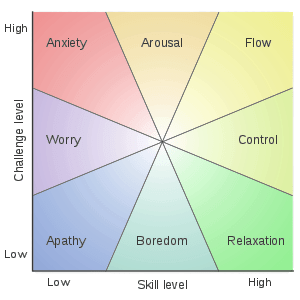
Flow is the mental state of operation in which a person performing an activity is fully immersed in a feeling of energized focus, full involvement, and enjoyment in the process of the activity. In essence, flow is characterized by complete absorption in what one does.
Proposed by Hungarian psychologist Mihály Csíkszentmihályi, the positive psychology concept has been widely referenced across a variety of fields including sports, arts, and science. Popular terms for this or similar mental states include: ‘to be in the moment,’ ‘present,’ ‘in the zone,’ ‘on a roll,’ ‘wired in,’ ‘in the groove,’ ‘on fire,’ ‘in tune,’ ‘centered,’ or ‘singularly focused.’
read more »
Posted in Health, Philosophy, Science |
Leave a Comment »


 The Daily Omnivore