April 22, 2013

Simplicity is the state or quality of being simple; it usually relates to the burden which a thing puts on someone trying to explain or understand it.
However, Herbert A. Simon (American political scientist, economist, sociologist, and psychologist) suggested, something is simple or complex depending on the way we choose to describe it. In some uses, simplicity can be used to imply beauty, purity, or clarity.
read more »
Posted in Language, Philosophy, Technology |
Leave a Comment »
April 22, 2013

Elegance is the attribute of being unusually effective and simple. It is frequently used as a standard of tastefulness, particularly in the areas of fashion and decoration. Some associate elegance with simplicity of design. Others understand the word in an opulent light as in tasteful richness of design or ornamentation. Visual stimuli are frequently considered elegant if a small number of colors and stimuli are used, emphasizing the remainder. The color white is often associated with elegance, usually along with blue or black.
Elegance is a synonym for beauty that has come to acquire the additional connotations of unusual effectiveness and simplicity. It is frequently used as a standard of tastefulness particularly in the areas of visual design, decoration, the sciences, and the esthetics of mathematics. Elegant things exhibit refined grace and dignified propriety.
read more »
Posted in Art, Language, Philosophy |
Leave a Comment »
April 18, 2013
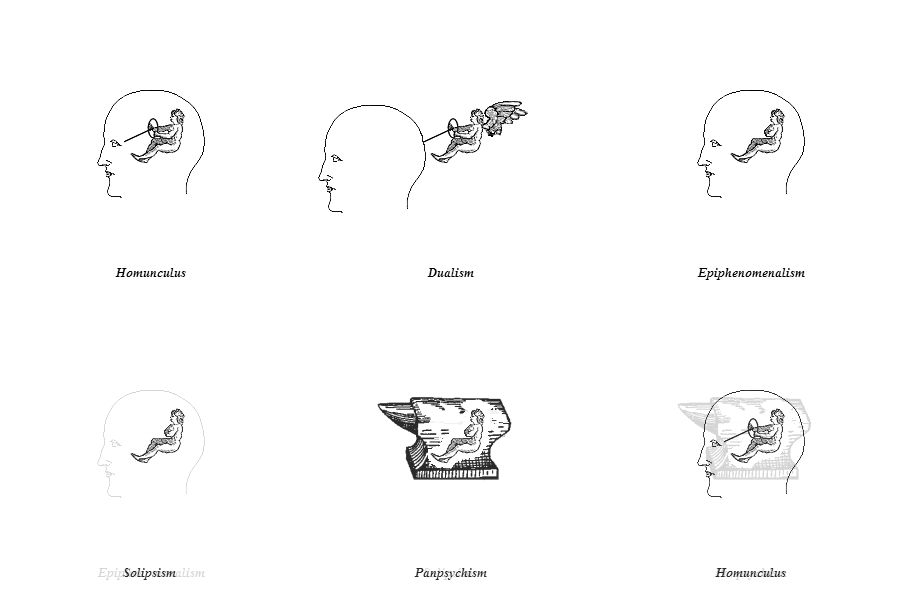
Panpsychism [pan-sahy-kiz-uhm] is the theory that everything in the universe is somehow sentient or conscious and connected parts of a whole. Panpsychists believe that all matter in the universe has some degree of consciousness.
In other words the substance of the universe is composed entirely of mind or consciousness. This is not to say that rocks have a mind but that the individual atoms and other particles in the rock have some sort of awareness and are aware of each other. Panpsychism is opposed to materialism or any doctrine that argues that the reality of the universe is composed solely of matter.
read more »
Posted in Philosophy |
Leave a Comment »
April 18, 2013

Perennialism [puh-ren-ee-uhl-iz-uhm] is a perspective within the philosophy of religion which views each of the world’s religious traditions as sharing a single, universal truth on which foundation all religious knowledge and doctrine has grown.
The idea of a perennial philosophy has great antiquity. It can be found in many of the world’s religions and philosophies. The term ‘philosophia perennis’ was first used during the Renaissance by Italian humanist Agostino Steuco, drawing on an already existing philosophical tradition, the most direct predecessors of which were Marsilio Ficino and Giovanni Pico della Mirandola.
read more »
Posted in Philosophy, World |
Leave a Comment »
April 17, 2013

A white elephant is an idiom for a valuable but burdensome possession of which its owner cannot dispose and whose cost (particularly cost of upkeep) is out of proportion to its usefulness or worth. The term derives from the story that the kings of Siam (now Thailand) were accustomed to make a present of one of these animals to courtiers who had rendered themselves obnoxious, in order to ruin the recipient by the cost of its maintenance. In modern usage, it is an object, scheme, business venture, facility, etc., considered to be without use or value.
The term derives from the sacred white elephants kept by Southeast Asian monarchs in Burma, Thailand, Laos, and Cambodia. To possess a white elephant was regarded (and is still regarded in Thailand and Burma) as a sign that the monarch reigned with justice and power, and that the kingdom was blessed with peace and prosperity.
read more »
Posted in Language, Philosophy |
Leave a Comment »
April 16, 2013

Fecund [fee-kuhnd] universes is a multiverse theory by American theoretical physicist Lee Smolin, also called cosmological natural selection theory, suggesting that a process analogous to biological natural selection applies at the grandest scales. Smolin summarized the idea in a book aimed at a lay audience called ‘The Life of the Cosmos.’ The theory surmises that a collapsing black hole causes the emergence of a new universe on the ‘other side,’ whose fundamental constant parameters (speed of light, Planck length, and so forth) may differ slightly from those of the universe where the black hole collapsed. Each universe therefore gives rise to as many new universes as it has black holes.
Thus the theory contains the evolutionary ideas of ‘reproduction’ and ‘mutation’ of universes, but has no direct analogue of natural selection. However, given any universe that can produce black holes that successfully spawn new universes, it is possible that some number of those universes will reach heat death with unsuccessful parameters. So, in a sense, fecundity cosmological natural selection is one where universes could die off before successfully reproducing, just as any biological being can die without having offspring.
read more »
Posted in Philosophy, Science |
1 Comment »
April 16, 2013

The evil twin is an antagonist found in many different fictional genres. They are physical copies of protagonists, but with radically inverted moralities. In filmed entertainment, they can have obvious physical differences with the protagonist—such as facial hair (often a goatee), eyepatches, scars or distinctive clothing—that make it easy for the audience to visually identify the two characters. Sometimes, however, the physical differences between the characters will be minimized, so as to confuse the audience. Both roles are almost always played by either the same actor or the actor’s actual twin (if the actor has one).
Though there may be moral disparity between actual biological twins, the term is more often a misnomer. In many cases, the two look-alikes are not actually twins, but rather physical duplicates produced by other phenomena (e.g. alternate universes). In others, the so-called ‘evil’ twin is more precisely a dual opposite to their ‘good’ counterpart, possessing at least some commonality with the value system of the protagonist.
read more »
Posted in Humor, Language, Philosophy |
Leave a Comment »
April 16, 2013
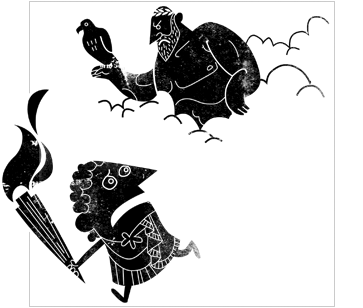
A culture hero is a mythological hero specific to some group (cultural, ethnic, religious, etc.) who changes the world through invention or discovery. A typical culture hero might be credited as the discoverer of fire, or agriculture, songs, tradition, law or religion, and is usually the most important legendary figure of a people, sometimes as the founder of its ruling dynasty. In some cultures, there are dualistic myths, featuring two culture heroes arranging the world in a complementary manner. Dualistic cosmologies are present in all inhabited continents and show great diversity: they may feature culture heroes, but also demiurges (artisan-like figures responsible for the fashioning and maintenance of the physical universe), or other beings; the two heroes may compete or collaborate; they may be conceived as neutral or contrasted as good versus evil; be of the same importance or distinguished as powerful versus weak; be brothers (even twins) or be not relatives at all.
In many cultures, the mythical figure of the trickster and the culture hero are combined. To illustrate, Prometheus, in Greek mythology, stole fire from the gods to give it to humans. In many Native American mythologies and beliefs, the coyote spirit stole fire from the gods (or stars or sun) and is more of a trickster than a culture hero. Natives from the Southeastern US typically saw a rabbit trickster/culture hero, and Pacific Northwest native stories often feature a raven in this role: in some stories, Raven steals fire from his uncle Beaver and eventually gives it to humans. The Western African trickster spider Ananse is also widely disseminated.
Posted in Philosophy, World |
Leave a Comment »
April 15, 2013

In mythology, and in the study of folklore and religion, a trickster is a god, goddess, spirit, man, woman, or anthropomorphic animal who plays tricks or otherwise disobeys normal rules and conventional behavior. The term was probably first used in this context by American ethnologist Daniel G. Brinton in 1885.
The trickster deity breaks the rules of the gods or nature, sometimes maliciously (for example, Loki) but usually with ultimately positive effects (though the trickster’s initial intentions may have been either positive or negative). Often, the bending/breaking of rules takes the form of tricks (e.g. Eris, Greek goddess of chaos) or thievery. Tricksters can be cunning or foolish or both; they are often funny even when considered sacred or performing important cultural tasks. An example of this is the sacred Iktomi of the Lakota, whose role is to play tricks and games and by doing so raises awareness and acts as an equalizer.
read more »
Posted in Humor, Philosophy, World |
Leave a Comment »
April 15, 2013
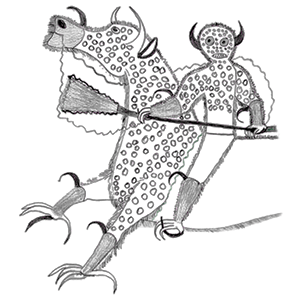
Heyoka [hay-oh-kah] is a spirit in Lakota Mythology that is seen as a trickster. It speaks, moves and reacts in an opposite fashion to the people around it. It is not a spirit that people wish to meet at any time; it usually appears to people when it wishes to take something from you or cause some sort of mayhem.
The Lakota people have learned to respect it enough to leave it be, avoiding it as much as possible. The word refers to the Lakota concept of a contrarian, jester, satirist, or sacred clown. The Heyoka are healers and have many functions, for example healing through laughter and awakening people to deeper meaning and concealed truth and to prepare the people for oncoming disaster with laughter.
read more »
Posted in Humor, Philosophy |
Leave a Comment »
April 15, 2013

Ritual clowns, also called sacred clowns, are a characteristic feature of the ritual life of many traditional religions, and they typically employ scatology and sexual obscenities. Ritual clowning is where comedy and satire originated; in Ancient Greece, ritual clowning, phallic processions (or penis parades) and aischrologia (ritual insults) found their literary form in the plays of Aristophanes.
Two famous examples of ritual clowns in North America are the Koyemshis (also known as Koyemshi, Koyemci or Mudheads) and the Newekwe (also spelled Ne’wekwe or Neweekwe). French sociologist Jean Cazeneuve is particularly renowned for elucidating the role of ritual clowns; reprising Ruth Benedict’s famous distinction of societies into Apollonian and Dionysian, he said that precisely because of the strictly repressive (apollonian) nature of the Zuñi society, the ritual clowns are needed as a dionysian element, a safety valve through which the community can give symbolic satisfaction to the antisocial tendencies. The Koyemshis clowns are characterized by a saturnalian (riotously merry) symbolism.
Posted in Humor, Philosophy, World |
3 Comments »
April 12, 2013

In Tibetan Buddhism Crazy wisdom or ‘yeshe chölwa’ (Tibetan: ‘wisdom gone wild’) refers to unconventional, outrageous, or unexpected behavior, being either a manifestation of buddha nature and spiritual teaching (enlightened activity) on the part of the guru (‘teacher’ or ‘master’), or a method of spiritual investigation undertaken by the student.
It is also held to be one of the manifestations of a siddha or a mahasiddha (the highest level gurus).
read more »
Posted in Philosophy |
1 Comment »


 The Daily Omnivore