January 8, 2013

Philosophy of futility is a phrase coined by Columbia University marketing professor Paul Nystrom to describe the disposition caused by the monotony of the new industrial age.
Nystrom observed the natural effect of this malaise was seeking gratification found in frivolous things, such as fashionable apparel and goods. This tendency, he theorized, could be used to increase consumption of fashionable goods and services, resulting in a vicious circle of dissatisfaction and the desire for new consumer goods.
read more »
Posted in Health, Money, Philosophy |
1 Comment »
January 6, 2013
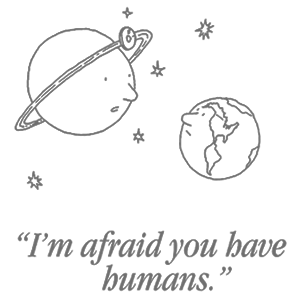
Cosmicism [koz-mih-siz-uhm] is the literary philosophy developed and used by the American writer H. P. Lovecraft in his fiction. Lovecraft was a writer of philosophically intense horror stories that involve occult phenomena like astral possession and alien miscegenation, and the themes of his fiction over time contributed to the development of this philosophy.
The philosophy of cosmicism states that there is no recognizable divine presence, such as a god, in the universe, and that humans are particularly insignificant in the larger scheme of intergalactic existence, and perhaps are just a small species projecting their own mental idolatries onto the vast cosmos, ever susceptible to being wiped from existence at any moment. This also suggested that the majority of undiscerning humanity are creatures with the same significance as insects and plants in a much greater struggle between greater forces which, due to humanity’s small, visionless and unimportant nature, it does not recognize.
read more »
Posted in Language, Philosophy, World |
1 Comment »
January 6, 2013

Criticism of atheism is criticism of the concepts, validity, or impact of atheism, including associated political and social implications.
Criticism of atheism is complicated by the fact that there exist multiple definitions and concepts of atheism (and little consensus among fellow atheists), including practical atheism (apatheism), theoretical atheism (ignosticism), negative and positive atheism, implicit and explicit atheism, and strong and weak atheism, with critics not always specifying the subset of atheism being criticized. Arguments for atheism range from the philosophical to the social to the historical.
read more »
Posted in Philosophy, Politics |
Leave a Comment »
January 4, 2013
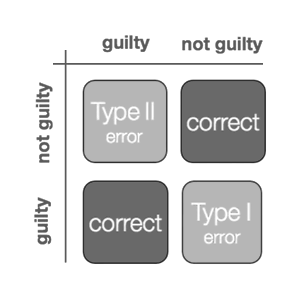
In statistics, Type I and type II errors are errors that happen when a coincidence occurs while doing statistical inference, which gives you a wrong conclusion. A Type I error is saying the original question is false, when it is actually true (e.g. a jury finding an innocent person guilty, a ‘false positive’); a Type II error is saying the original question is true, when it is actually false (e.g. a jury finding a guilty person not guilty, a ‘false negative’ or simply a ‘miss’).
Usually a type I error leads one to conclude that a thing or relationship exists when really it doesn’t: for example, that a patient has a disease being tested for when really the patient does not have the disease, or that a medical treatment cures a disease when really it doesn’t. Examples of type II errors would be a blood test failing to detect the disease it was designed to detect, in a patient who really has the disease; or a clinical trial of a medical treatment failing to show that the treatment works when really it does.
read more »
Posted in Language, Philosophy, Science |
Leave a Comment »
December 29, 2012

Negative capability describes the capacity of human beings to transcend and revise their contexts. The term has been used by poets and philosophers to describe the ability of the individual to perceive, think, and operate beyond any presupposition of a predetermined capacity of the human being.
It further captures the rejection of the constraints of any context, and the ability to experience phenomenon free from epistemological bounds, as well as to assert one’s own will and individuality upon their activity. The term was first used by the Romantic poet John Keats to critique those who sought to categorize all experience and phenomena and turn them into a theory of knowledge.
read more »
Posted in Art, Language, Philosophy |
1 Comment »
December 29, 2012

Ithkuil is a constructed language marked by outstanding grammatical complexity, expressed with a rich phonemic inventory or through an original, graphically structured, system of writing. The language’s author, John Quijada, presents Ithkuil as a cross between an a priori philosophical and a logical language designed to express deeper levels of human cognition overtly and clearly, particularly in regard to human categorization, yet briefly. It also strives to minimize the ambiguities and semantic vagueness found in natural human languages.
The many examples from the original grammar book show that a message, like a meaningful phrase or a sentence, can usually be expressed in Ithkuil with fewer sounds, or lexically distinct speech-elements, than in natural human languages. Quijada deems his creation too complex and strictly regular a language to have developed ‘naturally,’ but nonetheless a language suited for human conversation. No person is hitherto known to be able to speak Ithkuil fluently; Quijada, for one, does not.
read more »
Posted in Language, Philosophy, World |
Leave a Comment »
December 22, 2012

Female genital mutilation (FGM), also known as female circumcision, is defined by the World Health Organization (WHO) as ‘all procedures that involve partial or total removal of the external female genitalia, or other injury to the female genital organs for non-medical reasons.’ FGM is typically carried out on girls from a few days old to puberty. It may take place in a hospital, but is usually performed, without anaesthesia, by a traditional circumciser using a knife, razor, or scissors.
According to the WHO, it is practiced in 28 countries in western, eastern, and north-eastern Africa, in parts of the Middle East, and within some immigrant communities in Europe, North America, and Australasia. The WHO estimates that 100–140 million women and girls around the world have experienced the procedure, including 92 million in Africa. The practice is carried out by some communities who believe it reduces a woman’s libido.
read more »
Posted in Health, Philosophy, Sex |
Leave a Comment »
December 22, 2012

Male circumcision has often been, and remains, the subject of controversy on a number of grounds—including religious, ethical, sexual, and health related. The Ancient Greeks and Romans valued the foreskin and were opposed to circumcision – an opposition inherited by the canon and secular legal systems of the Christian West that lasted at least through to the Middle Ages. Traditional Judaism and Islam have advocated male circumcision as a religious obligation.
The ethics of circumcision are sometimes controversial. From the mid-19th century, there has been advocacy in some Anglophone countries on medical grounds, such as the prevention of masturbation and ‘reflex neurosis.’ Modern proponents argue that circumcision reduces the risks of a range of infections and diseases as well as conferring sexual benefits. In contrast, opponents, particularly of infant circumcision, often question its effectiveness in preventing disease, and object to subjecting newborn boys, without their consent, to a procedure they consider to have debatable benefits, significant risks, and a potentially negative impact on general health and later sexual enjoyment.
read more »
Posted in Health, Philosophy, Sex |
2 Comments »
December 12, 2012
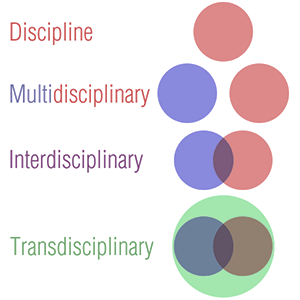
Transdisciplinarity connotes a research strategy that crosses many disciplinary boundaries to create a holistic approach.
It applies to research efforts focused on problems that cross the boundaries of two or more disciplines, such as research on effective information systems for biomedical research or bioinformatics, and can refer to concepts or methods that were originally developed by one discipline, but are now used by several others, such as ethnography, a field research method originally developed in anthropology but now widely used by other disciplines.
read more »
Posted in Education, Philosophy, Science |
Leave a Comment »
December 12, 2012

Interdisciplinarity involves the combining of two or more academic disciplines into one activity (e.g. a research project). It is about creating something new by crossing boundaries, and thinking across them. It is related to an interdiscipline (e.g. Sociolinguistics, Biosemiotics) which is an organizational unit that crosses traditional boundaries between academic disciplines or schools of thought, as new needs and professions have emerged.
Originally, the term interdisciplinary is applied within education and training pedagogies to describe studies that use methods and insights of several established disciplines or traditional fields of study. Interdisciplinarity involves researchers, students, and teachers in the goals of connecting and integrating several academic schools of thought, professions, or technologies – along with their specific perspectives – in the pursuit of a common task.
read more »
Posted in Education, Philosophy, Science |
Leave a Comment »
December 11, 2012
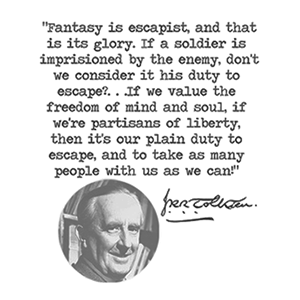
‘On Fairy-Stories‘ is an essay by J. R. R. Tolkien which discusses the fairy-tale as a literary form. It was initially written (and entitled simply ‘Fairy Stories’) for presentation by Tolkien as the Andrew Lang lecture at the University of St Andrews, Scotland, in 1939.
It first appeared in print, with some enhancement, in 1947, in a festschrift volume (a book honoring a respected person), ‘Essays Presented to Charles Williams,’ compiled by C. S. Lewis. British poet Charles Williams, a friend of Lewis’s, had been relocated with the Oxford University Press staff from London to Oxford during the London blitz in World War II. This allowed him to participate in gatherings of the Inklings (an informal literary discussion group) with Lewis and Tolkien.
read more »
Posted in Art, Language, Philosophy |
Leave a Comment »
December 6, 2012

The Jewish Autonomous Oblast is a federal subject of Russia (an autonomous oblast) situated in the Russian Far East, bordering China. Its administrative center is the town of Birobidzhan. Soviet authorities established the autonomous oblast in 1934. It was the result of Joseph Stalin’s nationality policy, which provided the Jewish population of the Soviet Union with a large territory in which to pursue Yiddish cultural heritage.
According to the 1939 population census, 17,695 Jews lived in the region (16% of the total population). The Jewish population peaked in 1948 at around 30,000, about one-quarter of the region’s population. The census of 1959, taken six years after Stalin’s death, revealed that the Jewish population of the JAO declined to 14,269 persons. As of 2002, 2,327 Jews were living in the JAO (1.2% of the total population), while ethnic Russians made up 90% of the population.
read more »
Posted in Philosophy, World |
Leave a Comment »


 The Daily Omnivore