November 5, 2012

The fine-tuned Universe is the proposition that the conditions that allow life in the Universe can only occur when certain universal fundamental physical constants lie within a very narrow range, so that if any of several fundamental constants were only slightly different, the Universe would be unlikely to be conducive to the establishment and development of matter, astronomical structures, elemental diversity, or life as it is presently understood.
The existence and extent of fine-tuning in the Universe is a matter of dispute in the scientific community.
read more »
Posted in Philosophy, Science |
2 Comments »
November 4, 2012

In astrophysics and cosmology, the anthropic [an-throp-ik] principle is the philosophical consideration that observations of the physical Universe must be compatible with the conscious life that observes it. Some proponents of the anthropic principle reason that it explains why the Universe has the age and the fundamental physical constants necessary to accommodate conscious life. As a result, they believe it is unremarkable the universe’s fundamental constants happen to fall within the narrow range thought to be compatible with life.
The strong anthropic principle (SAP) as explained by Barrow and Tipler states that this is all the case because the Universe is compelled, in some sense, for conscious life to eventually emerge. English writer Douglas Adams, who wrote ‘The Hitchhiker’s Guide to the Galaxy,’ used the metaphor of a living puddle examining its own shape, since, to those living creatures, the universe may appear to fit them perfectly (while in fact, they simply fit the universe perfectly).
read more »
Posted in Philosophy, Science |
2 Comments »
November 4, 2012

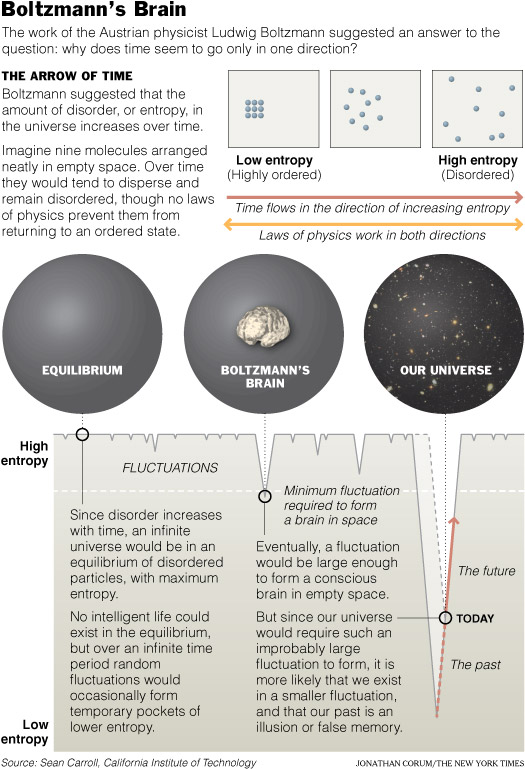
A Boltzmann brain is a hypothesized self-aware entity which arises due to random fluctuations out of a state of chaos. The idea is named for the physicist Ludwig Boltzmann (1844–1906), who advanced an idea that the known universe arose as a random fluctuation, similar to a process through which Boltzmann brains might arise. Boltzmann brains are often referred to in the context of the ‘Boltzmann brain paradox.’
They have also been referred to as ‘Boltzmann babies.’ The concept arises from the need to explain why we observe such a large degree of organization in the universe. The second law of thermodynamics states that the total entropy in a closed universe will never decrease. We may think of the most likely state of the universe as one of high entropy, closer to uniform and without order. So why is the observed entropy so low?
read more »
Posted in Philosophy, Science |
Leave a Comment »
November 2, 2012

The Structure of Scientific Revolutions by Thomas S. Kuhn, is an analysis of the history of science, published in 1962. Its publication was a landmark event in the history, philosophy, and sociology of scientific knowledge and it triggered an ongoing worldwide assessment and reaction in—and beyond—those scholarly communities. In this work, Kuhn challenged the then prevailing view of progress in ‘normal science’ (the routine work of scientists experimenting within a paradigm).
Scientific progress had been seen primarily as ‘development-by-accumulation’ of accepted facts and theories. Kuhn argued for an episodic model in which periods of such conceptual continuity in normal science were interrupted by periods of revolutionary science. During revolutions in science the discovery of anomalies leads to a whole new paradigm that changes the rules of the game and the ‘map’ directing new research, asks new questions of old data, and moves beyond the puzzle-solving of normal science.
read more »
Posted in Language, Philosophy, Science |
1 Comment »
November 1, 2012
Factual relativism or epistemic relativism is a mode of reasoning which extends relativism and subjectivism to factual matter and reason. In factual relativism the facts used to establish the truth or falsehood of any statement are understood to be relative to the perspective of those proving or falsifying the proposition. Factual relativism is contested by factual universalism.
One school of thought compares scientific knowledge to the mythology of other cultures, arguing that it is merely our society’s set of myths based on our society’s assumptions. For support, Austrian-American philosopher of science Paul Feyerabend’s comments in ‘Against Method’ that, The similarities between science and myth are indeed astonishing’ and ‘First-world science is one science among many’ are sometimes cited, although it is not clear if Feyerabend meant them entirely seriously.
read more »
Posted in Philosophy, Science |
Leave a Comment »
November 1, 2012

Cargo cult science refers to practices that have the semblance of being scientific, but do not in fact follow the scientific method. The term was first used by the physicist Richard Feynman during his commencement address at the California Institute of Technology in 1974. The speech is reproduced in the book ‘Surely You’re Joking, Mr. Feynman!’ He based the phrase on a concept in anthropology, the cargo cult, which describes how some pre-scientific cultures interpreted technologically advanced visitors as religious or supernatural figures who brought boons of cargo.
Later, in an effort to call for a second visit the natives would develop and engage in complex religious rituals, mirroring the previously observed behavior of the visitors manipulating mock machines but without understanding the true nature of those tasks. Just as cargo cultists create mock airports that fail to produce airplanes, cargo cult scientists conduct flawed research that superficially resembles the scientific method, but which fails to produce scientifically useful results.
read more »
Posted in Philosophy, Science |
Leave a Comment »
November 1, 2012

Social Darwinism is an ideology of society that seeks to apply biological concepts of Darwinism or of evolutionary theory to sociology and politics, often with the assumption that conflict between groups in society leads to social progress as superior groups outcompete inferior ones.
It is a modern name given to the various theories of society that emerged in England and the United States in the 1870s, which, it is alleged, sought to apply biological concepts to sociology and politics. The term social Darwinism gained widespread currency when used in 1944 to oppose these earlier concepts.
read more »
Posted in Philosophy, Politics, Science |
1 Comment »
November 1, 2012

‘Fashionable Nonsense: Postmodern Intellectuals’ Abuse of Science’ (French: ‘Impostures Intellectuelles’) is a 1997 book by NYU physics professor Alan Sokal and Belgian theoretical physicist Jean Bricmont. Sokal is best known for the Sokal Affair, in which he submitted a deliberately absurd article to ‘Social Text,’ a critical theory journal, and was able to get it published. The English editions were revised for greater relevance to debates in the English-speaking world.
As part of the so-called ‘science wars’ (a series of intellectual exchanges, between scientific realists and postmodernist critics), the book criticizes postmodernism in academia for what it claims are misuses of scientific and mathematical concepts in postmodern writing. According to some reports, the response within the humanities was ‘polarized.’ Critics of Sokal and Bricmont charge that they lack understanding of the writing they were criticizing. Responses from the scientific community were more supportive.
read more »
Posted in Language, Philosophy, Science |
Leave a Comment »
October 30, 2012

Day of the Dead (‘Día de los Muertos’) is a Mexican holiday where people gather to pray for and remember friends and family members who have died. The celebration takes place on November 1, in connection with the Catholic holidays of All Saints’ Day and All Souls’ Day (November 2).
Traditions connected with the holiday include building private altars honoring the deceased using edible sugar skulls, marigolds, and the favorite foods and beverages of the departed and visiting graves with these as gifts. They also leave possessions of the deceased. Scholars trace the origins of the modern Mexican holiday to indigenous observances dating back hundreds of years and to an Aztec festival dedicated to the goddess Mictecacihuatl (Queen of the Underworld).
read more »
Posted in Death, Philosophy, World |
2 Comments »
October 29, 2012

Finite and Infinite Games is a book by religious scholar James P. Carse. With this philosophy text, Carse demonstrates a way of looking at actions in life as being a part of at least two types of what he describes as ‘games,’ finite and infinite. Both games are played within rules, as agreed upon by the participants; however, the meaning of the rules are different between the two types of games.
The book stresses a non-serious (or ‘playful’) view of life on the part of ‘players,’ referring to their choices as ‘moves,’ and societal constructs and mores as ‘rules’ and ‘boundaries.’ He regularly employs familiar terms in specialized ways, but casts them as associated with finite or infinite play & players. Boundaries are ‘rules’ that one must stay within when playing a finite game, in contrast with horizons, which move with the player, and are constantly changing as he or she ‘plays.’ In short, a finite game is played with the purpose of winning (thus ending the game), while an infinite game is played with the purpose of continuing the play.
read more »
Posted in Games, Philosophy |
1 Comment »
October 28, 2012

Die Glocke (‘The Bell’) was a purported top secret Nazi scientific technological device, secret weapon, or ‘Wunderwaffe.’ First described by Polish journalist Igor Witkowski in 2000, it was later popularized by military journalist and author Nick Cook as well as by writers such as Joseph P. Farrell, who associates it with Nazi occultism and antigravity or free energy research.
According to Patrick Kiger writing in ‘National Geographic,’ Die Glocke has become a ‘popular subject of speculation’ and a following similar to science fiction fandom exists around it and other alleged Nazi ‘miracle weapons.’ Mainstream reviewers such as former aerospace scientist David Myhra express skepticism that such a device ever actually existed.
read more »
Posted in Philosophy, War |
Leave a Comment »
October 28, 2012

‘Vril, the Power of the Coming Race’ is an 1871 novel by Edward Bulwer-Lytton, originally printed as ‘The Coming Race.’ Many readers believe that its account of a superior subterranean master race and the energy-form called ‘Vril’ is accurate, to the extent that some theosophists accepted the book as truth. A popular book, ‘The Morning of the Magicians’ (1960) suggested that a secret Vril Society existed in pre-Nazi Berlin.
The novel centers on a young, independently wealthy traveler (the narrator), who accidentally finds his way into a subterranean world occupied by beings who seem to resemble angels and call themselves Vril-ya. The hero soon discovers that the Vril-ya are descendants of an antediluvian civilization who live in networks of subterranean caverns linked by tunnels.
read more »
Posted in Philosophy, Politics, War |
Leave a Comment »


 The Daily Omnivore