October 26, 2012
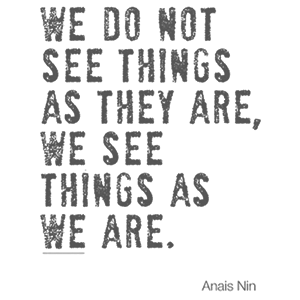
Reality tunnel is a term coined by Timothy Leary and popularized by Robert Anton Wilson, akin to the idea of representative realism (equivalent to the accepted view of ‘perception’ in natural science that states that we do not and cannot perceive the external world as it really is but know only our ideas and interpretations of the way the world is). The theory states that, with a subconscious set of mental ‘filters’ formed from their beliefs and experiences, every individual interprets the same world differently, hence ‘Truth is in the eye of the beholder.’ According to Wilson, ‘Every kind of ignorance in the world all results from not realizing that our perceptions are gambles.
We believe what we see and then we believe our interpretation of it, we don’t even know we are making an interpretation most of the time. We think this is reality.’ The idea does not necessarily imply that there is no objective truth; rather that our access to it is mediated through our senses, experience, conditioning, prior beliefs, and other non-objective factors. The implied individual world each person occupies is said to be their reality tunnel. The term can also apply to groups of people united by beliefs: we can speak of the fundamentalist Christian reality tunnel or the ontological naturalism reality tunnel.
read more »
Posted in Philosophy, Science |
Leave a Comment »
October 25, 2012

Consensus reality is that which is generally agreed to be reality, based on a consensus view. However, human beings do not fully understand or agree upon the nature of knowledge or knowing, and therefore (it is often argued) it is not possible to be certain beyond doubt what is real. Accordingly, this line of logic concludes, we cannot in fact be sure beyond doubt about the nature of reality. We can, however, seek to obtain some form of consensus, with others, of what is real.
We can use this consensus as a pragmatic guide, either on the assumption that it seems to approximate some kind of valid reality, or simply because it is more ‘practical’ than perceived alternatives. Consensus reality therefore refers to the agreed-upon concepts of reality which people in the world, or a culture or group, believe are real (or treat as real), usually based upon their common experiences as they believe them to be; anyone who does not agree with these is sometimes stated to be ‘in effect… living in a different world.’
read more »
Posted in Philosophy, Science |
Leave a Comment »
October 25, 2012
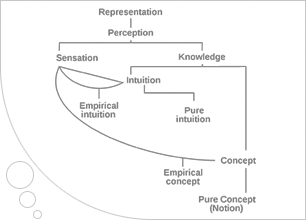

The noumenon [noo-muh-non] is a posited object or event that is known (if at all) without the use of the senses. The term is generally used in contrast with, or in relation to ‘phenomenon,’ which refers to anything that appears to, or is an object of, the senses. In Ancient philosophy, the noumenal realm was equated with the world of ideas known to the philosophical mind, in contrast to the phenomenal realm, which was equated with the world of sensory reality, known to the uneducated mind.
Modern philosophy has generally denied the possibility of knowledge independent of the senses, and Immanuel Kant gave this point of view its classical version, saying that the noumenal world may exist, but it is completely unknowable to humans. In Kantian philosophy the unknowable noumenon is often linked to the unknowable ‘thing per se’ (‘Ding an sich’), although how to characterize the nature of the relationship is a question yet open to some controversy.
read more »
Posted in Language, Philosophy |
Leave a Comment »
October 24, 2012
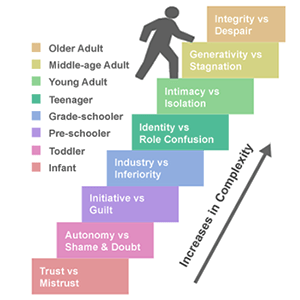
Erikson’s stages of psychosocial development are eight stages through which a healthily developing human should pass from infancy to late adulthood, according to neo-Freudian psychologist Erik Erikson. In each stage the person confronts, and hopefully masters, new challenges. Each stage builds on the successful completion of earlier stages. The challenges of stages not successfully completed may be expected to reappear as problems in the future. However, mastery of a stage is not required to advance to the next stage.
Erikson’s stage theory characterizes an individual advancing through the eight life stages as a function of negotiating his or her biological forces and sociocultural forces. Each stage is characterized by a psycho social crisis of these two conflicting forces. If an individual does indeed successfully reconcile these forces (favoring the first mentioned attribute in the crisis), he or she emerges from the stage with the corresponding virtue. For example, if an infant enters into the toddler stage (autonomy vs. shame & doubt) with more trust than mistrust, he or she carries the virtue of hope into the remaining life stages.
read more »
Posted in Health, Philosophy, Science |
Leave a Comment »
October 23, 2012

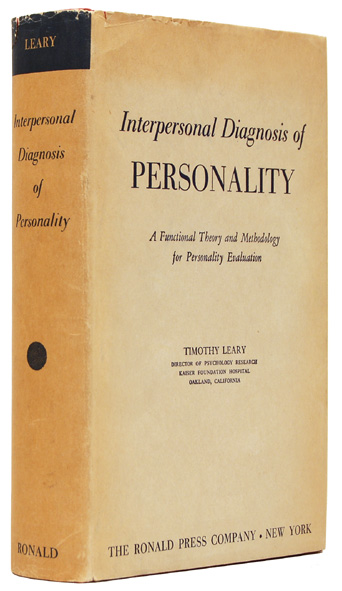
Interpersonal reflex is a term created by Timothy Leary and explained in the book, ‘Interpersonal Diagnosis of Personality: A functional theory and methodology for personality evaluation’ (1957). While examining recorded protocols of communications in adults, Leary discovered that typical patterns of interaction existed. Individual units of these behaviors were called interpersonal mechanisms or interpersonal reflexes: ‘They are defined as the observable, expressive units of face-to-face social behavior.’ These reflexes are automatic and involuntary responses to interpersonal situations. They are independent of the content of the communication. They are the individual’s spontaneous methods of reacting to others.
Leary states, ‘The reflex manner in which human beings react to others and train others to respond to them in selective ways is, I believe, the most important single aspect of personality. The systematic estimates of a patient’s repertoire of interpersonal reflexes is a key factor in functional diagnosis.’ Examining interpersonal reflexes helps to explain communication and behavioral patterns in healthy and unhealthy relationships. For example, tender, supportive operations tend to train others to agree, conciliate, and depend. Rigid autocratic individuals seek out docile admiring followers. Competitive, self-enhancing behavior pulls envy, distrust, inferiority feelings, and at times respectful admiration from others.
Posted in Health, Philosophy, Science |
Leave a Comment »
October 23, 2012

The interpersonal circumplex is a model for conceptualizing, organizing, and assessing interpersonal behavior, traits, and motives. It is defined by two orthogonal axes: a vertical axis (of status, dominance, power, or control) and a horizontal axis (of solidarity, friendliness, warmth, or love).
In recent years, it has become conventional to identify the vertical and horizontal axes with the broad constructs of agency and communion. Thus, each point in the interpersonal circumplex space can be specified as a weighted combination of agency and communion.
read more »
Posted in Health, Philosophy, Science |
Leave a Comment »
October 23, 2012

Indra’s net (also called ‘Indra’s jewels’ or ‘Indra’s pearls’) is a metaphor used to illustrate the concepts of emptiness, dependent origination (all things arise in dependence upon multiple causes and conditions), and interpenetration (all phenomena are intimately connected — and mutually arising) in Buddhist philosophy. The metaphor of Indra’s net was developed by the Mahayana Buddhist school in the 3rd century scriptures of the ‘Avatamsaka Sutra,’ and later by the Chinese Huayan school between the 6th and 8th century.
For the Huayan school, Indra’s net symbolizes a universe where infinitely repeated mutual relations exist among all members of the universe. This idea is communicated in the image of the interconnectedness of the universe as seen in the net of the Vedic god Indra, which hangs over his palace on Mount Meru, the axis mundi of Vedic cosmology and Vedic mythology. Indra’s net has a multifaceted jewel at each vertex, and each jewel is reflected in all of the other jewels.
read more »
Posted in Philosophy |
Leave a Comment »
October 23, 2012

The eight-circuit model of consciousness is a transhuman (an intermediary form between the human and a hypothetical posthuman) theory proposed by Timothy Leary and expanded on by Robert Anton Wilson and Antero Alli. The model describes eight circuits of information (eight ‘brains’) that operate within the human nervous system.
Each circuit is concerned with a different sphere of activity. The lower four, the ‘larval circuits,’ deal with normal psychology, while the upper four, the ‘stellar circuits,’ deal with psychic, mystical, enlightened and psychedelic states of mind.
read more »
Posted in Drugs, Health, Philosophy |
Leave a Comment »
October 23, 2012

Mind at Large is a concept from ‘The Doors of Perception’ and ‘Heaven and Hell’ by Aldous Huxley. This philosophy was influenced by the ideas of philosopher and historian C. D. Broad. Psychedelic drugs are thought to disable filters which block or suppress signals related to mundane functions from reaching the conscious mind.
In this book, Huxley explores the idea that the human mind filters reality, partly because handling the details of all of the impressions and images coming in would be unbearable, partly because it has been taught to do so. He believes that psychotropic drugs can partly remove this filter, which leaves the drug user exposed to ‘Mind at Large.’
read more »
Posted in Drugs, Philosophy |
1 Comment »
October 23, 2012

Hallucinogens [huh-loo-suh-nuh-juhns] are drugs which can cause hallucinations (seeing, hearing, or otherwise perceiving things that are not real). They are a general group of pharmacological agents that can be divided into three broad categories: psychedelics (drugs with perception-altering effects), dissociatives (drugs that produce feelings of detachment – dissociation – from the environment and self), and deliriants (drugs that induce a state of delirium in the user).
These classes of psychoactive drugs have in common that they can cause subjective changes in perception, thought, emotion and consciousness. Unlike other psychoactive drugs, such as stimulants and opioids, these drugs do not merely amplify familiar states of mind, but rather induce experiences that are qualitatively different from those of ordinary consciousness. These experiences are often compared to non-ordinary forms of consciousness such as trance, meditation, dreams, or insanity.
read more »
Posted in Drugs, Health, Philosophy |
Leave a Comment »
October 22, 2012

The Thule Society (originally the ‘Study Group for Germanic Antiquity’) was a German occultist and völkisch (popularist) group in Munich, named after a mythical northern country from Greek legend. The Society is notable chiefly as the organization that sponsored the Deutsche Arbeiterpartei (DAP), which was later reorganized by Adolf Hitler into the National Socialist German Workers’ Party (Nazi).
According to Hitler biographer Ian Kershaw, the organization’s ‘membership list…reads like a ‘Who’s Who’ of early Nazi sympathizers and leading figures in Munich,’ including Rudolf Hess, Alfred Rosenberg, Hans Frank, Julius Lehmann, Gottfried Feder, Dietrich Eckart, and Karl Harrer. However, Nicholas Goodrick-Clarke, an expert on the Thule Society, finds that while Hans Frank and Rudolf Hess had been Thule members, other leading Nazis had only been guests of the Thule or entirely unconnected with it. There is no evidence that Hitler ever attended the Thule Society. It is quite clear that Hitler himself had little interest in, and made little time for, ‘esoteric matters.’
read more »
Posted in Philosophy, War |
Leave a Comment »
October 21, 2012
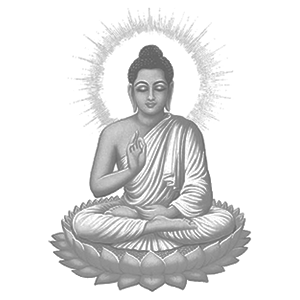
Luminous mind (‘brightly shining citta’) is a term attributed to the Buddha in the ‘Nikayas’ (Bhuddist scripture); the mind is said to be ‘luminous’ whether or not it is tainted by mental defilements.
The statement is given no direct doctrinal explanation in the discourses, but later Buddhist schools explained it using various concepts developed by them. There are two major sects in Buddhism, the older and more conservative Theravada and the larger, more modern Mahyana.
read more »
Posted in Philosophy |
Leave a Comment »


 The Daily Omnivore