October 1, 2012

The Cult of Mac is a book by technology writer Leander Kahney about fanaticism for the Apple product line. Professor of marketing Russell Belk argues that, like a religion, the Cult of Mac is a belief system that helps its followers understand technology and the world.
The attitude of Apple sympathizers and fans is viewed by many as being ‘cult-like.’ According to neurological research cited by the BBC on their ‘Secrets of the Superbrands’ documentary, the response from the brain of an Apple enthusiast when viewing the brand-related symbols and imagery is similar to the one of a religious devotee when exposed to religious symbols and images. Apple founder Steve Jobs is compared to a god figure and savior, and his life story is said to resemble Joseph Campbell’s heroic adventure myths. Jobs was often viewed as a saintly figure to Mac users.
read more »
Posted in Money, Philosophy, Technology |
1 Comment »
October 1, 2012

‘The Extended Mind‘ is a book in the field of philosophy of mind edited by MIT philosopher Richard Menary. It contains several papers by different philosophers. The ‘extended mind thesis’ (EMT) refers to an emerging concept that addresses the question as to the division point between the mind and the environment by promoting the view of active externalism.
The EMT proposes that some objects in the external environment are utilized by the mind in such a way that the objects can be seen as extensions of the mind itself. Specifically, the mind is seen to encompass every level of the cognitive process, which will often include the use of environmental aids.
read more »
Posted in Health, Philosophy, Technology |
Leave a Comment »
October 1, 2012

Nensha (Chinese: ‘spirit photography’ literally ‘sense inception’), better known to English speakers as ‘thoughtography’ or ‘projected thermography’ or ‘nengraphy,’ is the ability to psychically ‘burn’ images from one’s mind onto surfaces, or even into the minds of others.
It is common in fiction, and made noteworthy by ‘The Ring’ media franchise. While the term ‘thoughtography’ has been in the English lexicon since 1913, the more recent term ‘projected thermography’ is a neologism originating from the 2002 U.S. remake of ‘The Ring.’
read more »
Posted in Death, Philosophy, Science |
Leave a Comment »
October 1, 2012

Ectoplasm [ek-tuh-plaz-uhm] (Greek: ‘ektos,’ meaning ‘outside,’ and ‘plasma,’ meaning ‘something formed or molded’) is a term coined by French physiologist Charles Richet to denote a substance or spiritual energy ‘exteriorized’ by physical mediums (individuals who claim a spiritual connection to the dead).
Ectoplasm is said to be associated with the formation of spirits; however since World War II reports of ectoplasmic phenomena have declined and many psychical researchers doubt whether genuine cases ever existed. Ectoplasm is said to be formed by physical mediums when in a trance state. This material is excreted as a gauze-like substance from orifices on the medium’s body and spiritual entities are said to drape this substance over their nonphysical body, enabling them to interact in the physical and real universe. According to mediums, the ectoplasm can not occur in light conditions as the ectoplasmic substance would disintegrate.
read more »
Posted in Death, Philosophy, Science |
Leave a Comment »
October 1, 2012

George Lucas’ six-film Star Wars saga has had a significant impact on modern American popular culture. ‘Star Wars’ references are deeply embedded in popular culture; references to the main characters and themes of Star Wars are casually made in many English-speaking countries with the assumption that others will understand the reference. Darth Vader has become an iconic villain. Phrases like ‘evil empire’ and ‘May the Force be with you’ have become part of the popular lexicon. The first ‘Star Wars film’ in 1977 was a cultural unifier, enjoyed by a wide spectrum of people.
Science fiction since the original 1977 ‘Star Wars,’ particularly in film, has often been influenced by and compared to ‘Star Wars.’ Sounds, visuals, and even the music from the films have become part of the tapestry of American society. The film also helped launch the science fiction boom of the late 1970s and early 1980s, and made science fiction films a blockbuster genre. It has also been parodied in films and short videos, such as ‘Spaceballs.’
read more »
Posted in Art, Money, Philosophy |
Leave a Comment »
October 1, 2012

The dark side of the Force is a prominent moral, philosophical, metaphorical and psychic concept in the ‘Star Wars’ universe, which George Lucas intends as a metaphor for the universal human temptation towards cruelty and inhumanity as a means of gaining ‘power,’ or advantage, in life.
The dark side is the opposite of the ‘light side’ of ‘the Force,’ a mystical energy which permeates the universe. It is used by the Sith, and forbidden among their rivals, the Jedi. By channeling intense negative emotions – such as anger, jealousy or greed – into the Force, individuals can attain powers of the Force more easily – but at a consequence. They gain lust for power, and become increasingly self-aggrandizing.
read more »
Posted in Art, Philosophy, War |
Leave a Comment »
September 29, 2012
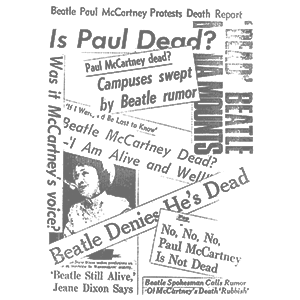
Backmasking is a recording technique in which a sound or message is recorded backward on to a track that is meant to be played forward. Backmasking is a deliberate process, whereas a message found through ‘phonetic reversal’ may be unintentional. Backmasking was popularized by The Beatles who used backward instrumentation on their 1966 album ‘Revolver.’ Artists have since used backmasking for artistic, comedic and satiric effect, on both analogue and digital recordings.
The technique has also been used to censor words or phrases for ‘clean’ releases of rap songs. Backmasking has been a controversial topic in the United States since the 1980s, when allegations from Christian groups of its use for Satanic purposes were made against prominent rock musicians, leading to record-burning protests and proposed anti-backmasking legislation by state and federal governments.
read more »
Posted in Humor, Philosophy, Science |
Leave a Comment »
September 27, 2012

Henny Penny, also known as ‘Chicken Licken’ or ‘Chicken Little,’ is a folk tale with a moral in the form of a cumulative tale about a chicken who believes the world is coming to an end. The phrase ‘The sky is falling!’ features prominently in the story, and has passed into the English language as a common idiom indicating a hysterical or mistaken belief that disaster is imminent.
The story is listed in the Aarne–Thompson tale type index (a listing designed to help folklorists identify recurring plot patterns in the narrative structures of traditional folktales) as type 20C, which includes international examples of folktales that make light of paranoia and mass hysteria.
read more »
Posted in Art, Language, Philosophy |
Leave a Comment »
September 27, 2012

The Master is a 2012 film written, directed, and co-produced by Paul Thomas Anderson. The film stars Joaquin Phoenix, Philip Seymour Hoffman, Amy Adams, and Laura Dern. The film depicts alcoholic Freddie Quell, a World War II veteran suffering from post-traumatic stress disorder and struggling to adjust to a post-war society. He is taken under the wing of a charismatic mystic Lancaster Dodd, progenitor of a new religious movement.
It was first reported in 2009 that Anderson had been working on a script about the founder of a new religious organization (described as being similar to Scientology) played by Phillip Seymour Hoffman. In 2011 it was reported that Megan Ellison, daughter of billionaire Larry Ellison, would finance ‘The Master’ and Anderson’s adaptation of the Thomas Pynchon novel ‘Inherent Vice’ under her new production company Annapurna Pictures. Harvey Weinstein later picked up the worldwide rights to the film.
read more »
Posted in Art, Philosophy |
Leave a Comment »
September 26, 2012

Lafayette Ronald Hubbard (1911 – 1986), better known as L. Ron Hubbard and often referred to by his initials, LRH, was an American pulp fiction author and the founder of the Church of Scientology. After establishing a career as a writer, becoming best known for his science fiction and fantasy stories, he developed a self-help system called ‘Dianetics’ which was first published in 1950. He subsequently developed his ideas into a wide-ranging set of doctrines and rituals as part of a new religious movement that he called Scientology. His writings became the guiding texts for the Church of Scientology and a number of affiliated organizations that address such diverse topics as business administration, literacy, and drug rehabilitation.
The Church of Scientology describes Hubbard in hagiographic terms, and he portrayed himself as a pioneering explorer, world traveler, and nuclear physicist, with expertise in a wide range of disciplines, including photography, art, poetry, and philosophy. His critics have characterized him as a liar, a charlatan, and mentally unstable. Though many of his autobiographical statements have been proven to be fictitious, the Church rejects any suggestion that its account of Hubbard’s life is not historical fact.
read more »
Posted in Philosophy, Politics, World |
Leave a Comment »
September 24, 2012

Profanity is language that is strongly impolite or offensive in many situations. It can show a desecration or debasement of someone or something, or show strong or intense emotion. Profanity can take the form of words, expressions, gestures (such as flipping the middle finger), or other social behaviors that are construed or interpreted as insulting, rude, vulgar, obscene, obnoxious, foul, desecrating, or other forms. The original meaning of the adjective ‘profane’ referred to items not belonging to the church, e.g., ‘The fort is the oldest profane building in the town, but the local monastery is older, and is the oldest building.’
The meaning has changed over time. Analyses of recorded conversations reveal that roughly 80–90 spoken words each day – 0.5% to 0.7% of all words – are swear words, with usage varying from between 0% to 3.4%. The term ‘profane’ originates from classical Latin ‘profanus,’ literally ‘before (outside) the temple.’ It carried the meaning of either ‘desecrating what is holy’ or ‘with a secular purpose’ as early as the 1450s. Profanity represented secular indifference to religion or religious figures, while blasphemy was a more offensive attack on religion and religious figures, considered sinful, and a direct violation of The Ten Commandments.
read more »
Posted in Language, Philosophy, World |
Leave a Comment »
September 24, 2012

The relationship between religiosity and intelligence is the subject of much research and controversy. Although IQ is a clearly operationalized measure, some professionals believe that IQ is given too much attention over other measures of human ability. Also, religiosity studies can be too broadly defined, and must be careful to identify relationships between beliefs, sentiments, and practices. Studies have begun to explore the link between religiosity and issues related to intelligence, such as educational level.
Research shows that the poorest countries are consistently the most religious, and experts have proposed that religions may play more functional roles there. Various studies further suggest that intuitive thinking styles (as opposed to reflective, questioning, analytical thinking styles) tend to increase belief in gods, and decrease the likelihood of changing views held in childhood. Intuitive thinking styles may also lead to more convicted beliefs in general. In other words, IQ could correlate with atheism, not simply because of raw cognitive ability, but because higher IQs lead to more critical analysis.
read more »
Posted in Education, Philosophy, World |
3 Comments »


 The Daily Omnivore