July 13, 2012
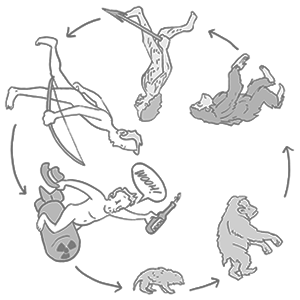
Fermi’s paradox asks why, given the age and size of the universe, we have not detected any other alien civilizations. Unless the Earth is very atypical, extraterrestrial life should be common. In an informal discussion in 1950, Italian American physicist Enrico Fermi questioned why, if a multitude of advanced extraterrestrial civilizations exists in the Milky Way galaxy, evidence such as spacecraft or probes is not seen.
Another common name for the phenomenon is silentium universi (‘the silence of the universe’). There have been attempts to resolve the paradox by locating evidence of extraterrestrial civilizations (e.g. SETI), along with proposals that such life could exist without human knowledge. Counterarguments suggest that intelligent extraterrestrial life does not exist or occurs so rarely or briefly that humans will never make contact with it.
read more »
Posted in Philosophy, Science, Technology |
3 Comments »
July 9, 2012

The Age of Spiritual Machines is a book by futurist Ray Kurzweil about the future course of humanity, particularly relating to the development of artificial intelligence and its impact on human consciousness. It is also a study on the concept of technological singularity, the hypothetical future emergence of greater-than-human superintelligence through technological means.
Originally published in 1999, the book predicts that machines with human-like intelligence will be available from affordable computing devices within a couple of decades, revolutionizing most aspects of life, and that eventually humanity and its machinery will become one and the same.
read more »
Posted in Language, Philosophy, Technology |
Leave a Comment »
June 29, 2012

Mise [meez] en [awn] abyme [ah-beem] is a term originally from the French and means ‘placed into abyss.’ The commonplace usage of this phrase is describing the visual experience of standing between two mirrors, seeing an infinite reproduction of one’s image, but it has several other meanings in the realm of the creative arts and literary theory. In Western art history, ‘mise en abyme’ is a formal technique in which an image contains a smaller copy of itself, the sequence appearing to recur infinitely.
In the terminology of heraldry, the ‘abyme’ is the center of a coat of arms. The term ‘mise en abyme’ then meant literally ‘put in the center.’ It described a coat of arms that appears as a smaller shield in the center of a larger one (the Droste effect). For example, the two-headed eagle on modern coat of arms of Russia has a scepter with coat of arms of Russia on top of it, with the same scepter.
read more »
Posted in Art, Language, Philosophy |
Leave a Comment »
June 26, 2012

Speciesism [spee-shee-ziz-uhm] involves assigning different values or rights, or special consideration, to individuals solely on the basis of their species membership. The term was coined in 1973 by British psychologist Dick D. Ryder to denote prejudice against non-humans based on morally irrelevant physical differences.
The term is mostly used by animal rights advocates, who argue that species membership has no moral significance, and that it is both irrational and morally wrong to regard sentient beings as objects or property. Philosopher Tom Regan argues that all animals have inherent rights and that we cannot assign them a lesser value because of a perceived lack of rationality, while assigning a higher value to infants and the mentally impaired solely on the grounds of membership of a certain species. Peter Singer’s philosophical arguments against speciesism are based on the principle of equal consideration of interests.
read more »
Posted in Philosophy, Politics |
1 Comment »
June 26, 2012

The Kama Sutra is an ancient Hindu text widely considered to be the standard work on human sexual behavior in Sanskrit. A portion of the work consists of practical advice on sexual intercourse.
‘Kāma’ which is one of the three goals of Hindu life, means sensual or sexual pleasure, and ‘sūtra’ literally means a thread or line that holds things together, and more metaphorically refers to an aphorism (or line, rule, formula), or a collection of such aphorisms in the form of a manual. Contrary to popular perception, especially in the western world, Kama sutra is not just an exclusive sex manual; it presents itself as a guide to a virtuous and gracious living that discusses the nature of love, family life and other aspects pertaining to pleasure oriented faculties of human life.
read more »
Posted in Language, Philosophy, Sex |
Leave a Comment »
June 25, 2012
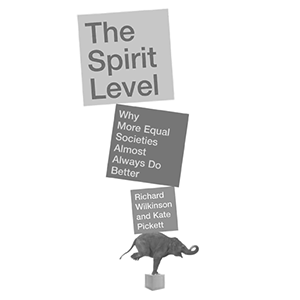
Equality of outcome is a controversial political concept which describes a state in which people have approximately the same material wealth or, more generally, in which the general conditions of their lives are similar. Achieving this requires reducing or eliminating material inequalities between individuals or households in a society. This could involve a transfer of income and/or wealth from wealthier to poorer individuals, or adopting other institutions designed to promote equality of condition from the start.
The concept is central to some political ideologies and is used regularly in political discourse, often in contrast to the term equality of opportunity. A related way of defining equality of outcome is to think of it as ‘equality in the central and valuable things in life.’ After the Russian Revolution of 1917, the political structure of the Soviet Union tried to emphasize equality of outcome as a primary goal.
read more »
Posted in Money, Philosophy, Politics |
Leave a Comment »
June 21, 2012

Hyperreality, according to French sociologist Jean Baudrillard is, ‘A real without origin or reality.’ Italian philosopher called it, ‘The authentic fake.’ More recently, Hungarian filmmaker Pater Sparrow forwarded the term ‘virtual irreality.’ The term is used in semiotics (the study of symbols) and postmodern philosophy to describe an inability of consciousness to distinguish reality from a simulation of reality, especially in technologically advanced post-modern societies. Hyperreality is a way of characterizing what our consciousness defines as ‘real’ in a world where a multitude of media can radically shape and filter an original event or experience. Most aspects of the concept can be thought of as ‘reality by proxy.’
Baudrillard in particular suggests that the world we live in has been replaced by a copy world, where we seek simulated stimuli and nothing more. He borrows, from Jorge Luis Borges’ ‘On Exactitude in Science’ (which borrowed from Lewis Carroll), the example of a society whose cartographers create a map so detailed that it covers the very things it was designed to represent. When the empire declines, the map fades into the landscape and there is neither the representation nor the real remaining – just the hyperreal. Baudrillard’s idea of hyperreality was heavily influenced by phenomenology, semiotics, and Marshall McLuhan.
read more »
Posted in Money, Philosophy, Science |
Leave a Comment »
June 21, 2012

‘Simulacra and Simulation‘ [sim-yuh-ley-kruh / sim-yuh-ley-shuhn] is a philosophical treatise by French sociologist Jean Baudrillard seeking to interrogate the relationship among reality, symbols, and society. A simulacrum (singular form of simulacra) in an imperfect simulation (a recreation of something). Baudrillard claims that our current society has replaced all reality and meaning with symbols and signs, and that human experience is of a simulation of reality.
Moreover, these simulacra are not merely mediations of reality, nor even deceptive mediations of reality; they are not based in a reality nor do they hide a reality, they simply hide that anything like reality is irrelevant to our current understanding of our lives. The simulacra that Baudrillard refers to are the significations and symbolism of culture and media that construct perceived reality, the acquired understanding by which our lives and shared existence is and are rendered legible; Baudrillard believed that society has become so saturated with these simulacra and our lives so saturated with the constructs of society that all meaning was being rendered meaningless by being infinitely mutable. Baudrillard called this phenomenon the ‘precession of simulacra.’
read more »
Posted in Language, Philosophy, Science |
Leave a Comment »
June 21, 2012

Simulacrum [sim-yuh-ley-kruhm] (Latin: ‘likeness, similarity’) was first recorded in the English language in the late 16th century, to describe a representation, such as a statue or a painting, especially of a god. By the late 19th century, it had gathered a secondary association of inferiority: an image without the substance or qualities of the original.
Philosopher Fredric Jameson offers photorealism as an example of artistic simulacrum, where a painting is sometimes created by copying a photograph that is itself a copy of the real. Other art forms that play with simulacra include Trompe l’oeil, Pop Art, Italian neorealism, and the French New Wave.
read more »
Posted in Art, Philosophy, Technology |
1 Comment »
June 18, 2012
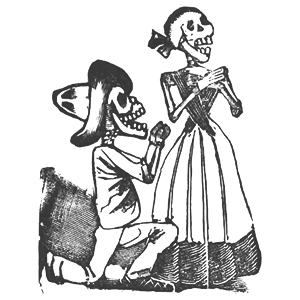
La Calavera Catrina (‘The Elegant Skull’) is a 1910 zinc etching by Mexican printmaker José Guadalupe Posada, part of his series of calaveras (humorous images of contemporary figures depicted as skeletons, which often were accompanied by a poem). The image has since become a staple of Mexican imagery, and often is incorporated into artistic manifestations of the Day of the Dead in November, such as altars and calavera costumes. Although these holy days have a long cultural history reaching into the prehistoric traditions of several European cultures, many aspects of the Mexican festival have indigenous origins in an Aztec festival dedicated to the goddess Mictecacihuatl. After the conquest of Mexico, the Spanish superimposed their cultural traditions upon the similar Aztec festival and a synthesis occurred.
‘La Catrina,’ as it is commonly known, was a popular print in Posada’s day, but soon faded from the popular memory. Along with the rest of Posada’s prints, it was revived by French artist and art historian Jean Charlot shortly after the Mexican Revolution in the 1920s. ‘La Catrina’ soon gained iconic status as a symbol of uniquely Mexican art and was reproduced en masse. The image was incorporated into Diego Rivera’s mural ‘Dream of a Sunday’in Alameda Park,’ which also includes images of his wife Frida Kahlo, Posada, and a self-portrait of Rivera. Notable paper cutter Marcelino Bautista Sifuentes has also recreated the famous ‘La Calavera Catrina’ in papel picado (a decorative craft made out of paper cut into elaborate designs).
Posted in Death, Philosophy, World |
Leave a Comment »
June 18, 2012

A calaca [kal-ah-kuh] (a colloquial Mexican Spanish name for skeleton) is a figure of a skull or skeleton (usually human) commonly used for decoration during the Mexican Day of the Dead festival, although they are made all year round. Tracing their origins from Aztec imagery, calacas are frequently shown with marigold flowers and foliage. As with other aspects of the Day of the Dead festival, calacas are generally depicted as joyous rather than mournful figures. They are often shown wearing festive clothing, dancing, and playing musical instruments to indicate a happy afterlife. This draws on the Mexican belief that no dead soul likes to be thought of sadly, and that death should be a joyous occasion. This goes back to Aztec beliefs, one of the few traditions to remain after the Spanish conquest.
Calacas used in the festival include carved skull masks worn by revelers, small figures made out of carved wood or fired clay, and sweet treats in the form of skulls or skeletons. Calacas are sometimes made of wood, stone, or even candy. A popular phrase among Mexicans and those Latinos that personally know some is ‘se lo (la) llevo la calaca’ after someone has died, literally meaning ‘the Calaca took him (her)’ or ‘death took him (her).’ In Guatemala, ‘calaca’ is understood as ‘death’ and implies fear of death. Thus, it is not depicted as a joyful image. Calaca-like figures can be seen in the Tim Burton films ‘The Nightmare Before Christmas’ and ‘Corpse Bride,’ the 2008 PlayStation 3 game ‘LittleBigPlanet,’ and the 1998 Tim Schafer computer game ‘Grim Fandango.’
Posted in Death, Philosophy, World |
Leave a Comment »
June 18, 2012

Transculturation [trans-kuhl-chuh-rey-shuhn] is a term coined by Cuban anthropologist Fernando Ortiz in 1940 to describe the phenomenon of merging and converging cultures. Transculturation encompasses more than transition from one culture to another; it does not consist merely of acquiring another culture (acculturation) or of losing or uprooting a previous culture (deculturation).
Rather, it merges these concepts and additionally carries the idea of the consequent creation of new cultural phenomena (neoculturation). Ortiz also referred to the devastating impact of Spanish colonialism on Cuba’s indigenous peoples as a ‘failed transculturation.’ Transculturation can often be the result of colonial conquest and subjugation, especially in a postcolonial era as native peoples struggle to regain their own sense of identity.
read more »
Posted in Philosophy, Politics, World |
Leave a Comment »


 The Daily Omnivore