June 18, 2012

Cosmopolitanism [koz-muh-pol-i-tn-iz-uhm] is the ideology that all kinds of human ethnic groups belong to a single community based on a shared morality. This is contrasted with communitarianism, which emphasizes the need to balance individual rights and interests with that of the community as a whole, and argues that individual people are shaped by the cultures and values of their communities.
Cosmopolitanism may entail some sort of world government or it may simply refer to more inclusive moral, economic, and/or political relationships between nations or individuals of different nations. The word derives from Greek ‘cosmos’ (‘the Universe’) and ‘polis’ (‘city’).
read more »
Posted in Philosophy, Politics, World |
Leave a Comment »
June 15, 2012

Technological utopianism is the belief that advances in science and technology will eventually bring about a utopia, or at least help to fulfill one or another utopian ideal. A techno-utopia is therefore a hypothetical ideal society, in which laws, government, and social conditions are solely operating for the benefit and well-being of all its citizens, set in the near- or far-future, when advanced science and technology will allow these ideal living standards to exist; for example, post scarcity, transformations in human nature, the abolition of suffering, and even the end of death.
In the late 20th and early 21st centuries, several ideologies and movements, such as the cyberdelic counterculture, the Californian Ideology, transhumanism, and singularitarianism, have emerged promoting a form of techno-utopia as a reachable goal. Cultural critic Imre Szeman argues technological utopianism is an irrational social narrative because there is no evidence to support it. He concludes that what it shows is the extent to which modern societies place a lot of faith in narratives of progress and technology overcoming things, despite all evidence to the contrary.
read more »
Posted in Philosophy, Politics, Technology |
Leave a Comment »
June 9, 2012

There are many theories of humor which attempt to explain what humor is, what social function it serves, and what would be considered humorous. It would be very difficult to explain humor to a hypothetical person who did not have a sense of humor already. In fact, to such a person humor would appear to be quite strange if not outright irrational behavior.
Among the prevailing types of theories that attempt to account for the existence of humor there are: psychological theories (the vast majority of which consider humor to be very healthy behavior); spiritual theories (which may consider humor to be a ‘gift from God’). There are also theories that consider humor to be an unexplainable mystery, very much like a mystical experience. Although various classical theories of humor and laughter may be found, in contemporary academic literature three theories of humor appear repeatedly: relief theory, superiority theory, and incongruity theory.
read more »
Posted in Health, Humor, Philosophy |
Leave a Comment »
June 7, 2012


The evolutionary psychology of religion is the study of religious belief using evolutionary psychology principles. As with all other organs and organ functions, the brain and cognition’s functional structure have been argued to have a genetic basis, and are therefore subject to the effects of natural selection and evolution. Like other organs and tissues, this functional structure should be universally shared amongst humans and should solve important problems of survival and reproduction. Evolutionary psychologists seek to understand cognitive processes, religion in this case, by understanding the survival and reproductive functions they might serve.
There is general agreement among scientists that a propensity to engage in religious behavior evolved early in human history. However, there is disagreement on the exact mechanisms that drove the evolution of the religious mind. There are two schools of thought. One is that religion itself evolved due to natural selection and is an adaptation, in which case religion conferred some sort of evolutionary advantage. Alternatively, religious beliefs and behaviors may have emerged as by-products of other adaptive traits without initially being selected for because of their own benefits (called spandrels).
read more »
Posted in Health, Philosophy, Science |
Leave a Comment »
June 7, 2012
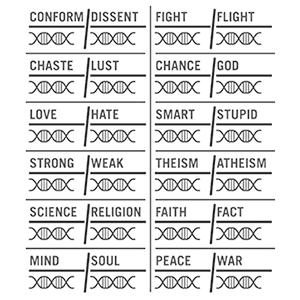
The evolutionary origin of religions theorizes about the emergence of religious behavior during the course of human evolution. Humanity’s closest living relatives are common chimpanzees and bonobos. These primates share a common ancestor with humans who lived between four and six million years ago. It is for this reason that chimpanzees and bonobos are viewed as the best available surrogate for this common ancestor.
Anthropologist Barbara King argues that while non-human primates are not religious, they do exhibit some traits that would have been necessary for the evolution of religion. These traits include high intelligence, a capacity for symbolic communication, a sense of social norms, realization of ‘self’ and a concept of continuity. There is inconclusive evidence that Homo neanderthalensis may have buried their dead. Elephants are the only other species known to have any recognizable ritual surrounding death. Ecologist Marc Bekoff, however, argues that many species grieve death and loss.
read more »
Posted in Philosophy, Science |
1 Comment »
June 6, 2012

Vedanta [veh-dahn-ta] was originally used a synonym for the part of the Vedas (Hindu scripture) known as the Upanishads (the appendix to the Vedic hymns, which are passed down orally). ‘Vedanta’ is the end of the Vedas both literally and metaphorically: it bookends the Veda, but is also in some ways ‘the purpose or goal [end] of the Vedas.’ By the 8th century CE, the word also came to be used to describe a group of philosophical traditions concerned with the self-realization by which one understands the ultimate nature of reality (Brahman, the godhead, the divine source of being, through which all emanates).
Vedanta can also be used as a noun to describe one who has mastered all four of the original Vedas. The Vedanta is also called Uttara Mimamsa, or the ‘latter enquiry’ or ‘higher enquiry,’ and is often paired with Purva Mimamsa, the ‘former enquiry’ (usually simply called Mimamsa), which deals with explanations of the fire-sacrifices of the Vedic mantras and the Brahmanas (expositions of the Vedas).
read more »
Posted in Language, Philosophy, World |
Leave a Comment »
June 1, 2012
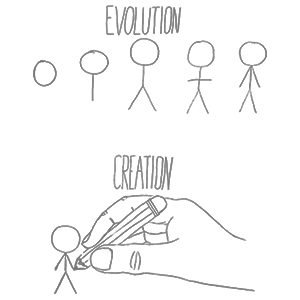
Irreducible complexity is an argument by proponents of intelligent design that certain biological systems are too complex to have evolved from simpler, or ‘less complete’ predecessors, through natural selection acting upon a series of advantageous naturally occurring, chance mutations.
The argument is central to intelligent design, and is rejected by the scientific community at large, which overwhelmingly regards intelligent design as pseudoscience. Irreducible complexity is one of two main arguments (both discredited) used by intelligent design proponents, the other being specified complexity (which singles out patterns that are both specified and complex as markers of design by an intelligent agent).
read more »
Posted in Philosophy, Science |
1 Comment »
May 31, 2012

‘Teach the Controversy‘ is the name of a campaign by the Discovery Institute (a conservative Christian think tank based in Seattle) to promote a variant of traditional creationism, intelligent design, while attempting to discredit evolution in US public high school science courses.
The central claim is that fairness and equal time requires educating students with a ‘critical analysis of evolution’ where ‘the full range of scientific views,’ evolution’s ‘unresolved issues,’ and the ‘scientific weaknesses of evolutionary theory’ will be presented and evaluated alongside intelligent design concepts like irreducible complexity. The overall goal of the movement is to ‘defeat [the] materialist world view’ represented by the theory of evolution and replace it with ‘a science consonant with Christian and theistic convictions.’
read more »
Posted in Education, Philosophy, Science |
Leave a Comment »
May 25, 2012

‘There are no atheists in foxholes‘ is an aphorism used to argue that in times of extreme stress or fear, such as when participating in warfare, all people will believe in or hope for a higher power. The precise origin of the phrase is uncertain.
While primarily used to comment on the specific experiences faced by combat soldiers, the statement is often adapted to other perilous situations such as ‘there are no atheists in Probate Court.’
read more »
Posted in Death, Philosophy, War |
Leave a Comment »
May 22, 2012

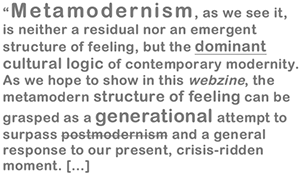
Metamodernism is a term employed to situate and explain recent developments across current affairs, critical theory, philosophy, architecture, art, cinema, music and literature which are emerging from and reacting to postmodernism.
The term metamodernism was introduced as an intervention in the post-postmodernism debate by the cultural theorists Timotheus Vermeulen and Robin van den Akker in 2010. In their article ‘Notes on metamodernism’ they assert that the 2000s are characterized by the return of typically modern positions without altogether forfeiting the postmodern mindsets of the 1990s and 1980s.
read more »
Posted in Art, Language, Philosophy |
Leave a Comment »
May 22, 2012

Post-Postmodernism is a general term used to describe new developments emerging from Postmodernism. It is a positive idea that faith, sincerity, and trust can be better for society than Postmodern irony.
The term ‘Post-Postmodernism’ was initially coined by seminal cultural theorist Alice Sanders in her magnum opus ‘The Shadow of the Rainbow.’
read more »
Posted in Language, Philosophy, Politics |
1 Comment »
May 22, 2012
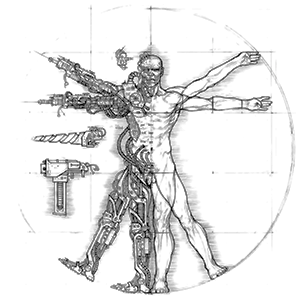
Hypermodernity is a type, mode, or stage of society that reflects a deepening or intensification of modernity. Characteristics include a deep faith in humanity’s ability to understand, control, and manipulate every aspect of human experience. This typically is manifested in a forward-looking commitment to science and knowledge, particularly with regard to the convergence of technology and biology.
The emphasis on the value of new technology to overcome natural limitations lends itself to a diminution or outright repudiation of the past, since yesterday’s knowledge can be considered ‘less’ than today’s. There can be a profound lack of integration between the past and the present since: what happened necessarily took place under ‘lesser’ circumstances than now, which generates a fundamentally separate context; and artifacts from the past superabundantly clutter the cultural landscape and are seamlessly reused to generate an even greater superabundance from which individuals are unable to discern original intent or meaning.
read more »
Posted in Philosophy, Politics, Technology |
Leave a Comment »


 The Daily Omnivore