March 6, 2012

Karma is the universal principle of cause and effect. Our actions, both good and bad, come back to us in the future, helping us to learn from life’s lessons and become better people. In religions that include reincarnation, karma extends through one’s present life and all past and future lives as well. Karma is basically energy. One person throws out energy through thoughts, words and actions, and it comes back, in time, through other people. Karma is the best teacher, forcing people to face the consequences of their actions and thus improve and refine their behavior, or suffer if they do not. Even harsh karma, when faced in wisdom, can be the greatest spark for spiritual growth. The conquest of karma lies in intelligent action and unemotional response.
The concept of cyclical patterns is very prominent in Indian religions. The wheel of life represents an endless cycle of birth, life, and death from which one seeks liberation. In Tantric Buddhism, a wheel of time concept known as the Kalachakra expresses the idea of an endless cycle of existence and knowledge. However it is to be noted that the cycle of life in Buddhism does not involve a soul passing from one body to another, but the karma of the deceased being carrying on to another being born. To get rid of this cycle the person should get rid of its karma through the attainment of enlightenment.
read more »
Posted in Philosophy, World |
1 Comment »
March 1, 2012

The Invisible Pink Unicorn (IPU) is the goddess of a parody religion used to satirize theistic beliefs, taking the form of a unicorn that is paradoxically both invisible and pink. She is a rhetorical illustration used by atheists and other religious skeptics as a contemporary version of Russell’s teapot, sometimes mentioned in conjunction with the Flying Spaghetti Monster.
The IPU is used to argue that supernatural beliefs are arbitrary by, for example, replacing the word God in any theistic statement with Invisible Pink Unicorn. The mutually exclusive attributes of pinkness and invisibility, coupled with the inability to disprove the IPU’s existence, satirize properties that some theists attribute to a theistic deity.
read more »
Posted in Humor, Philosophy |
Leave a Comment »
March 1, 2012

Cryptomnesia [krip-tam-nee-zha] occurs when a forgotten memory returns without it being recognized as such by the subject, who believes it is something new and original. It is a memory bias whereby a person may falsely recall generating a thought, not deliberately engaging in plagiarism but rather experiencing a memory as if it were a new inspiration.
The word was first used by the psychiatrist Théodore Flournoy, in reference to the case of a psychic medium, to suggest a high incidence of ‘latent memories on the part of the medium that come out, sometimes greatly disfigured by a subliminal work of imagination or reasoning, as so often happens in our ordinary dreams.’ Jung suggested the phenomenon in Nietzsche’s ‘Also Sprach Zarathustra.’
read more »
Posted in Language, Philosophy, Politics |
Leave a Comment »
February 28, 2012

When Prophecy Fails is a 1956 classic book in social psychology by Leon Festinger, Henry Riecken, and Stanley Schachter about a UFO religion that believes the end of the world is at hand. Festinger’s theory of cognitive dissonance (holding conflicting thoughts or feelings at the same time causes distress) can account for the psychological consequences of disconfirmed expectations.
Festinger and his associates read an interesting item in their local newspaper headlined ‘Prophecy from planet Clarion call to city: flee that flood.’ A housewife given the name ‘Marian Keech’ (real name Dorothy Martin, later known as Sister Thedra), had mysteriously been given messages in her house in the form of ‘automatic writing’ from alien beings. These messages revealed that the world would end in a great flood before dawn on December 21, 1954.
read more »
Posted in Health, Language, Philosophy |
1 Comment »
February 28, 2012
Cognitive dissonance [dis-uh-nuhs] is a discomfort caused by holding conflicting thoughts or feelings at the same time. In this state, people may feel surprise, dread, guilt, anger, or embarrassment. An example is the conflict between wanting to smoke and knowing that smoking is unhealthy. Reacting to this unpleasant state, people often change their feelings, thoughts or memories so they are less in conflict. For instance, a smoker might change their belief about the likelihood that smoking will make them ill, or they might introduce the idea that there are other benefits that make smoking worth it.
The phrase was coined by American psychologist Leon Festinger in his 1956 book ‘When Prophecy Fails,’ which chronicled the followers of a UFO cult as reality clashed with their fervent belief in an impending apocalypse. The believers met at a predetermined place and time, believing they alone would survive the Earth’s destruction. The appointed time came and passed without incident. They faced acute cognitive dissonance: had they been the victim of a hoax? Had they donated their worldly possessions in vain? Most members chose to believe something less dissonant: the aliens had given earth a second chance, and the group was now empowered to spread the word: earth-spoiling must stop. The group dramatically increased their proselytism despite the failed prophecy.
read more »
Posted in Health, Philosophy |
1 Comment »
February 26, 2012
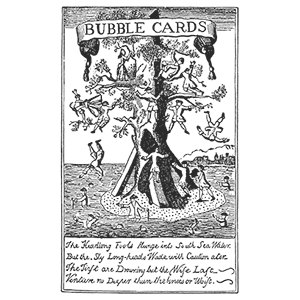
Extraordinary Popular Delusions and the Madness of Crowds is a history of popular folly by Scottish journalist Charles Mackay, first published in 1841. The book chronicles its subjects in three parts: National Delusions, Peculiar Follies, and Philosophical Delusions.
Despite its journalistic and rather sensational style, the book has gathered a body of academic support as a work of considerable importance in the history of social psychology and psychopathology. The subjects of Mackay’s debunking include economic bubbles, alchemy, crusades, witch-hunts, prophecies, fortune-telling, haunted houses, popular follies of great cities, and popular admiration of great thieves.
read more »
Posted in Language, Money, Philosophy |
Leave a Comment »
February 23, 2012

Jewish humor is self-deprecating, crude, and often anecdotal humor originating in Eastern Europe, which took root in the United States over the last hundred years. Beginning with vaudeville, and continuing through radio, stand-up comedy, film, and television, a disproportionately high percentage of American and Russian comedians have been Jewish.
Jewish humor is rooted in several traditions. The first is the intellectual and legal methods of the Talmud, which uses elaborate arguments and situations often seen as so absurd as to be humorous in order to tease out the meaning of religious law. There is an egalitarian tradition among the Jewish communities of Eastern Europe in which the powerful were often mocked subtly, rather than attacked overtly—as Saul Bellow once put it, ‘oppressed people tend to be witty.’ Jesters known as badchens used to poke fun at prominent members of the community during weddings, creating a good-natured tradition of humor as a levelling device.
read more »
Posted in Humor, Philosophy, Politics |
1 Comment »
February 21, 2012

Everybody Draw Mohammed Day was an event held on 20 May 2010 in support of free speech and freedom of artistic expression of those threatened by violence for drawing representations of the Islamic Prophet Muhammad. It began as a protest against censorship of an American television show, ‘South Park,’ ‘201’ by its distributor, Comedy Central, in response to death threats against some of those responsible for two segments broadcast in April. Observance of the day began with a drawing posted on the Internet on April 20, 2010, accompanied by text suggesting that ‘everybody’ create a drawing representing Muhammad, on May 20, 2010, as a protest against efforts to limit freedom of speech. U.S. cartoonist Molly Norris of Seattle created the artwork. Depictions of Muhammad are explicitly forbidden by a few hadiths (sayings of and about Muhammad), though not by the Qur’an.
South Park episodes ‘200’ and ‘201,’ broadcast in April 2010, featured a character in a bear costume, who various other characters stated was Muhammad. The ‘South Park’ episode sparked statements from the extremist website Revolution Muslim, which posted a picture of the partially decapitated body of the Dutch filmmaker, Theo van Gogh, with a statement declaring that Parker and Stone could meet a similar fate. Comedy Central self-censored the episode when it was broadcast by removing the word ‘Muhammad’ and a speech about intimidation and fear from the episode.
Posted in Humor, Philosophy, Politics |
1 Comment »
February 21, 2012

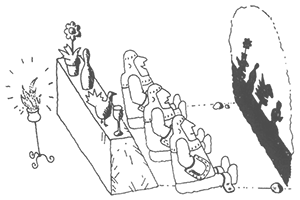
Simulated reality is the proposition that reality could be simulated—perhaps by computer simulation—to a degree indistinguishable from ‘true’ reality. It could contain conscious minds which may or may not be fully aware that they are living inside a simulation.
This is quite different from the current, technologically achievable concept of virtual reality. Virtual reality is easily distinguished from the experience of actuality; participants are never in doubt about the nature of what they experience. Simulated reality, by contrast, would be hard or impossible to separate from ‘true’ reality.
read more »
Posted in Philosophy, Technology, World |
3 Comments »
February 21, 2012
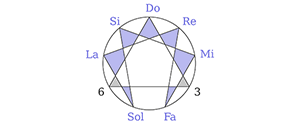

The Fourth Way refers to a concept used by Russian spiritualist G.I. Gurdjieff to describe an approach to self-development learned over years of travel in the East that combined what he saw as three established traditional ‘ways,’ or ‘schools’ into a fourth way. These three ways were of the body, mind, and emotions. The term ,The Fourth Way, was further developed by Russian esotericist P.D. Ouspensky in his lectures and writings. Posthumously, Ouspensky’s students published a book entitled ‘Fourth Way,’ based on his lectures. The ‘Fourth Way’ is sometimes referred to as ‘The Work,’ ‘Work on oneself,’ or ‘The System.’
According to this system, the chief difference between the three traditional schools, or ways, and the fourth way is that ‘they are permanent forms which have survived throughout history mostly unchanged, and are based on religion. Where schools of yogis, monks or fakirs exist, they are barely distinguishable from religious schools. The fourth way differs in that it is not a permanent way. It has no specific forms or institutions and comes and goes controlled by some particular laws of its own.’
read more »
Posted in Language, Philosophy |
Leave a Comment »
February 21, 2012
A Guide for the Perplexed is a short book by E. F. Schumacher, published in 1977. The title is a reference to Maimonides’s ‘The Guide for the Perplexed.’ Schumacher himself considered ‘A Guide for the Perplexed’ to be his most important achievement, although he was better known for his 1974 environmental economics bestseller ‘Small Is Beautiful,’ which made him a leading figure within the ecology movement.
His daughter wrote that her father handed her the book on his deathbed, five days before he died and he told her ‘this is what my life has been leading to.’ The book is a statement of the philosophical underpinnings that inform ‘Small is Beautiful.’
read more »
Posted in Language, Philosophy, Science |
1 Comment »
February 17, 2012

The Ganzfeld effect (German: ‘complete field’) is a phenomenon of visual perception caused by staring at an undifferentiated and uniform field of color. The effect is described as the loss of vision as the brain cuts off the unchanging signal from the eyes. The result is ‘seeing black’ – apparent blindness. In the 1930s, research by psychologist Wolfgang Metzger established that when subjects gazed into a featureless field of vision they consistently hallucinated and their electroencephalograms changed. The Ganzfeld effect is the result of the brain amplifying neural noise in order to look for the missing visual signals. The noise is interpreted in the higher visual cortex, and gives rise to hallucinations. This is similar to dream production because of the brain’s state of sensory deprivation during sleep.
The Ganzfeld effect has been reported since ancient times. The adepts of Pythagoras retreated to pitch black caves to receive wisdom through their visions, known as the prisoner’s cinema. Miners trapped by accidents in mines frequently reported hallucinations, visions and seeing ghosts when they were in the pitch dark for days. Arctic explorers seeing nothing but featureless landscape of white snow for a long time also reported hallucinations and an altered state of mind.
Posted in Health, Philosophy, Science |
Leave a Comment »


 The Daily Omnivore