February 16, 2012

In Buddhism, rigpa is the knowledge that ensues from recognizing one’s nature. The opposite of rigpa is marigpa (ignorance). In the ‘The Tibetan Book of the Dead,’ the same term refers to the fundamental innate mind in its natural state of spontaneity and purity. It is translated as ‘intrinsic awareness,’ and is described as giving a meditator access to pristine cognition or the buddha-mind itself, and it stands in direct contrast to fundamental ignorance, which is the primary cause of rebirth in cyclic existence (reincarnation). The direct introduction to intrinsic awareness is a distinctive teaching within the Nyingma school. This practice is a central component of the Esoteric Instruction Class of Atiyoga, where it is known as Cutting Through Resistance (Khregs-chod).
‘A Dzogchen Master STARTS with ‘direct introduction’ with everyone. If they don’t ‘get it’ then one starts to use all the infinite methods and means to help bring about the experience of Rigpa. When one has the experience of Rigpa, then one confirms the validity of one’s path now being ‘remaining with Rigpa’ as path.’
Posted in Philosophy |
Leave a Comment »
February 16, 2012

Bruce Feiler (b. 1964) is a popular American writer on faith, family, and finding meaning in everyday life. He is also the writer/presenter of the PBS miniseries ‘Walking the Bible.’ His latest book, ‘The Council of Dads: My Daughters, My Illness, and the Men Who Could Be Me,’ describes how he responded to a diagnosis of cancer by asking six men from all passages of his life to be present through the passages of his young daughters’ lives. ‘Walking the Bible’ describes his perilous, 10,000-mile journey retracing the Five Books of Moses through the desert. ‘Where God Was Born’ describes his year-long trek retracing the Bible through Israel, Iraq, and Iran. ‘America’s Prophet: Moses and the American Story’ discusses the significance of Moses as a symbolic prophet throughout four-hundred years of American history.
Feiler completed his undergraduate degree at Yale University, before spending time teaching English in Japan. This experience led to his first book, ‘Learning to Bow: Inside the Heart of Japan,’ a popular portrait of life in a small Japanese town. Upon his return he earned a masters degree in international relations from the University of Cambridge in the UK, which he chronicled in his book ‘Looking for Class.’ His early books involve immersing himself in different cultures and bringing other worlds to life. He also entered the world of a traveling circus for ‘Under the Big Top,’ which depicts the year he spent performing as a clown in the Clyde Beatty-Cole Bros. Circus. Feiler is also credited with formulating the Feiler Faster Thesis which states that the increasing pace of society is matched by (and perhaps driven by) journalists’ ability to report events and the public’s desire for more information.
Posted in Death, Language, Philosophy |
Leave a Comment »
February 13, 2012


Kitsch [kich] (loanword from German) is a form of art that is considered an inferior, tasteless copy of an extant style of art or a worthless imitation of art of recognized value. The concept is associated with the deliberate use of elements that may be thought of as cultural icons while making cheap mass-produced objects that are unoriginal.
Kitsch also refers to the types of art that are aesthetically deficient (whether or not being sentimental, glamorous, theatrical, or creative) and that make creative gestures which merely imitate the superficial appearances of art through repeated conventions and formulae. Excessive sentimentality often is associated with the term.
read more »
Posted in Art, Language, Philosophy |
1 Comment »
February 12, 2012

Myrmecia, often called bull ants, is a genus of ants found almost exclusively in Australia. These ants are well-known for their aggressive behavior and powerful stings. The venom of these ants has the potential to induce anaphylactic shock in allergic sting victims. As with most severe allergic reactions, if left untreated the reaction may be lethal. Bull ants eat small insects, honeydew (a sweet, sticky liquid found on leaves, deposited from various insects), seeds, fruit, fungi, gums, and nectar. They have larger eyes, and hence better vision, than most ants.
The bull ant famously appears in the philosopher Arthur Schopenhauer’s major work, ‘The World as Will and Representation,’ as a paradigmatic example of strife and constant destruction endemic to the ‘will to live.’ ‘But the bulldog-ant of Australia affords us the most extraordinary example of this kind; for if it is cut in two, a battle begins between the head and the tail. The head seizes the tail in its teeth, and the tail defends itself bravely by stinging the head: the battle may last for half an hour, until they die or are dragged away by other ants. This contest takes place every time the experiment is tried.’
Posted in Death, Philosophy, Science |
Leave a Comment »
February 9, 2012

Salting the earth, or sowing with salt, is the ritual of spreading salt on conquered cities to symbolize a curse on their re-inhabitation. It originated as a practice in the ancient Near East and became a well-established folkloric motif in the Middle Ages. The custom of purifying or consecrating a destroyed city with salt and cursing anyone who dared to rebuild it was widespread in the ancient Near East, but historical accounts are unclear as to what the sowing of salt meant in that process. Various Hittite and Assyrian texts speak of ceremonially strewing salt, minerals, or plants over destroyed cities.
The Book of Judges says that Abimelech, the judge of the Israelites, sowed his own capital, Shechem, with salt, ca. 1050 BCE, after quelling a revolt against him. Starting in the 19th century, various texts claim that the Roman general Scipio Africanus plowed over and sowed the city of Carthage with salt after defeating it in the Third Punic War (146 BCE), sacking it, and forcing the survivors into slavery. However, no ancient sources exist documenting this. The Carthage story is a later invention, probably modelled on the story of Shechem (a city now residing in Israel’s West Bank).
Posted in Philosophy, War, World |
Leave a Comment »
February 9, 2012

The role of salt in the Bible is relevant to understanding Hebrew society during the Old Testament and New Testament periods. Salt is a necessity of life and was a mineral that was used since ancient times in many cultures as a seasoning, a preservative, a disinfectant, a component of ceremonial offerings, and as a unit of exchange.
The Bible contains numerous references to salt. In various contexts, it is used metaphorically to signify permanence, loyalty, durability, fidelity, usefulness, value, and purification. The main source of salt in the region was the area of the Dead Sea, especially the massive six mile long salt cliffs of Jebel Usdum. The face of the ridge is constantly changing as weather interacts with the rock salt. The Hebrew people harvested salt by pouring sea water into pits and letting the water evaporate until only salt was left. They used the mineral for seasoning and as a preservative. In addition, salt was used to disinfect wounds.
read more »
Posted in Language, Philosophy |
Leave a Comment »
February 7, 2012
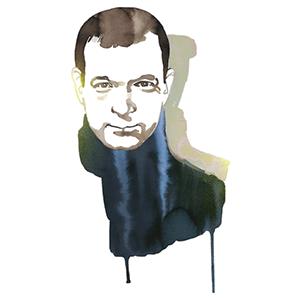
New Historicism is a school of literary theory that developed in the 1980s, primarily through the work of the critic Stephen Greenblatt, and gained widespread influence in the 1990s. The goal of the theory is to understand information by its historical context, and to understand cultural and intellectual history through literature. Michel Foucault based his approach both on his theory of the limits of collective cultural knowledge and on his technique of examining a broad array of documents in order to understand a particular time. New Historicism is claimed to be a more neutral approach to historical events, and to be sensitive towards different cultures.
‘Sub-literary’ texts and uninspired non-literary texts all came to be read as documents of historical discourse, side-by-side with the ‘great works of literature.’ A typical focus of New Historicist critics, led by Stephen Orgel, has been on understanding Shakespeare less as an autonomous great author in the modern sense than as a clue to the conjunction of the world of Renaissance theater—a collaborative and largely anonymous free-for-all—and the complex social politics of the time. In this sense, Shakespeare’s plays are seen as inseparable from the context in which he wrote.
read more »
Posted in Language, Philosophy, Politics |
1 Comment »
February 7, 2012
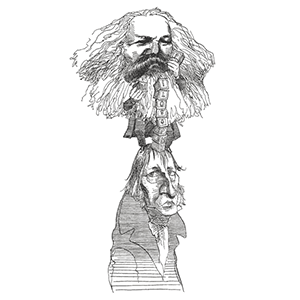
Historicism is doctrine that emphasizes the importance of history. It is a mode of thinking that assigns a central and basic significance to a specific context, such as historical period, geographical place and local culture. As such it is in contrast to individualist theories of knowledge such as empiricism and rationalism, which often discount the role of traditions. Historicism therefore tends to be hermeneutical (investigative of interpretations), because it places great importance on cautious, rigorous and contextualized interpretation of information and/or relativist (in support of the theory that knowledge is always relative to limitations of the mind), because it rejects notions of universal, fundamental and immutable interpretations.
The term has developed different and divergent, though loosely related, meanings. Elements of historicism appear in the writings of Italian philosopher G. B. Vico and French essayist Michel de Montaigne, and became fully developed with the dialectic of G. W. F. Hegel, influential in 19th-century Europe. The writings of Karl Marx, influenced by Hegel, also contain historicism. The term is also associated with the empirical social sciences and the work of Franz Boas. Historicism may be contrasted with reductionist theories, which suppose that all developments can be explained by fundamental principles (such as in economic determinism), or theories that posit historical changes as result of random chance. The theological use of the word denotes the interpretation of biblical prophecy as being related to church history. Post-structuralism uses the term New Historicism, which has some connections to both anthropology and Hegelianism.
Posted in Philosophy, Politics, Science |
1 Comment »
February 6, 2012
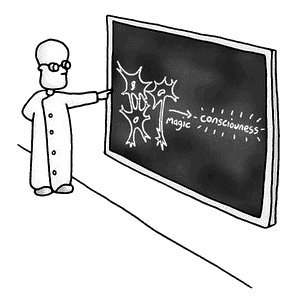
The explanatory gap is the difficulty that physicalist theories have in explaining how physical properties give rise to the way things feel when they are experienced. It is the claim that consciousness and human experiences such as qualia (individual instances of subjective, conscious experience) cannot be fully explained just by identifying the corresponding physical (neural) processes.
Bridging this gap is known as ‘the hard problem.’ The explanatory gap has vexed and intrigued philosophers and AI researchers alike for decades and caused considerable debate.
read more »
Posted in Education, Philosophy, Science |
1 Comment »
February 6, 2012
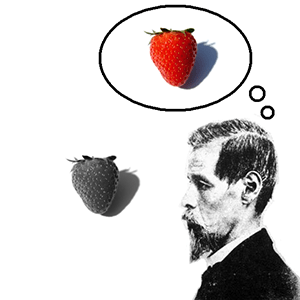
Qualia [kwah-lee-uh], singular ‘quale’ [kwah-lee], from a Latin word meaning for ‘what sort’ or ‘what kind,’ is a term used in philosophy to refer to subjective conscious experiences as ‘raw feels.’ Examples of qualia are the pain of a headache, the taste of wine, the experience of taking a recreational drug, or the perceived redness of an evening sky.
American philosopher Daniel Dennett writes that qualia is ‘an unfamiliar term for something that could not be more familiar to each of us: the ways things seem to us.’ Erwin Schrödinger, the famous physicist, had this counter-materialist take: ‘The sensation of color cannot be accounted for by the physicist’s objective picture of light-waves. Could the physiologist account for it, if he had fuller knowledge than he has of the processes in the retina and the nervous processes set up by them in the optical nerve bundles and in the brain? I do not think so.’
read more »
Posted in Language, Philosophy, Science |
1 Comment »
February 6, 2012

Mary’s room (also known as Mary the super-scientist) is a philosophical thought experiment proposed by Frank Jackson in his article ‘Epiphenomenal Qualia’ (1982) and extended in ‘What Mary Didn’t Know'(1986).
The argument is intended to motivate what is often called the ‘Knowledge Argument’ against physicalism — the view that the universe, including all that is mental, is entirely physical. The debate that emerged following its publication became the subject of an edited volume — ‘There’s Something About Mary’ (2004) — which includes replies from such philosophers as Daniel Dennett, David Lewis, and Paul Churchland.
read more »
Posted in Philosophy, Science |
Leave a Comment »
February 3, 2012
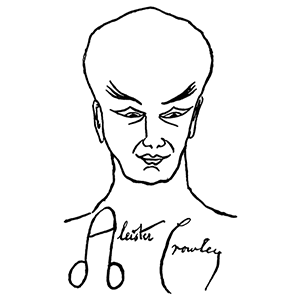
Eroto-comatose lucidity is a technique of sex magic known best by its formulation by English author and occultist Aleister Crowley, but which has several variations and is used in a number of ways by different spiritual communities.
A common form of the ritual uses repeated sexual stimulation (but not to orgasm) to place the individual in a state between full sleep and full wakefulness as well as exhaustion, allowing the practitioner to commune with their god. The rite may end in one of two ways. The ritualist may simply sink into total sleep. Or they may achieve orgasm and then sink into a deep and ‘undisturbable’ sleep.
Posted in Philosophy, Sex |
2 Comments »


 The Daily Omnivore