October 10, 2011
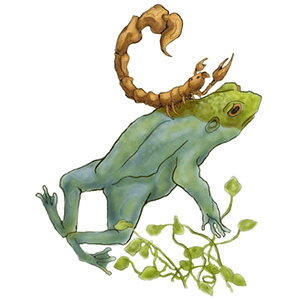
The Scorpion and the Frog is a fable about a scorpion asking a frog to carry him across a river. The frog is afraid of being stung during the trip, but the scorpion argues that if it stung the frog, the frog would sink and the scorpion would drown. The frog agrees and begins carrying the scorpion, but midway across the river the scorpion does indeed sting the frog, dooming them both. When asked why, the scorpion points out that this is its nature. The fable is used to illustrate the position that the behaviour of some creatures is irrepressible, no matter how they are treated and no matter what the consequences.
Variations commonly include a farmer, youth, turtle, or fox in place of the frog, and a snake in place of the scorpion. The Farmer and the Viper is a specific variant that can be attributed to Aesop. There is also a variation in which the final words of the scorpion are ‘It is better we should both perish than that my enemy should live.’ The origin and author are unknown. Variations of the fable appear in West African and European folktales. A study published in a German journal in 2011 points out a connection between the genesis of the fable and the tradition of the Panchatantra, a collection of animal fables dating back to India in the 3rd century BCE.
Posted in Death, Language, Philosophy |
Leave a Comment »
September 29, 2011


The concept known as the law of the instrument, Maslow’s hammer, or a golden hammer is an over-reliance on a familiar tool; as psychologist Abraham Maslow said in 1966, ‘It is tempting, if the only tool you have is a hammer, to treat everything as if it were a nail.’ The sentiment that people look for cure-alls, and over-use familiar tools, is likely traditional; see panacea. Likewise, the use of a hammer and nail as imagery are likely as old as hammers and nails, or even the use of rocks as tools, which the hammer evokes.
The hammer and nail metaphor may not be original to Kaplan or Maslow, and has been attributed to Mark Twain, though there is no documentation of this origin in Twain’s published writings. Under the name of ‘Baruch’s Observation,’ it is also been attributed to Bernard M. Baruch, a stock market speculator and author.
read more »
Posted in Humor, Philosophy, Technology |
Leave a Comment »
September 25, 2011
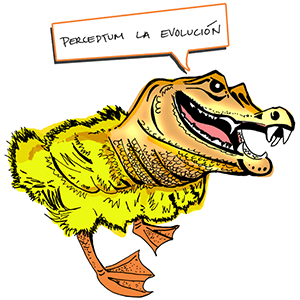
The term ‘crocoduck‘ was originally presented in a 2004 children’s story, ‘Guji Guji.’ The author and illustrator Chih-Yuan Chen produced the bestselling children’s story in 2004 as a modern day twist on The Ugly Duckling story in which a crocodile egg rolls into a duck’s nest and is raised in a brood of ducklings, growing up as a ‘crocoduck’ who thinks he is ‘not a bad crocodile,’ but ‘Of course, I’m not exactly a duck either.’ It was later used by creationists to claim that the absence of any half-crocodile, half-duck creature disproves evolution, an argument that quickly became a popular theme used to ridicule a common misrepresentation of the theory of evolution.
In 2007 creationists Kirk Cameron and Ray Comfort participated in a televised debate, parts of which were aired on ABC Nightline, on the existence of God. Comfort says they produced composite pictures of what ‘we imagined would be genuine species-to-species transitional forms. We called one a ‘crocoduck’ and another was called a ‘birddog.’ These pictures were used to show exactly what they thought evolutionists believe, but can’t back up through the fossil record.’ Their composite picture of the imaginary ‘crocoduck’ showed the head of a crocodile on a duck’s body. However, modern species share a common ancestor, but are neither descended from each other nor from some crude composite chimera, and ducks are not descended from crocodiles.
Posted in Humor, Philosophy, Science |
1 Comment »
September 22, 2011

Michael Murdock (b. 1946) is a televangelist and pastor of the Wisdom Center ministry based in Fort Worth, Texas. His father, J.E. Murdock, is also a pastor. Murdock was educated in LaGrange High School in Lake Charles, and in Southwestern Assemblies of God University in Waxahachie for three semesters. He received an honorary doctorate from International Seminary in Florida which is not accredited. Murdock preaches around the world and is best known for his promotion of prosperity theology, whose claim the Bible teaches that financial blessing is the will of God for Christians.
He often preaches with Benny Hinn and has also preached with Tammy Faye Bakker. Additionally, he hosts the Wisdom Keys with Mike Murdock television program. Mike Murdock preached his first public sermon at the age of eight and began full-time evangelism at the age of 19. Murdock receives hundreds of invitations to speak in churches, colleges, and business corporations. He has a weekly television program, Wisdom Keys with Mike Murdock. Murdock is a Founding Trustee on the Board of International Charismatic Ministries along with the late Dr. Oral Roberts.
read more »
Posted in Money, Philosophy, Politics |
Leave a Comment »
September 20, 2011

Bless you, or God bless you, is a common English expression addressed to a person after they sneeze. In non-English-speaking cultures, words referencing good health or a long life are often used instead of ‘bless you,’ though some also use references to God. English speakers also respond to sneezing with the German word Gesundheit, which means ‘health.’
The origin of the custom and its original purpose is unknown. Several possible origins are commonly given. The practice of blessing someone who sneezes, dating as far back as at least 77 CE, however, is far older than most specific explanations can account for.
read more »
Posted in Health, Language, Philosophy |
1 Comment »
September 20, 2011

Superstition is a belief in a non-physical (i.e. supernatural) causality: that one event causes another without any physical process linking the two events. The word is often used pejoratively to refer to practices (e.g. Voodoo) other than the one prevailing in a given society (e.g. Christianity in western culture), although the prevailing religion may contain just as many supernatural beliefs.
It is also commonly applied to beliefs and practices surrounding luck, prophecy and spiritual beings, particularly the belief that future events can be foretold by specific unrelated prior events.
read more »
Posted in Language, Philosophy, Science |
Leave a Comment »
September 13, 2011
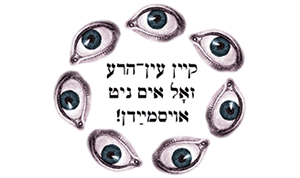

Apotropaic [ap-uh-truh-pey-ik] magic is the use of rituals to ward off harmful influences like the ‘evil eye’ or invidia (jealous or hostile gazes). This can be a long ritual, or it can take the form of simply wearing an amulet or other token, against bad luck, or gestures such as fingers crossed or knocking on wood. When faced with a bad omen the Greeks made offerings to the Averting Gods, underworld deities and heroes who might offer them protection Apotropaic rituals were practiced throughout the ancient Near East and Egypt. Fearsome deities were invoked to ward away evil spirits.
In ancient Egypt, these household rituals were embodied by the deity who personified magic itself, Heka. Other gods invoked include the hippopotamus-like fertility goddess, Taweret, and the lion-demon, Bes (who developed from the early apotropaic dwarf demon-god, Aha, literally meaning ‘fighter’). In the region today, symbol of an eye is common to represent apotropaic intentions. A Turkish airline has adopted the symbol (known as ‘Nazar bonjuk’) as a motif for its planes. The Yiddish expression, ‘Kain ein horeh’ is apotropaic in nature, and literally translates to ‘no evil eye,’ somewhat equivalent to the expression, ‘Knock on wood.’
read more »
Posted in Philosophy, World |
Leave a Comment »
September 9, 2011

Acedia [uh-see-dee-uh] (Greek: ‘negligence’) describes a state of listlessness or torpor, of not caring or not being concerned with one’s position or condition in the world. It can lead to a state of being unable to perform one’s duties in life. Its spiritual overtones make it related to but distinct from depression. Acedia was originally noted as a problem among monks and other ascetics who maintained a solitary life. In the medieval Latin tradition of the seven deadly sins, acedia has generally been folded into the sin of sloth.
Moral theologians, intellectual historians and cultural critics have variously construed acedia as the ancient depiction of a variety of psychological states, behaviors or existential conditions: primarily laziness, ennui or boredom. The demon of acedia manifests itself in a range of psychological and somatic symptoms that is far broader and more complex than the familiar tradition in the West.
read more »
Posted in Health, Language, Philosophy |
Leave a Comment »
September 7, 2011

Mushin (‘without mind’) is a mental state into which very highly trained martial artists are said to enter during combat. They also practice this mental state during everyday activities. The term is shortened from’ mushin no shin,’ a Zen expression meaning the mind without mind and is also referred to as the state of ‘no-mindness.’ That is, a mind not fixed or occupied by thought or emotion and thus open to everything. It is somewhat analogous to ‘flow’ experienced by artists deeply in a creative process, or athletes being ‘in the zone’ while playing a sport.
Mushin is achieved when a person’s mind is free from thoughts of anger, fear, or ego during combat or everyday life. There is an absence of discursive thought and judgment, so the person is totally free to act and react towards an opponent without hesitation and without disturbance from such thoughts. At this point, a person relies not on what they think should be the next move, but what is their trained natural reaction or what is felt intuitively. It is not a state of relaxed, near-sleepfulness, however. The mind could be said to be working at a very high speed, but with no intentions, plans or direction. In analogy a clear mind is compared to a still pond, which is able to clearly reflect the moon and trees. But just as waves in the pond will distort the picture of reality, so will the thoughts we hold onto disrupt the true perception of reality.
read more »
Posted in Language, Philosophy, War |
Leave a Comment »
August 23, 2011

David Foster Wallace (1962 – 2008) was an American author of novels, essays, and short stories, and a professor at Pomona College in Claremont, California. He was widely known for his 1996 novel ‘Infinite Jest.’ In 1997, Wallace received a MacArthur Fellowship. He was born in Ithaca, New York. His father teaches philosophy at the University of Illinois and his mother teaches English at a community college in Champaign. In fourth grade, he moved to Urbana, Illinois. As an adolescent, he was a regionally ranked junior tennis player.
He attended his father’s alma mater, Amherst College, and majored in English and philosophy, with a focus on modal logic and mathematics. His philosophy senior thesis on modal logic, titled ‘Richard Taylor’s ‘Fatalism’ and the Semantics of Physical Modality’ was awarded the Gail Kennedy Memorial Prize by Amherst. His other senior thesis, in English, would later become his first novel, ‘The Broom of the System,’ which centers on an emotionally challenged, 24-year-old telephone switchboard operator who has issues about whether or not she’s real.
read more »
Posted in Art, Language, Philosophy |
Leave a Comment »
August 15, 2011

Global Orgasm, also known as GORG, was an action originally scheduled for December 22, 2006 to coincide with the end of solstice. The idea was for participants throughout the world to have an orgasm during this one day while thinking about peace in order to emit positive energy to Earth. The Second Annual Synchronized Global Orgasm for Peace occurred at 6:08 (GMT) on December 22, 2007, the actual moment of the Solstice.
In 2009 Ani Sinclair took over the cause (and website) of Global Orgasm. She encourages everyone to practice conscious dedication of orgasmic energy to world peace. The Solstice on December 21st is the day to culminate the practice for the year and then to begin again, practicing for the next year. She would like to help change the perception about sexuality from ‘original sin’ to ‘original blessing,’ honoring and empowering women.Studies have found increases in the hormone oxytocin at orgasm in both men and women. Oxytocin’s role in increasing trust, pair bonding and reducing anxiety has meant it is sometimes referred to as the ‘love and trust’ hormone.
Posted in Philosophy, Sex, War |
Leave a Comment »
August 10, 2011

Since its premiere in 1968, 2001: A Space Odyssey has been analyzed and interpreted by multitudes of people ranging from professional movie critics to amateur writers and science fiction fans. The director of the film, Stanley Kubrick, wanted to leave the film open to philosophical and allegorical interpretation, purposely presenting the final sequences of the film without the underlying thread being apparent; a concept illustrated by the final frame of the film, which contains the image of the embryonic ‘Starchild.’
Kubrick encouraged people to explore their own interpretations of the film, and refused to offer an explanation of ‘what really happened’ in the movie, preferring instead to let audiences embrace their own ideas and theories. In a 1968 interview with Playboy magazine, Kubrick stated: ‘You’re free to speculate as you wish about the philosophical and allegorical meaning of the film—and such speculation is one indication that it has succeeded in gripping the audience at a deep level—but I don’t want to spell out a verbal road map for ‘2001’ that every viewer will feel obligated to pursue or else fear he’s missed the point.’
read more »
Posted in Art, Philosophy, Technology |
Leave a Comment »


 The Daily Omnivore