July 3, 2011

Milk kinship, formed during nursing by a non-biological mother, was a form of fostering allegiance with fellow community members. In the early modern period, milk kinship was widely practiced in many Arab countries for both religious and strategic purposes. Like the Christian practice of godparenting, milk kinship established a second family that could take responsibility for a child whose biological parents came to harm. ‘Milk kinship in Islam thus appears to be a culturally distinctive, but by no means unique, institutional form of adoptive kinship.’ A child in one of these societies would be breastfed by a woman of a lower class, enabling the child’s biological mother to maintain her modesty.
The childhood of the prophet Muhammad illustrates the practice of traditional Arab milk kinship. In his early childhood, he was sent away to foster-parents amongst the Bedouin. By nursing him, Halimah bint Abdullah became his ‘milk-mother.’ The rest of her family was drawn into the relationship as well: her husband al-Harith became Muhammad’s ‘milk-father,’ and Muhammad was raised alongside their biological children as a ‘milk-brother.’ This case suggests that it was typical for a child’s wet nurse to be responsible for raising him.
read more »
Posted in Food, Philosophy, World |
Leave a Comment »
June 30, 2011

‘Demian: The Story of Emil Sinclair’s Youth’ is a 1919 novel by Herman Hesse. It is a bildungsroman, a novel showing a character’s maturation from youth to adulthood. The book was first published under the pseudonym ‘Emil Sinclair,’ the name of the narrator of the story, but Hesse was later revealed to be the author.
Emil Sinclair is a young boy raised in a bourgeois home, amid what is described as a ‘Scheinwelt,’ a play on words that means ‘world of light’ as well as ‘world of illusion.’ Emil’s entire existence can be summarized as a struggle between two worlds: the show world of illusion (related to the Hindu concept of maya) and the real world, the world of spiritual truth. In the course of the novel, accompanied and prompted by his mysterious classmate ‘Max Demian,’ he detaches from and revolts against the superficial ideals of the world of appearances and eventually awakens into a realization of self.
read more »
Posted in Art, Language, Philosophy |
Leave a Comment »
June 30, 2011
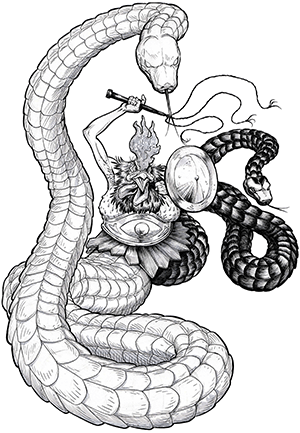
‘Abraxas‘ [uh-brak-suhs] is the second studio album by the latin band Santana. Consolidating their live success at the Woodstock Festival in 1969, and the interest generated by their first album the band took some time to issue a follow-up. Released in 1970, the album’s mix of rock, blues, jazz, salsa and other influences made it a classic that defined Santana’s early sound, and showed a musical maturation from their first album. The album’s cover features the 1961 painting ‘Annunciation,’ by Mati Klarwein.
Abraxas is the name of a deity in Gnostic cosmology. The title of the album comes from a line from Herman Hesse’s book ‘Demian.’ Abraxas is used as a symbol throughout the text, idealizing the harmonious union of all that is good and evil in the world. Demian argues that the Christian God is an insufficient god; it rules over all that is wholesome, but there is another half of the world. The symbol of Abraxas appears as a bird breaking free from an egg or a globe.
Posted in Art, Language, Philosophy |
1 Comment »
June 29, 2011
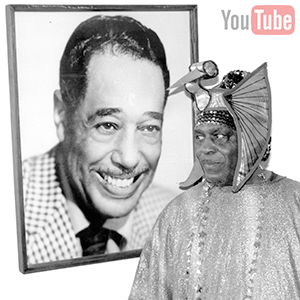
Sun Ra (1914 – 1993), born Herman Poole Blount, was a prolific jazz artist and philosopher known for his ‘cosmic’ music and philosophies. His eclectic music and unorthodox lifestyle made him controversial. Claiming that he was of the ‘Angel Race’ and not from Earth, but from Saturn, Sun Ra developed a complex persona using ‘cosmic’ philosophies and lyrical poetry that made him a pioneer of afrofuturism. He preached awareness and peace above all.
He abandoned his birth name and took on the name and persona of Sun Ra (Ra being the Egyptian God of the Sun), and used several other names throughout his career, including Le Sonra and Sonny Lee. Sun Ra denied any connection with his birth name, saying ‘That’s an imaginary person, never existed … Any name that I use other than Ra is a pseudonym.’
read more »
Posted in Art, Humor, Philosophy |
Leave a Comment »
June 29, 2011


The ‘veil of ignorance‘ and the ‘original position’ (state of nature) are concepts introduced by Hungarian economist, John Harsanyi, and later appropriated by American Philosopher, John Rawls, in ‘A Theory of Justice.’
It is a method of determining the morality of a certain issue (e.g. slavery) based upon the following principle: imagine that societal roles were completely re-fashioned and redistributed, and that from behind the veil of ignorance, one does not know what role they will be reassigned. Only then can one truly consider the morality of an issue.
read more »
Posted in Philosophy, Politics |
1 Comment »
June 27, 2011

Neophile [nee-uh-fahyl] is a term used by counterculture cult writer Robert Anton Wilson to describe a particular type of personality. A neophile or neophiliac can be defined as a personality type characterized by a strong affinity for novelty.
Neophiles/Neophiliacs have the following basic characteristics: The ability to adapt rapidly to extreme change. A distaste or downright loathing of tradition, repetition, and routine. A tendency to become bored quickly with old things. A desire, bordering on obsession in some cases, to experience novelty. A corresponding and related desire to create novelty by creating or achieving something and/or by stirring social or other forms of unrest.
read more »
Posted in Language, Philosophy, Technology |
Leave a Comment »
June 27, 2011

Loompanics Unlimited was an American book seller and publisher specializing in nonfiction on generally unconventional or controversial topics, with a philosophy arguably tending to a mixture of libertarian and left wing ideals, although Loompanics carried books expressing other political viewpoints (including far right) as well as outspokenly apolitical ones. The topics in their title list included drugs, weapons, anarchism, sex, and conspiracy theory, among others. Many of their titles describe some illicit or extralegal actions, such as ‘Counterfeit I.D. Made Easy,’ while others are purely informative, like ‘Opium for the Masses.’
Mike Hoy started Loompanics Unlimited in East Lansing, Michigan, in 1975. He later moved the business to Port Townsend, Washington, where his friend and fellow publisher R.W. Bradford had earlier located. The company’s name is a play on words inspired by Hoy’s fondness for National Lampoon.
read more »
Posted in Money, Philosophy, Politics |
Leave a Comment »
June 27, 2011


Work is a book published by Crimethinc Far East, a decentralized anarchist publishing collective. It covers a wide range of economic, political, and philosophical issues, mostly relating to the ethical and utilitarian implications of Capitalism. Central to the book’s theme is that Capitalism is inherently immoral and inevitably causes massive wealth inequality and degradation of general human experience.
The book focuses specifically on the causes and effects crises suffered by capitalist economies, such as the 2008 financial crisis, and how the people can subvert global Capitalism to create a better future. The book features an ‘updated’ version of the Pyramid of the Capitalist System, designed by American artist, Packard Jennings, on the inside flap.
Posted in Money, Philosophy, Politics |
Leave a Comment »
June 27, 2011

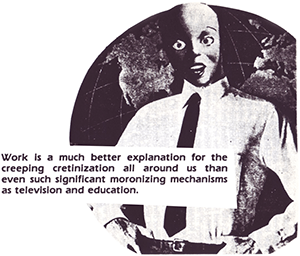
‘The Abolition of Work‘ is an essay written by American anarchist, Bob Black in 1985. The essay was part of an anthology of essays entitled ‘The Abolition of Work and Other Essays’ published by Loompanics (a publisher specializing in nonfiction on generally unconventional or controversial topics).
It is an exposition of Black’s ‘type 3 anarchism’ – a blend of post-Situationist theory and individualist anarchism – focusing on a critique of the work ethic. He adopted Situationist tropes that had recently been re-popularized (or recuperated) by pop bands of the time (Bow Wow Wow in particular having earlier featured ‘demolition of the work ethic’ and ‘there’s no need to work ever’ among similar lines in their lyrics).
read more »
Posted in Money, Philosophy, Politics |
Leave a Comment »
June 23, 2011

Inverted spectrum is the apparent possibility of two people sharing their color vocabulary and discriminations, although the colors one sees — their qualia — are systematically different from the colors the other person sees.
The argument dates back to John Locke. It invites us to imagine that we wake up one morning, and find that for some unknown reason all the colors in the world have been inverted. Furthermore, we discover that no physical changes have occurred in our brains or bodies that would explain this phenomenon. Supporters of the existence of qualia argue that, since we can imagine this happening without contradiction, it follows that we are imagining a change in a property that determines the way things look to us, but that has no physical basis.
read more »
Posted in Philosophy |
Leave a Comment »
June 23, 2011
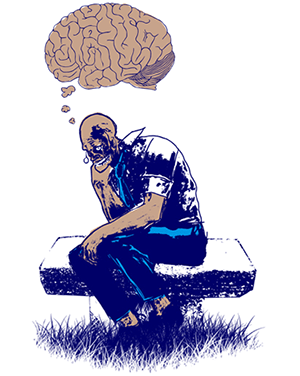
A philosophical zombie or p-zombie in the philosophy of mind and perception is a hypothetical being that is indistinguishable from a normal human being except in that it lacks conscious experience, qualia, or sentience.
When a zombie is poked with a sharp object, for example, it does not feel any pain though it behaves exactly as if it does feel pain (it may say ‘ouch’ and recoil from the stimulus, or tell us that it is in intense pain).
read more »
Posted in Philosophy |
1 Comment »
June 21, 2011


The Edicts of Ashoka are a collection of 33 inscriptions on the Pillars of Ashoka, as well as boulders and cave walls, made by the Emperor Ashoka of the Mauryan dynasty during his reign from 269 BCE to 231 BCE. These inscriptions are dispersed throughout the areas of modern-day Bangladesh, India, Nepal and Pakistan and represent the first tangible evidence of Buddhism.
The edicts describe in detail the first wide expansion of Buddhism through the sponsorship of one of the most powerful kings of Indian history. According to the edicts, the extent of Buddhist proselytism during this period reached as far as the Mediterranean, and many Buddhist monuments were created.
read more »
Posted in Philosophy, War, World |
Leave a Comment »



 The Daily Omnivore