June 21, 2011

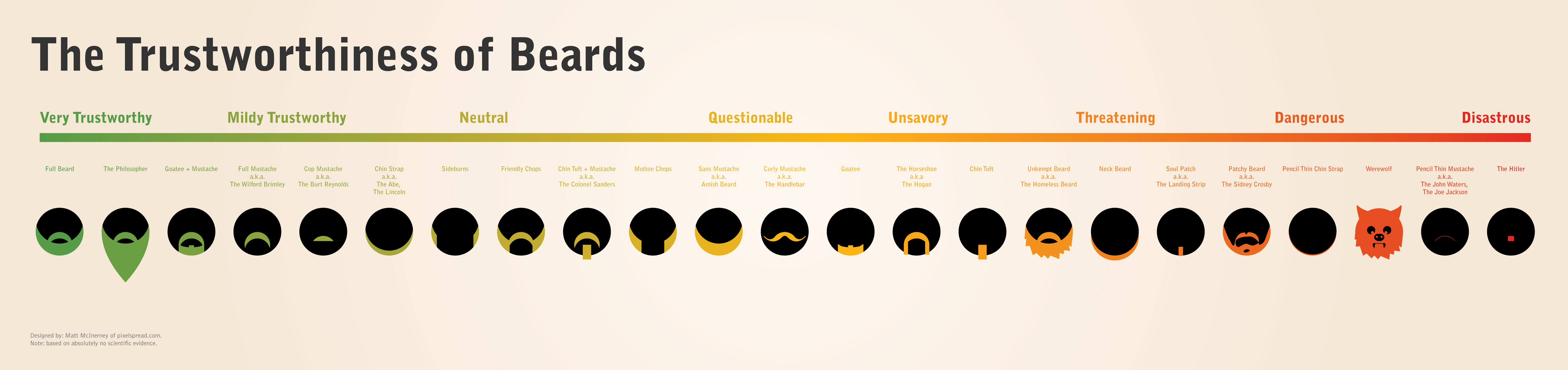
‘Barba non facit philosophum‘ is a Latin phrase meaning ‘A beard does not constitute a philosopher.’ According to the Latin author Aulus Gellius, who relates he was present at the episode, a man in a cloak, ‘with long hair and a beard that reached almost to his waist’ once came to the Athenian aristocrat, Herodes Atticus, who was renown for his ‘charm and his Grecian eloquence,’ and asked that money be given him for bread. When Herodes asked him who he was, the man, seemingly taking offense, replied that he was a philosopher, adding that he wondered why Herodes thought it necessary to ask what was obvious
‘I see,’ said Herodes, ‘a beard and a cloak; the philosopher I do not yet see.’ Some of Herodes’ companions informed him that the fellow was a actually a beggar ‘of worthless character,’ whose behavior was often abusive. Hearing which, Herodes said: ‘Let us give him some money, then, whatever his character may be, not because he is a man, but because we are men,’ and ordered that enough money be given to the man so that he could ‘buy bread for thirty days.’ The Athenian’s phrase, shortened to ‘A beard does not constitute a philosopher,’ has taken on a meaning similar to the proverb: ‘Clothes do not make the man,’ encountered in many cultures.
Posted in Humor, Language, Philosophy |
1 Comment »
June 21, 2011
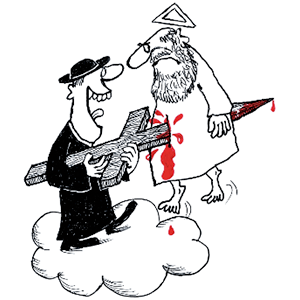
Jean Meslier (1664 – 1729) was a French Catholic priest who was discovered, upon his death, to have written a book-length philosophical essay promoting atheism. Described by the author as his ‘testament’ to his parishioners, the text denounces all religion.
He began learning Latin from a neighborhood priest in 1678 and eventually joined the seminary; he later claimed this was done to please his parents. At the end of his studies, he took Holy Orders and became priest in Champagne. One public disagreement with a local nobleman aside, Meslier was to all appearances generally unremarkable, and he performed his office without complaint or problem for 40 years. He lived like a pauper, and every penny left over was donated to the poor.
read more »
Posted in Language, Philosophy |
Leave a Comment »
June 15, 2011

Possibilianism is a philosophy which rejects both the idiosyncratic claims of traditional theism and the positions of certainty in atheism in favor of a middle, exploratory ground.
The term was first defined by neuroscientist David Eagleman in relation to his book of fiction ‘Sum.’ Asked whether he was an atheist or a religious person he replied, ‘I call myself a Possibilian: I’m open to…ideas that we don’t have any way of testing right now’
read more »
Posted in Philosophy |
Leave a Comment »
June 15, 2011

The Brights Movement is a social movement that aims to promote public understanding and acknowledgment of the naturalistic worldview (disbelief of the supernatural), including equal civil rights and acceptance for people who hold a naturalistic worldview. It was co-founded by Paul Geisert and Mynga Futrell in 2003.
The movement aims to create an Internet constituency that will pursue the following aims: Promote public understanding and acknowledgment of the naturalistic worldview, which is free of supernatural and mystical elements. Gain public recognition that persons who hold such a worldview can bring principled actions to bear on matters of civic importance. Educate society toward accepting the full and equitable civic participation of all such people.
read more »
Posted in Philosophy, Politics, Science |
Leave a Comment »
June 15, 2011
Derek Parfit (b. 1942) is a British philosopher who specializes in problems of personal identity, rationality and ethics, and the relations between them. His 1984 book ‘Reasons and Persons’ has been very influential. His most recent book, ‘On What Matters’ (2011), has already been widely discussed, having circulated in draft form for many years.
He has worked at Oxford for the whole of his academic career, and is presently an Emeritus Senior Research Fellow at All Souls College, Oxford. ‘Reasons and Persons’ is a four-part work, with each successive section building on the last. Parfit believes that nonreligious ethics is a young and fertile field of inquiry. He asks questions about which actions are right or wrong and shies away from meta-ethics, which focuses more on logic and language.
read more »
Posted in Philosophy |
Leave a Comment »
June 13, 2011
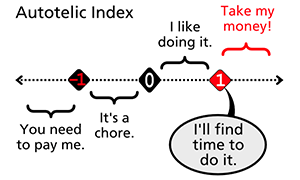

‘Art for art’s sake‘ is the usual English rendering of a French slogan, from the early 19th century, ‘l’art pour l’art,’ and expresses a philosophy that the intrinsic value of art, and the only ‘true’ art, is divorced from any didactic (educational), moral or utilitarian function.
Such works are sometimes described as ‘autotelic,’ from the Greek ‘autoteles,’ ‘complete in itself,’ a concept that has been expanded to embrace ‘inner-directed’ or ‘self-motivated’ human beings. A Latin version of this phrase, ‘Ars gratia artis,’ is used as a slogan by Metro-Goldwyn-Mayer and appears in its logo.
read more »
Posted in Art, Language, Philosophy |
1 Comment »
June 12, 2011

‘The Black Swan: The Impact of the Highly Improbable’ is a book by Lebanese American, philosopher Nassim Nicholas Taleb. The book focuses on the extreme impact of certain kinds of rare and unpredictable events (outliers) and humans’ tendency to find simplistic explanations for these events retrospectively, after the fact. This theory has since become known as the black swan theory. The book also covers subjects relating to knowledge, aesthetics, and ways of life, and uses elements of fiction in making its points.
Taleb, bestselling author of ‘Fooled by Randomness,’ treats uncertainty and randomness as a single idea. The main idea in Taleb’s book is not to attempt to predict Black Swan Events, but to build robustness into negative ones that occur and being able to exploit positive ones. Taleb contends that banks and trading firms are very vulnerable to hazardous Black Swan Events and are exposed to losses beyond those that are predicted by their defective models.
read more »
Posted in Language, Philosophy, Science |
Leave a Comment »
June 7, 2011
Radiolab is a radio program produced by WNYC, a public radio station in New York City. The show is nationally syndicated and is available as a podcast. Hosted by Jad Abumrad and Robert Krulwich, the show focuses on topics of a scientific and philosophical nature. The show attempts to approach broad, difficult topics such as ‘time’ and ‘morality’ in an accessible and light-hearted manner and with a distinctive audio production style.
Each Radiolab episode is elaborately stylized. For instance, thematic—and often discordant—music accompanies much of the commentary. Abumrad explained the choice in music thusly: ‘I put a lot of jaggedy sounds, little plurps and things, strange staccato, percussive things.’ In addition, previously recorded interview segments are interspersed in the show’s live dialogue, adding a layered, call-and-response affect to the questions posed by the hosts. These recordings are often unedited and the interviewee’s asides appear in the final product. Abumrad said, ‘You’re trying to capture the rhythms and the movements, the messiness of the actual experience…It sounds like life.’ And unlike traditional journalism, in which the reader is given only access to the final article, not the interview, Abumrad added that Radiolab’s process is more transparent.
Posted in Philosophy, Science |
Leave a Comment »
June 1, 2011
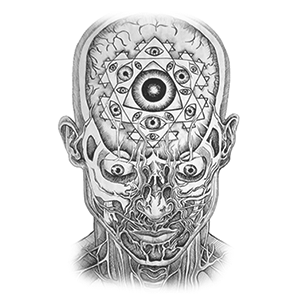
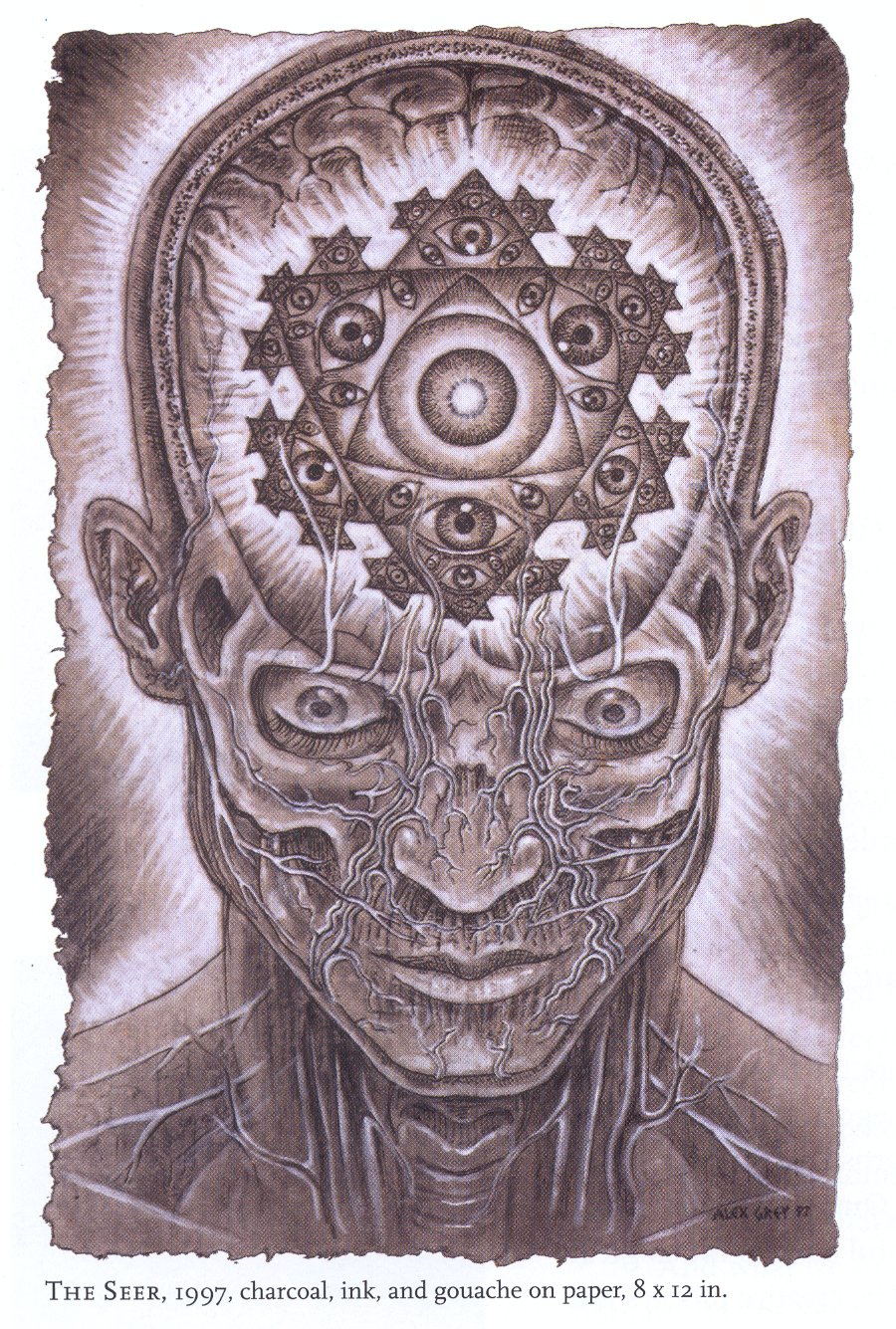
Alex Grey (b. 1953) is an American artist specializing in spiritual and psychedelic art (or visionary art) that is sometimes associated with the New Age movement. Grey is a Vajrayana practitioner, one the three main sects of Buddhism. His body of work spans a variety of forms including performance art, process art, installation art, sculpture, and painting. He and his wife Allyson Grey are the co-founders of the Chapel of Sacred Mirrors, a non-profit institution supporting Visionary Culture in New York City.
Grey’s paintings can be described as a blend of sacred, visionary art and postmodern art. He is best known for his paintings of glowing anatomical human bodies, images that ‘x-ray’ the multiple layers of reality. His art is a complex integration of body, mind, and spirit. ‘The Sacred Mirrors,’ a life-sized series of 21 paintings, took 10 years to complete, and examines in detail the physical and metaphysical anatomy of the individual.
read more »
Posted in Art, Philosophy, Science |
1 Comment »
June 1, 2011
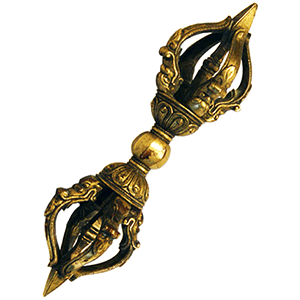
Vajra [vuhj-ruh] is a Sanskrit word meaning both thunderbolt and diamond. It is a short metal weapon – originally a kind of fist-iron like Japanese yawara – that has the symbolic nature of a diamond (it can cut any substance but not be cut itself) and that of the thunderbolt (irresistible force). The vajra is believed to represent firmness of spirit and spiritual power. It is a ritual tool or spiritual implement which is symbolically used by Buddhism, Jainism and Hinduism, all of which are traditions of Dharma. In Buddhism the vajra is the symbol of Vajrayana, one of the three major branches of Buddhism. Vajrayana is translated as ‘Thunderbolt Way’ or ‘Diamond Way’ and can imply the thunderbolt experience of Buddhist enlightenment or bodhi. It also implies indestructibility, just as diamonds are harder than other gemstones.
The vajra is made up of several parts. In the center is a sphere which represents Sunyata, the primordial nature of the universe, the underlying unity of all things. Emerging from the sphere are two eight petaled lotus flowers. One represents the phenomenal world (or in Buddhist terms Samsara), the other represents the noumenal world (or Nirvana). This is one of the fundamental dichotomies which are perceived by the unenlightened. Arranged equally around the mouth of the lotus are two, four, or eight mythical creatures which are called makaras. These are mythological half-fish, half-crocodile creatures made up of two or more animals, often representing the union of opposites, (or a harmonisation of qualities that transcend our usual experience). From the mouths of the makaras come tongues which come together in a point.
Posted in Philosophy, War |
Leave a Comment »
May 20, 2011

Wear Sunscreen is the common name of an essay titled ‘Advice, like youth, probably just wasted on the young’ written by Chicago Tribune columnist Mary Schmich, and published in 1997, but often erroneously attributed to a commencement speech by author Kurt Vonnegut.
Both its subject and tone are similar to the 1927 poem ‘Desiderata.’ The most popular and well-known form of the essay is the music single ‘Everybody’s Free (To Wear Sunscreen),’ released in 1998, by Baz Luhrmann.
Posted in Education, Humor, Philosophy |
Leave a Comment »
May 20, 2011

Desiderata [dih-sid-uh-rey-tuh] (Latin: ‘desired things’) is a 1927 poem by American writer Max Ehrmann (1872-1945).
The text was largely unknown in the author’s lifetime and became widely known after its use in a devotional in 1959 by a church in Baltimore. When Adlai Stevenson died in 1965, a guest in his home found the Desiderata near his bedside and discovered that Stevenson had planned to use it in his Christmas cards.
read more »
Posted in Art, Language, Philosophy |
Leave a Comment »




 The Daily Omnivore