February 22, 2011

The Patriot Guard Riders (PGR) is a motorcycle club whose members attend the funerals of members of the United States armed forces at the invitation of the deceased’s family. The group was formed in 2005, to shelter and protect funerals from protesters from the Westboro Baptist Church, who claim that the deaths of American troops in Iraq and Afghanistan are divine retribution for American tolerance of homosexuality. PGR members position themselves to physically shield the mourners from the presence of the Westboro protesters by blocking the protesters from view with their motorcade, or by having members hold American flags. The group also drowns out the protesters’ chants by singing patriotic songs or by revving motorcycle engines.
Although initially founded by motorcyclists, the organization is open to anyone, regardless of political affiliation, veteran status, or whether they ride or not. The Patriot Guard was established in Mulvane, Kansas at American Legion Post 136 in 2005. The group’s mission quickly expanded to include the funerals of law enforcement officers, fire department personnel, all first responders, and any active duty member or veteran of the U.S. Armed Forces from all previous wars and conflicts and is now largely focused on recognizing and honoring the sacrifices of fallen servicemembers as well as their families and loved ones.
Posted in Philosophy, Politics, War |
Leave a Comment »
February 21, 2011

The Dharmacakra (Sanskrit for ‘Wheel of Law’) is a symbol that has represented dharma, the Buddha’s teaching of the path to enlightenment, since the early period of Indian Buddhism. The symbol is represented as a chariot wheel with eight or more spokes.
Posted in Philosophy |
Leave a Comment »
February 17, 2011

Dualism is the idea or theory that something (an object, an idea or the whole world) is split into two parts. These parts are separate from each other and the thing cannot be divided up into any other way. The idea or theory that something cannot be split into any parts is called monism. The idea that something can be split into many parts is called pluralism.
read more »
Posted in Language, Philosophy |
Leave a Comment »
February 17, 2011

Heraclitus [her-uh-klahy-tuhs] (535 – 475 BCE) was a pre-Socratic Greek philosopher, a native of the Greek city Ephesus, Ionia, on the what is now the Turkish coast of the Aegean Sea. He was of distinguished parentage. Little is known about his early life and education, but he regarded himself as self-taught and a pioneer of wisdom. From the lonely life he led, and still more from the riddling nature of his philosophy and his contempt for humankind in general, he was called ‘The Obscure,’ and the ‘Weeping Philosopher.’
Heraclitus is famous for his doctrine of change being central to the universe, as stated in his famous saying, ‘You cannot step twice into the same stream.’ He believed in the unity of opposites, stating that ‘the path up and down are one and the same,’ existing things being characterized by pairs of contrary properties, and other explorations of the concept of dualism.
Posted in Philosophy |
Leave a Comment »
February 14, 2011
Jaron Lanier [lah-neer] (b. 1960) is an American computer scientist and artist. In the early 1980s he popularized the term ‘Virtual Reality’ (VR) for a field in which he was a pioneer. At that time, he founded VPL Research, the first company to sell VR products. His current appointments include Interdisciplinary Scholar-in-Residence, CET, UC Berkeley. In what is probably his most famous paper ‘One-Half of a Manifesto’ (Wired, 2000) Lanier opposes the prospect of so called ‘cybernetic totalism,’ which is ‘a cataclysm brought on when computers become ultra-intelligent masters of matter and life.’
Lanier’s position is that humans may not be considered to be biological computers, i.e., they may not be compared to digital computers in any proper sense, and it is very unlikely that humans could be generally replaced by computers easily in few decades, even economically. While processor performance increases according to Moore’s law, overall performance rises only very slowly. This is because our productivity in developing software increases only slightly, and software becomes more bloated and remains as error-prone as it ever was. He warns that the biggest problem of any theory is not that it is false, ‘but when it claims to be the sole and utterly complete path to understanding life and reality.’
Posted in Philosophy, Politics, Technology |
Leave a Comment »
February 13, 2011
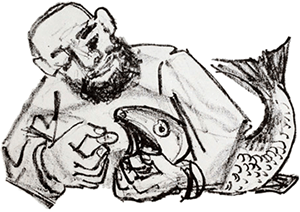

Coin in the fish’s mouth is one of the miracles of Jesus in the Gospels of Matthew. According to the Gospel, after Jesus and his disciples arrived in Capernaum, the collectors of the two-drachma temple tax came to Apostle Peter and asked, ‘Doesn’t your teacher pay the temple tax?’ And Peter replied: ‘Yes, he does.’ When Peter came into the house, Jesus was the first to speak and said: ‘What do you think, Simon?’ he asked. ‘From whom do the kings of the earth collect duty and taxes—from their own children or from others?’ ‘From others,’ Peter answered. ‘Then the children are exempt,’ Jesus said to him.
Then Jesus said: ‘But so that we may not cause offense, go to the lake and throw out your line. Take the first fish you catch; open its mouth and you will find a four-drachma coin. Take it and give it to them for my tax and yours’ The Bible does not name the fish, but Tilapia is sometimes referred to as St. Peter’s fish.
Posted in Philosophy |
Leave a Comment »
February 10, 2011


The Buddha Machine is a small musical loop player released by FM3, a China-based music duo. The name and idea derived from a popular Chinese music player that intones repeating loops of Buddhist chanting. The Buddha Machine continuously plays one of 9 ambient sound loops (drones) that range in length from 5 to 40 seconds. Resembling a small transistor radio, the device has a volume control that doubles as an on/off switch; a headphone jack; a 4.5V AC adapter jack; and a switch that, when moved, selects the next of 9 ambient loops. In 2008, the second edition (version 2.0) was released commercially; it replaces the original nine loops with nine new ones (totaling approximately 300 seconds of sound), and includes a new control that allows the user to alter the pitch of the sound.
In 2009, FM3 Productions Ltd released an iPhone app that has similar functionality to the real device. It has the option to select from version 1.0 or version 2.0 of the device and a single button that selects the loop to play. Also that year, Throbbing Gristle & Industrial Records released their version of the Buddha Machine, ‘Gristleism,’ with more loops and almost twice the frequency range of the Buddha Machine. In 2010, FM3 released the third generation Buddha Machine, titled Chan Fang. The music is divided into four loops which were composed and performed on the Gu Qin, an ancient Chinese classical instrument.
Posted in Art, Philosophy, Technology |
Leave a Comment »
February 10, 2011
FM-2030 (1930 – 2000) was a transhumanist author, born Fereidoun M. Esfandiary in Brussels to an Iranian diplomat. He became notable in 1989 with the book ‘Are You a Transhuman?: Monitoring and Stimulating Your Personal Rate of Growth in a Rapidly Changing World.’ He also wrote a number of works of fiction under his original name. He changed his name to FM-2030 to reflect the hope and belief that he would live to celebrate his 100th birthday in 2030, and more importantly, to break free of the widespread practice of naming conventions that he saw as rooted in a collectivist mentality, and existing only as a relic of humankind’s tribalistic past. He viewed traditional names as almost always stamping a label of collective identity – varying from gender, to nationality – on the individual.
Many of FM-2030’s predictions about social trends from the 1970s through the early 21st century proved remarkably prescient. He argued that the inherent dynamic of the modern globalizing civilization would bring such changes about despite the best efforts of conservative elites to enforce traditional beliefs. He predicted in vitro fertilization and correcting genetic flaws in 1977; in 1980, he predicted teleconferencing, telemedicine, and teleshopping. He taught at The New School, UCLA, and Florida International University. He worked as a corporate consultant for Lockheed and J.C. Penney. He was a lifelong vegetarian and said he would not eat anything that had a mother. He died from pancreatic cancer and was placed in cryonic suspension at the Alcor Life Extension Foundation in Arizona, where his body remains today.
Posted in Art, Philosophy, Technology |
Leave a Comment »
February 10, 2011

Flipism is a pseudophilosophy under which all decisions are made by flipping a coin. It originally appeared in the Disney comic ‘Flip Decision’ by Carl Barks, published in 1953. Barks called a practitioner of ‘Flipism’ a ‘Flippist.’ In the comic book, Donald Duck meets Professor Batty, who persuades Donald to make decisions based on flipping a coin at every crossroad of life. Donald soon gets into trouble when following this advice. He drives a one way road in the wrong direction and is fined $50.
Posted in Humor, Philosophy |
Leave a Comment »
February 10, 2011

Cat burning was a form of zoosadistic entertainment in 17th century Paris, France. People would gather dozens of cats in a net and hoist them high into the air from a special bundle onto a bonfire. Those assembled shrieked with laughter as the animals, howling with pain, were singed, roasted, and finally carbonized.
The people collected the embers and ashes of the fire and took them home, believing that they brought good luck. The French kings often witnessed these spectacles and even lit the bonfire with their own hands. In the medieval and early modern periods, cats, which were associated with vanity and witchcraft, were sometimes burned as symbols of the Devil.
Posted in Death, Philosophy, World |
1 Comment »
February 10, 2011
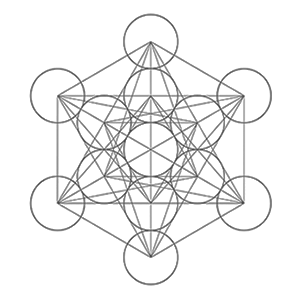
Sacred geometry ascribes symbolic and sacred meanings to certain geometric shapes and certain geometric proportions. It is associated with the belief that a god is the geometer (geometry mathematician) of the world. The geometry used in the design and construction of religious structures such as churches, temples, mosques, religious monuments, altars, and tabernacles has sometimes been considered sacred. The concept applies also to sacred spaces such as temenoi, sacred groves, village greens, and holy wells, and the creation of religious art.
The belief that a god created the universe according to a geometric plan has ancient origins. Plutarch attributed the belief to Plato, writing that ‘Plato said God geometrizes continually’ In modern times, the mathematician Carl Friedrich Gauss adapted this quote, saying ‘God arithmetizes.’ As late as Johannes Kepler (1571–1630), a belief in the geometric underpinnings of the cosmos persisted among some scientists.
read more »
Posted in Art, Philosophy, Technology |
Leave a Comment »
February 8, 2011
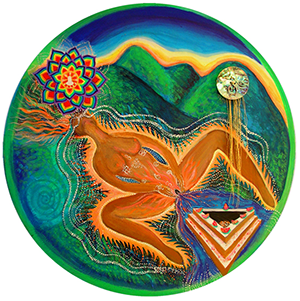
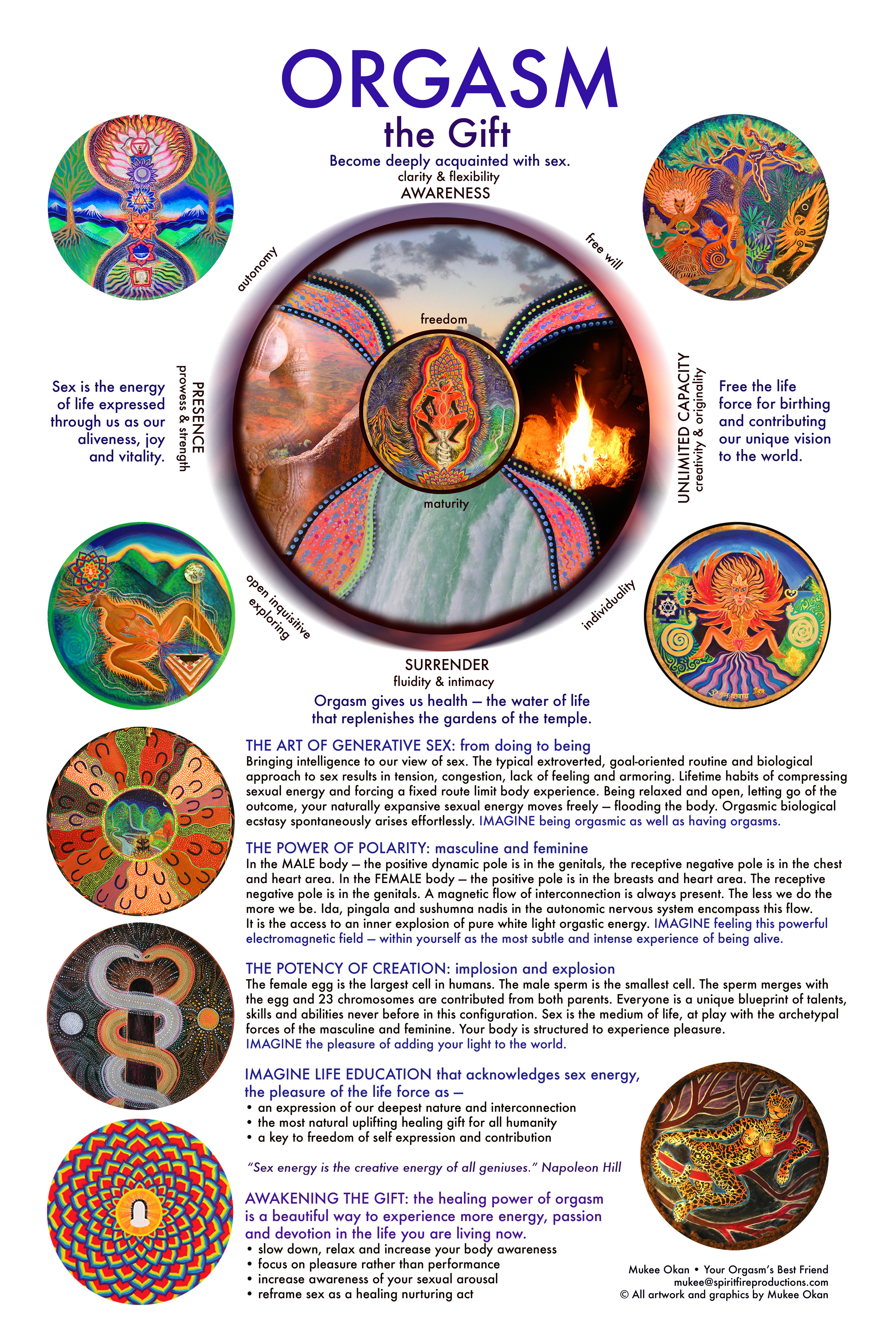
Neotantra is a term used to describe the modern, western use of the word Tantra (one of the later Hindu or Buddhist scriptures dealing especially with techniques and rituals including meditative and sexual practices). Neotantra refers to both the New Age and modern Western interpretations of traditional Indian tantra. Some of its proponents refer to ancient and traditional texts and principles, and many others use tantra as a catch-all phrase for ‘sacred sexuality,’ and may incorporate unorthodox practices. In addition, not all of the elements of Indian tantra are used in neotantric practices, in particular the reliance on a guru, or teacher.
Posted in Language, Philosophy, Sex |
Leave a Comment »




 The Daily Omnivore