January 18, 2011

Salvation Mountain is a colorful art installation covering much of a small hill north of Calipatria, California, near Slab City (an RV camp) and just several miles from the Salton Sea. It is made from adobe, straw, and thousands of gallons of paint. It was created by Leonard Knight to convey the message ‘God Is Love.’ Steps cut into the side of the hill lead to the summit, which is topped by a cross. Salvation Mountain also features many large straw bale and adobe walls supported by a matrix of logs enclosing several cave-like spaces. Knight lives full-time at the site in a small cabin mounted on the rear of a 1930s Chevrolet.
Like Salvation Mountain, Knight’s ‘Salvation Truck’ and a collection of other vehicles and machinery are entirely covered with paint and Biblical quotes. He estimates that more than 100,000 gallons of paint have gone into the creation of the mountain and that every California-based paint manufacturer has donated paint to the project. Once labeled an environmental hazard, the hill was threatened with removal by Imperial County. In recent years, the furor has died down. Although the project is unauthorized and on state land, Salvation Mountain was placed under protection in 2002 when Senator Barbara Boxer entered it into the Congressional Record as a national treasure.
Posted in Art, Philosophy |
Leave a Comment »
January 18, 2011

Sokushinbutsu were Buddhist monks or priests who caused their own deaths in a way that resulted in their mummification. This practice took place almost exclusively in northern Japan around the Yamagata Prefecture. It is believed that many hundreds of monks tried, but only between 16 and 24 such mummifications have been discovered to date. The practice is not advocated or practiced today by any Buddhist sect.
read more »
Posted in Death, Philosophy, World |
Leave a Comment »
January 17, 2011
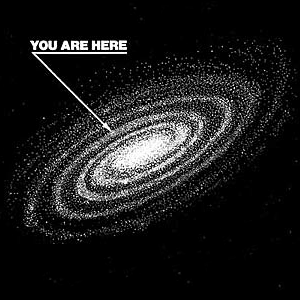
The mediocrity principle is the notion that there is nothing special about humans or the Earth. In a broader context, the mediocrity principle states that: life on Earth depends on just a few basic molecules; the elements that make up these molecules are (to a greater or lesser extent) common to all stars, and the laws of science we know apply to the entire universe (and there is no reason to assume that they do not). Thus, given sufficient time – life must have originated elsewhere in the cosmos.
Posted in Philosophy, Science |
Leave a Comment »
January 17, 2011

Schrödinger’s [shroh-ding-ers] cat is a thought experiment in quantum physics, usually described as a paradox, devised by Austrian physicist Erwin Schrödinger in 1935. In the experiment, a cat is placed in a room that is separated from the outside world; a small amount of a radioactive element is in the room.
Within some time, say one hour, one of the atoms of the radioactive material may decay (because the material unstable), or it may not. If the material breaks down, it will release poisonous gas, which will kill the cat. The question now is: at the end of the hour, is the cat alive or dead?
read more »
Posted in Death, Philosophy, Science |
Leave a Comment »
January 12, 2011

A personality test aims to describe aspects of a person’s character that remain stable throughout their lifetime (patterns of behavior, thoughts, and feelings). The 20th century heralded a new interest in defining and identifying separate personality types, in close correlation with the emergence of the field of psychology. As such, several distinct tests emerged; some attempt to identify specific characteristics, while others attempt to identify personality as a whole. The Myers-Briggs Type Indicator describes categories of functioning where individuals differ, such as introverted or extroverted.
The Strength Deployment Inventory assesses motivation, or purpose, of behavior, rather than the behavior itself. The 5-factor test is popular a tool for career planning, and has been shown to predict job satisfaction and performance. However, it is easy for personality test participants to become complacent about their own personal uniqueness and instead become dependent on the description associated with them. This can be potentially dangerous with persons who are already suffering from a form of identity disorder or may be a catalyst to instigate particular behaviors in a person who was previously believed to be of sound mental health.
Posted in Health, Philosophy, Science |
Leave a Comment »
January 11, 2011


Avram Noam Chomsky (b. 1928) is an American linguist, philosopher, political activist, author, and lecturer. He is a professor emeritus of linguistics at MIT. Chomsky created one of the most important contributions to the field of linguistics made in the 20th century: the theory of generative grammar, a branch of theoretical linguistics that works to provide a set of rules that can accurately predict which combinations of words are able to make grammatically correct sentences. In the 1950’s he helped start the cognitive revolution in psychology through his review of B. F. Skinner’s work.
He challenged the behaviorist way of looking at behavior and language. His natural approach to the study of language also changed the philosophy of language and mind. He invented the Chomsky hierarchy, a way of looking at formal languages in terms of their power to explain language. In the 1960s he criticized the Vietnam War. Because of that, Chomsky became more widely known for his media criticism and politics. He is a key intellectual figure within the left wing of United States politics.
Posted in Language, Philosophy, Politics |
Leave a Comment »
January 11, 2011

The Iron Ring is a ring worn by many engineers in Canada as a symbol and reminder of the obligations and ethics associated with the profession. Obtaining the ring is an optional endeavour, as it is not a prerequisite to becoming a Professional Engineer. The ring is given in a ceremony known as The Ritual of the Calling of an Engineer, administered by a body called The Corporation of the Seven Wardens. The first set of rings were conferred at the University of Toronto in 1925.
read more »
Posted in Philosophy, Technology |
Leave a Comment »
January 4, 2011

The Skoptsy [skopt-see] were a secret sect in imperial Russia best known for practicing castration of men and the mastectomy of women in accordance with their teachings against sexual lust. They were persecuted by the imperial government and later by the Soviet Union, but enjoyed substantial growth before fading into obscurity by the mid-twentieth century. The name ‘Skoptsy’ is a plural of ‘skopets,’ an archaic word meaning ‘castrated one’ in the Russian language.
As their title indicates, the main feature of the sect was castration. They believed that after the expulsion from the Garden of Eden, Adam and Eve had the halves of the forbidden fruit grafted onto their bodies forming testicles and breasts. Thus, the removal of these sexual organs restored the Skoptsy to the pristine state before the Original Sin. Men who had underwent the ‘greater seal’ (removal of the penis and testicles) used a cow-horn when urinating.
Posted in Philosophy, Sex, World |
Leave a Comment »
January 3, 2011

A smudge stick is a bundle of dried herbs (commonly white sage) that releases a pleasant aroma when burnt; it is used in Native American shamanic traditions. Using scent and scented smoke in rites of purification, whether through smudging (the process of using a smudge stick) or burning incense, is common in many traditional cultures around the world.
Smudging in the modern era has been incorporated into many belief systems, including new age spirituality. Smudging rituals are regarded by their practitioners as psychologically and spiritually cleansing, and as a means to ‘clear negative energy.’ Participants can smudge themselves or others by fanning smoke in the appropriate direction, often with other ritual tools such as a bundle of feathers.
Posted in Philosophy |
Leave a Comment »
January 1, 2011

Free Beer, formerly known as ‘Our Beer,’ is the first brand of Danish beer with a ‘free’ recipe – free as in ‘freedom,’ taken after the term ‘free software.’ The name ‘Free Bee’ is a play on Richard Stallman’s common explanation that free software is ‘free as in speech, not free as in beer.’ The recipe is published under a Creative Commons license, specifically the Attribution-ShareAlike license. The beer was created by students at the IT-University in Copenhagen together with Superflex, a Copenhagen-based artist collective, to illustrate how concepts of the free software movement might be applied outside the digital world.
Initially, much of the homebrewing community spoke out against the quality and comprehensiveness of the recipe. Making reference to the technical problems of when software instructions (‘source code’) cannot be made into a functioning program, several people commented that if the recipe were source code, it would not compile (a compiler is a program that takes ‘source code’ from a high-level language and changes it to a target language, mostly machine code, the lowest level language). Since then the recipe went through several iterations and has now reached version 4.0, which corrects most of the early mistakes. The quality of the beer also improved, and the amount of sugar in it decreased by 90%.
Posted in Drugs, Food, Philosophy |
Leave a Comment »
December 19, 2010


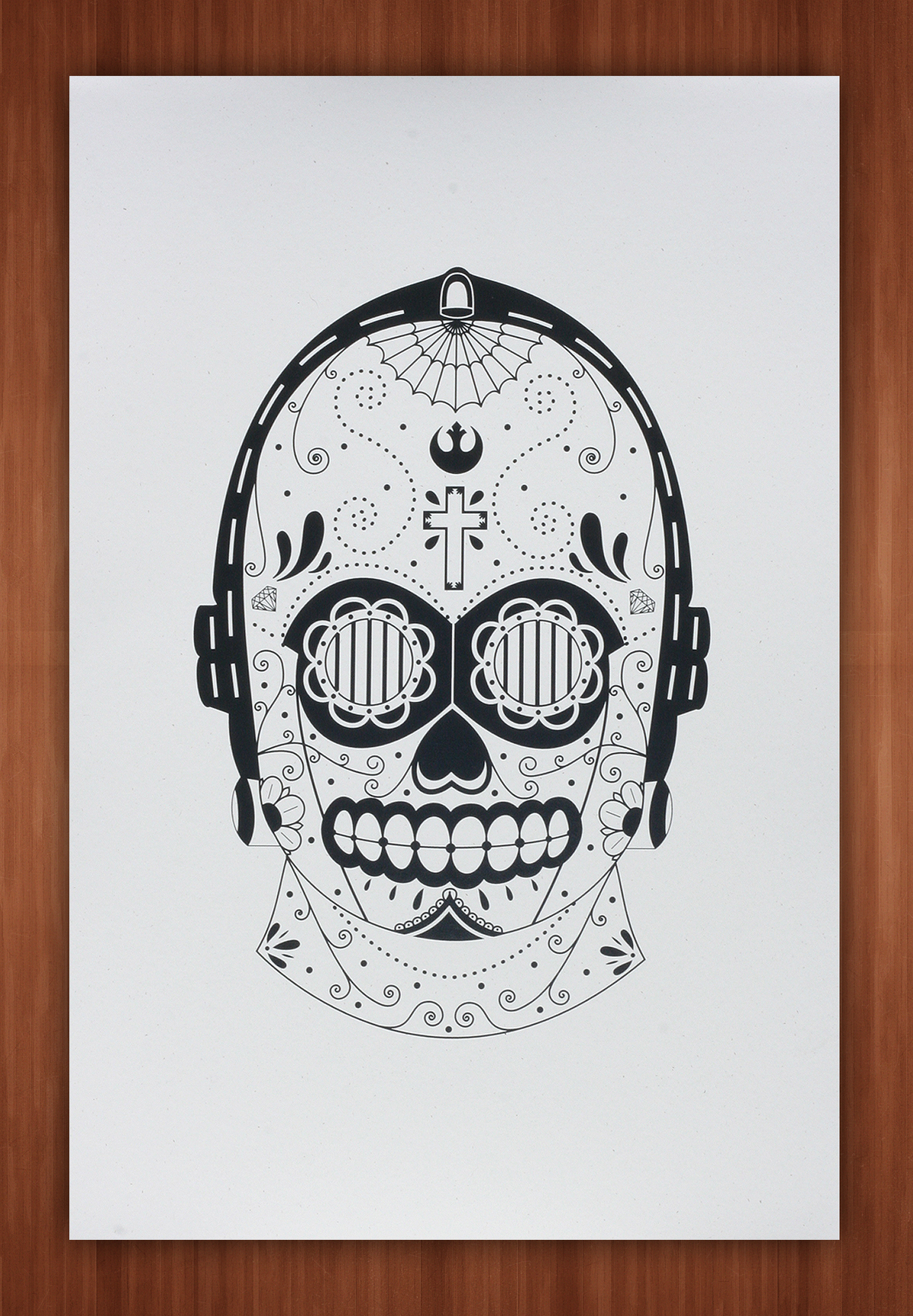
The word calavera, Spanish for ‘skull,’ can refer to a number of cultural phenomena associated with the Mexican celebration of the Day of the Dead and the Roman Catholic holiday All Souls Day. Calaveras de azúcar (‘sugar skulls’) are used to adorn altars and can be eaten. Calaveras are poems, written for the Day of the Dead but intended to humorously criticize the living. Calavera can refer to any artistic representations of skulls, such as the lithographs of José Guadalupe Posada.
Posted in Art, Death, Philosophy |
Leave a Comment »
December 15, 2010
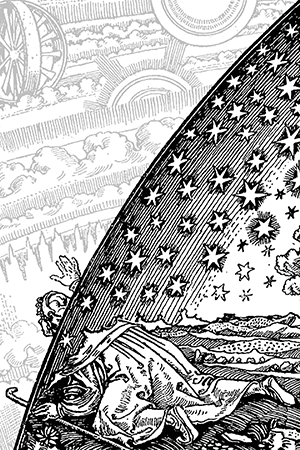
The Flammarion [fla-ma-ryawn] woodcut is an anonymous wood engraving (once believed to be a woodcut), so named because its first documented appearance is in Camille Flammarion’s 1888 book L’atmosphère: météorologie populaire (‘The Atmosphere: Popular Meteorology’).
The engraving depicts a man, dressed as a mediaeval pilgrim and carrying a pilgrim’s staff, who peers through the sky as if it were a curtain to look at the hidden workings of the universe. One of the elements of the cosmic machinery bears a strong resemblance to traditional pictorial representations of the ‘wheel in the middle of a wheel’ (Merkabah).
Posted in Art, Philosophy |
Leave a Comment »





 The Daily Omnivore