November 16, 2010
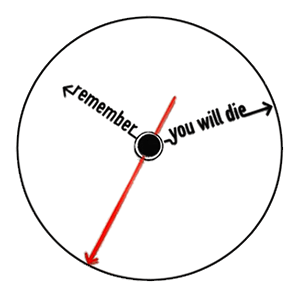
Memento mori is a Latin phrase translated as ‘Remember your mortality’ or “remember you will die’ – (literally: ‘[in the future] remember to die’). It names a genre of artistic creations that vary widely from one another, but which all share the same purpose: to remind people of their own mortality. The phrase has a tradition in art that dates back to antiquity. In ancient Rome, the words are believed to have been used on the occasions when a Roman general was parading through the streets during a victory triumph. Standing behind the victorious general was his slave, who was tasked to remind the general that, though his highness was at his peak today, tomorrow he could fall.
The thought came into its own with Christianity, whose strong emphasis on Divine Judgment, Heaven, Hell, and the salvation of the soul brought death to the forefront of consciousness. Most memento mori works are products of Christian art, although there are equivalents in Buddhist art.
Posted in Art, Death, Philosophy |
Leave a Comment »
November 16, 2010

Principia Discordia is a Discordian religious text written by Greg Hill (Malaclypse The Younger) and Kerry Thornley (Omar Khayyam Ravenhurst). It was originally published under the title ‘Principia Discordia or How The West Was Lost’ in a limited edition of 5 copies in 1965. Discordianism is a religion centered on the idea that chaos is all that there is, and that disorder and order are both illusions that are imposed on chaos. There is some division as to whether it should be regarded as a parody religion, and if so to what degree.
It has been called ‘Zen for roundeyes,’ based on similarities with absurdist interpretations of the Rinzai school of Buddhism. Discordianism recognizes chaos, discord, and dissent as valid and desirable qualities, in contrast with most religions, which idealize harmony and order. While the Principia is full of literal contradictions and unusual humor, it contains several passages which propose that there is serious intent behind the work. Saints identified include Emperor Norton, Yossarian, Don Quixote, and Bokonon.
Posted in Humor, Language, Philosophy |
1 Comment »
November 16, 2010


Fnord is the typographic representation of disinformation or irrelevant information intending to misdirect, with the implication of a worldwide conspiracy. The word was coined as a nonsensical term with religious undertones in the Discordian religious text Principia Discordia (1965) by Kerry Thornley and Greg Hill, but was popularized by The Illuminatus! Trilogy (1975) of satirical conspiracy fiction novels by Robert Shea and Robert Anton Wilson.
read more »
Posted in Humor, Language, Philosophy |
Leave a Comment »
November 10, 2010

Meta (from Greek: ‘after,’ ‘beyond,’ ‘with,’ ‘adjacent,’ ‘self’), is a prefix used in English to indicate a concept which is an abstraction from another concept, used to complete or add to the latter. In epistemology, the prefix meta is used to mean about (its own category). For example, metadata are data about data (who has produced them, when, what format the data are in and so on). Similarly, metamemory in psychology means an individual’s knowledge about whether or not they would remember something if they concentrated on recalling it.
Another, slightly different interpretation of this term is ‘about’ but not ‘on’ (exactly its own category). For example, in linguistics a grammar is considered as being expressed in a metalanguage, or a sort of language for describing another language (and not itself). In Greek, the prefix meta- is generally less esoteric than in English; Greek meta- is equivalent to the Latin words post- or ad-. The use of the prefix in this sense occurs occasionally in scientific English terms derived from Greek. For example: the term Metatheria (the name for the clade of marsupial mammals) uses the prefix meta- merely in the sense that the Metatheria occur on the tree of life adjacent to the Theria (the placental mammals).
Posted in Language, Philosophy |
Leave a Comment »
November 9, 2010
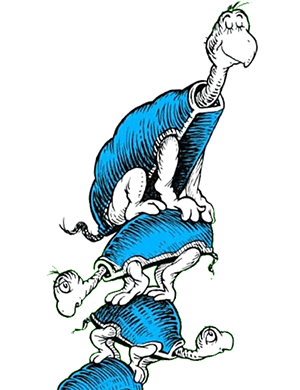
‘Turtles all the way down‘ is a jocular expression of the infinite regress problem in cosmology. The joke goes as follows: An Eastern guru affirms that the earth is supported on the back of a tiger. When asked what supports the tiger, he says it stands upon an elephant; and when asked what supports the elephant he says it is a giant turtle. When asked, finally, what supports the giant turtle, he is briefly taken aback, but quickly replies ‘Ah, after that it is turtles all the way down.’
The phrase was popularized by Stephen Hawking in 1988. The ‘turtle’ metaphor in the anecdote represents a popular notion of a primitive cosmological myth, viz. the flat earth supported on the back of a World Turtle.
Posted in Humor, Philosophy |
Leave a Comment »
November 8, 2010

Jainism [jahy-niz-uhm] is an Indian religion that prescribes a path of non-violence towards all living beings. Its philosophy and practice emphasize the necessity of self-effort to move the soul towards divine consciousness and liberation. Any soul that has conquered its own inner enemies and achieved the state of supreme being is called Jina (Conqueror or Victor). Jainism, which its followers consider to have always existed, has prehistoric origins dating before 3000 BC, and before the beginning of Indo-Aryan culture. Organized Jainism is believed by historians to have arisen between the ninth and the sixth centuries BCE. Some have speculated that the religion may have its roots in much earlier times, reflecting native spirituality prior to the Indo-Aryan migration into India.
In the modern world, it is a small but influential religious minority with as many as 4.2 million followers in India, and successful growing immigrant communities in North America, Western Europe, the Far East, Australia and elsewhere. Jains have successfully sustained this longstanding religion to the present day and have significantly influenced and contributed to ethical, political and economic spheres in India. Jains have an ancient tradition of scholarship and have the highest degree of literacy in India; Jain libraries are the oldest in the country.
Posted in Philosophy, World |
Leave a Comment »
November 8, 2010

Bokononism is a fictional religion practiced by many of the characters in Kurt Vonnegut’s novel ‘Cat’s Cradle.’ It is based on the concept of ‘foma,’ which are defined as harmless untruths. The primary tenet of Bokononism is to ‘Live by the foma that make you brave and kind and healthy and happy.’
Many of the sacred texts of Bokononism were written in the form of calypsos. The foundation of Bokononism is that all religion, including Bokononism and all its texts, is formed entirely of lies; however, one who believes and adheres to these lies will at least have peace of mind, and perhaps live a good life.
read more »
Posted in Humor, Language, Philosophy |
Leave a Comment »
November 7, 2010

Secular Humanism is a philosophy that espouses reason, ethics, and the search for human fulfillment, and specifically rejects supernatural and religious dogma as the basis of morality and decision-making. Secular Humanism is a life stance that focuses on the way human beings can lead happy and functional lives. The term was coined in the 20th century by British worker’s rights advocate George Holyoake.
Fundamental to the concept is the strongly held belief that ideology—be it religious or political—must be examined by each individual and not simply accepted or rejected on faith. Along with this belief, an essential part of Secular Humanism is a continually adapting search for truth, primarily through science and philosophy. The humanist stance emphasises the unique responsibility facing humanity and the ethical consequences of human decisions.
Posted in Language, Philosophy, Politics |
Leave a Comment »
November 5, 2010

The problem of other minds is an epistemological challenge raised by skeptics. It is often expressed as follows: given that I can only observe the behavior of others, how can I know that others have minds? The thought behind the question is that no matter how sophisticated someone’s behavior is, behavior on its own is not sufficient to guarantee the presence of mentality. It remains possible, for example, that other people are actually nothing more than meaty automata (or ‘Philosophical zombies’).
Bertrand Russel argued to the contrary that the idea was a logical fallacy, specifically, argument from analogy: ‘where we take two things which are similar in some observed ways and infer from this similarity that they are similar in other unobserved ways. If the observed similarity is not relevant to the posited unobserved similarity then this is a form of fallacy.’
Posted in Philosophy |
Leave a Comment »
November 4, 2010

The Cremaster Cycle is an art project consisting of five feature length films, together with related sculptures, photographs, drawings, and artist’s books; it is the best-known work of American visual artist and filmmaker Matthew Barney.
The films were made over a period of eight years (1994–2002) and culminated in a major museum exhibition organized by Nancy Spector of the Solomon R. Guggenheim Museum in New York City, which traveled to the Museum Ludwig in Cologne and the Musée d’art Moderne in Paris from 2002-03. Barney’s longtime collaborator Jonathan Bepler composed and arranged the soundtracks for the films.
read more »
Posted in Art, Philosophy, Sex |
Leave a Comment »
November 4, 2010
The Qatsi trilogy is the informal name given to a series of three films produced by Godfrey Reggio and scored by Philip Glass: Koyaanisqatsi: Life out of balance (1983), Powaqqatsi: Life in transformation (1988), and Naqoyqatsi: Life as war (2002). The titles of all three films are words from the language of the Hopi people; ‘qatsi’ means life. See Also: Baraka (1992) – an experimental documentary film directed by Ron Fricke, cinematographer on Koyaanisqatsi, and Chronos (1985) – an experimental film about the passage of time on different scales, also by Fricke.
Posted in Art, Philosophy, World |
1 Comment »
November 2, 2010

Pantheism [pan-thee-iz-uhm] is the view that the Universe (Nature) and God are identical. Pantheists thus do not believe in a personal, anthropomorphic or creator god. Although there are divergences within Pantheism, the central ideas found in almost all versions are the Cosmos as an all-encompassing unity and the sacredness of Nature.
The term ‘pantheist’ — from which the word ‘Pantheism’ was derived — was purportedly first used in English by Irish writer John Toland in his 1705 work, ‘Socinianism Truly Stated, by a pantheist.’ However, many earlier writers, schools of philosophy, and religious movements expressed pantheistic ideas such as Heraclitus and Anaximander, and the early Taoism of Laozi and Zhuangzi is also pantheistic.
Posted in Language, Philosophy |
Leave a Comment »




 The Daily Omnivore