February 21, 2016

In scholastic philosophy, quiddity [kwid-i-tee] was another term for the essence of an object, literally ‘what it is’ or its ‘whatness.’ The term derives from the Latin word ‘quidditas,’ meaning ‘what it was to be (a given thing),’ which was used by the medieval scholastics as a literal translation of the equivalent term in Aristotle’s Greek. It describes properties that a particular substance (e.g. a person) shares with others of its kind. The question ‘what (quid) is it?’ asks for a general description by way of commonality.
Quiddity was often contrasted by the scholastic philosophers with the ‘haecceity’ or ‘thisness’ of an item, which was supposed to be a positive characteristic of an individual that caused them to be this individual, and no other. It is used in this sense in British poet George Herbert’s eponymous poem, ‘Quiddity.’ In law, the term is used to refer to a quibble or academic point. An example can be seen in Hamlet’s graveside speech: ‘Where be his quiddities now, his quillets, his cases, his tenures’ says Hamlet, referring to a lawyer’s quiddities.
Posted in Language, Philosophy |
1 Comment »
February 11, 2016

A Shabbat elevator is an elevator which works in a special mode, operating automatically, a way to circumvent the Jewish law requiring observers to abstain from operating electric switches during the Sabbath. In this mode, an elevator will stop automatically at every floor, allowing people to step in and out without having to press any buttons. They are found in Israeli hospitals, hotels, and apartment buildings, and in some synagogues.
The Israeli Knesset passed a special Shabbat elevator law in 2001 ordering the planning and building of all residential buildings, and public buildings which have more than one elevator, to install a control mechanism for Shabbat (Shabbat module) in one of the elevators. In 2009 senior haredi rabbis, led by Rabbi Yosef Shalom Elyashiv, published a religious injunction forbidding the use of Shabbat elevators on the grounds that even in Shabbat mode the user is indirectly violating Shabbat.
Posted in Philosophy, Technology, World |
Leave a Comment »
February 9, 2016
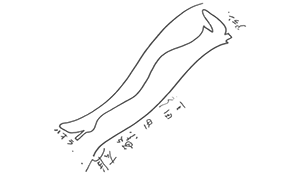

Ma is a Japanese word which can be roughly translated as ‘gap,’ ‘space,’ ‘pause,’ or ‘the space between two structural parts.’ It is best described as a consciousness of place, not in the sense of an enclosed three-dimensional entity, but rather the simultaneous awareness of form and non-form, similar to the concept of ‘negative space’ in graphic design. Ma is not something that is created by compositional elements; it is the thing that takes place in the imagination of the human who experiences these elements. Therefore, ma can be defined as experiential place understood with emphasis on interval.
In his 2001 book ‘The Art of Looking Sideways,’ graphic designer Alan Fletcher discusses the importance of exemplifying ‘space’ as a substance: ‘Cézanne painted and modelled space. Giacometti sculpted by ‘taking the fat off space.’ Mallarmé conceived poems with absences as well as words. Ralph Richardson asserted that acting lay in pauses… Isaac Stern described music as ‘that little bit between each note – silences which give the form’… The Japanese have a word (‘ma’) for this interval which gives shape to the whole. In the West we have neither word nor term. A serious omission.’
Posted in Art, Philosophy, World |
Leave a Comment »
January 18, 2016

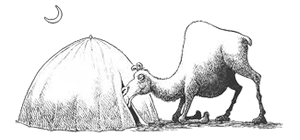
For Want of a Nail is a proverb, having numerous variations over several centuries, reminding that seemingly unimportant acts or omissions can have grave and unforeseen consequences: ‘For want of a nail the shoe was lost. For want of a shoe the horse was lost. For want of a horse the rider was lost. For want of a rider the message was lost. For want of a message the battle was lost. For want of a battle the kingdom was lost. And all for the want of a horseshoe nail.’
The earliest reference to the full proverb may refer to the death of Richard III of England at the Battle of Bosworth Field in 1485. This short variation of the proverb was published in ‘Fifty Famous People’ by James Baldwin. Richard III is unhorsed in the rhyme, but, historically Richard’s horse was merely mired in the mud. The reference to losing a horse is directly linked to the titular character famously shouting ‘A Horse! A Horse! My Kingdom for a Horse!,’ in Shakespeare’s ‘Richard III’ (c. 1591).
read more »
Posted in Language, Philosophy, War |
Leave a Comment »
January 9, 2016
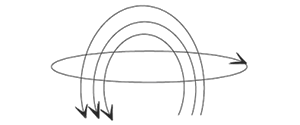

In the psychoanalysis of Sigmund Freud, afterwardsness is a ‘mode of belated understanding or retroactive attribution of [meaning] to earlier events… [from the German word] ‘Nachträglichkeit,’ translated as ‘deferred action, retroaction, après-coup, afterwardsness.’ As summarized by another scholar, ‘In one sense, Freud’s theory of deferred action can be simply stated: memory is reprinted, so to speak, in accordance with later experience.’
Closely related for Freud to deferred action was ‘deferred obedience’: again, ‘a deferred effect…a ‘deferred obedience’ under the influence of repression.’ Thus for instance Freud explored the different phases of a man’s infantile attitude to his father: ‘As long as his father was alive it showed itself in unmitigated rebelliousness and open discord, but immediately after his death it took the form of a neurosis based on abject submission and deferred obedience to him.’ In ‘Totem and Taboo’ he generalized the principle and ‘depicted the social contract also as based on posthumous obedience to the father’s authority’ — offset at times by its converse, occasional Carnival-like licence such as ‘the memorial festival of the totem meal, in which the restrictions of deferred obedience no longer held.’
read more »
Posted in Death, Health, Philosophy |
Leave a Comment »
January 8, 2016

The psychological concept of the uncanny [uhn-kan-ee] was first described by Sigmund Freud in his essay ‘Das Unheimliche’ as something that is strangely familiar, rather than just mysterious. Because the uncanny is familiar, yet incongruous, it has been seen as creating cognitive dissonance within the experiencing subject, due to the paradoxical nature of being simultaneously attracted to yet repulsed by an object.
This cognitive dissonance (discomfort stemming from holding conflicting beliefs) often leads to an outright rejection of the object, as one would rather reject than rationalize, as in the ‘uncanny valley’ effect (people are not as affected in an emotional way by an object if it is easy to tell it is not human, but after a certain point, they start to feel emotionally about it, but feel bad emotions because it is so nonhuman).
read more »
Posted in Health, Philosophy |
Leave a Comment »
January 7, 2016


Tikkun [tee-koon] olam [oh-lahm] (Hebrew: ‘repair of the world,’ alternatively, ‘construction for eternity’) as a concept in Judaism, is a subject of much debate, being interpreted by strict constructionists of Orthodox Judaism as the prospect of the Creator wiping out all forms of idolatry, and being interpreted by modern movements in Judaism as a commandment for created beings to behave and act constructively and beneficially.
Documented use of the term dates back the Mishnaic period (1-4 CE). Subsequently, in medieval times, kabbalistic literature (Jewish mysticism) began broadening use of the term. Modern movements of Judaism have expanded the terms to include ‘the thesis that Jews bear responsibility not only for their own moral, spiritual, and material welfare, but also for the welfare of society at large.’ To the ears of contemporary pluralistic Rabbis, the term connotes ‘the establishment of Godly qualities throughout the world.’
read more »
Posted in Philosophy, World |
1 Comment »
January 6, 2016


Anomalistics [uh-nom-uh-list-iks] is the use of scientific methods to evaluate anomalies (phenomena that fall outside of current understanding), with the aim of finding a rational explanation. The term itself was coined in 1973 by Drew University anthropologist Roger W. Wescott, who defined it as being the ‘serious and systematic study of all phenomena that fail to fit the picture of reality provided for us by common sense or by the established sciences.’
Wescott credited journalist and researcher Charles Fort as being the creator of anomalistics as a field of research, and he named biologist Ivan T. Sanderson and ‘Sourcebook Project’ compiler William R. Corliss as being instrumental in expanding anomalistics to introduce a more conventional perspective into the field. Anomalistics covers several sub-disciplines, including ufology (the study of unidentified flying objects), cryptozoology (the study of hidden animals), and parapsychology (the study of psychic events).
read more »
Posted in Philosophy, Science |
Leave a Comment »
January 5, 2016

In rhetoric, parrhesia [puh-reez-ee-uh] refers to speaking candidly or asking forgiveness for so speaking. Its nominal form, is translated from Latin to ‘free speech.’ The term first appears in Greek literature in the tragic plays of ‘Euripides.’ The term is borrowed from the Greek word meaning ‘to speak everything’ and by extension ‘to speak freely,’ ‘to speak boldly,’ or ‘boldness.’ It implies not only freedom of speech, but the obligation to speak the truth for the common good, even at personal risk.
In Ancient Greece, rhetoric and parrhesia were understood to be in opposition of each other through the dialogues written by Plato. There are two major philosophies during this time one being Sophistry and one being Dialectic. Sophistry is most commonly associated with the uses of rhetoric or means of persuasion to teach or persuade an audience. In its opposition is the practice of dialectic, supported by Plato and his mentor Socrates, which practices using dialogue to break apart complex issues in search of absolute truth or knowledge.
read more »
Posted in Language, Philosophy, Politics |
Leave a Comment »
December 14, 2015
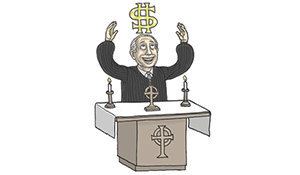

Almighty dollar is an idiom often used to satirize an individual or cultural obsession with material wealth, or with capitalism in general. The phrase implies that money is a kind of deity. Although the phrase was not popularized until the 19th century, similar expression were used much earlier. For example, British writer Ben Jonson wrote in 1616: ‘Whilst that for which all virtue now is sold, And almost every vice, almightie gold.’
The ‘dollar’ version of the phrase is commonly attributed to American writer Washington Irving, who used it in the story ‘The Creole Village,’ which was first published in the 1837 edition of ‘The Magnolia,’ a literary annual: ‘The almighty dollar, that great object of universal devotion throughout our land, seems to have no genuine devotees in these peculiar villages; and unless some of its missionaries penetrate there, and erect banking houses and other pious shrines, there is no knowing how long the inhabitants may remain in their present state of contented poverty.’
Posted in Money, Philosophy |
1 Comment »
November 16, 2015

The Great Disappointment was the reaction that followed Baptist preacher William Miller’s proclamations that Jesus Christ would return to the earth in 1844. Many Millerites had given away all of their possessions and were left bereft when the prophecy proved false. Despite this, the movement wasn’t entirely disbanded, and eventually developed into several other denominations of Christianity, notably the Seventh Day Adventists.
The event is viewed by some scholars as indicative of ‘cognitive dissonance’ (discomfort from holding conflicting views) and ‘true-believer syndrome’ (maintaining a belief in the face of evidence to the contrary). The theory was proposed by social psychologist Leon Festinger to describe the formation of new beliefs and increased proselytizing in order to reduce the tension, or dissonance, that results from failed prophecies. His theory was that believers experienced emotional strain following the failure of Jesus’ reappearance in 1844, which led to a variety of new explanations, some of which outlived the disappointment.
read more »
Posted in Philosophy |
1 Comment »
October 19, 2015


The Third Man factor refers to the reported situations where an unseen presence such as a ‘spirit’ provides comfort or support during traumatic experiences. Polar explorer Sir Ernest Shackleton in his book ‘South,’ described his belief that an incorporeal being joined him and two others during the final leg of their journey. Shackleton wrote, ‘during that long and racking march of thirty-six hours over the unnamed mountains and glaciers of South Georgia, it seemed to me often that we were four, not three.’ His admission resulted in other survivors of extreme hardship coming forward and sharing similar experiences.
In recent years well-known adventurers like climber Reinhold Messner and polar explorers Peter Hillary and Ann Bancroft have reported the experience. One study of cases involving adventurers reported that the largest group involved climbers, followed by solo sailors and shipwreck survivors. Some journalists have related this to the concept of a ‘guardian angel’ or ‘imaginary friend.’ Scientific explanations consider this a coping mechanism. Modern psychologists have used the ‘third man factor’ to treat victims of trauma. The ‘cultivated inner character’ lends imagined support and comfort.
Posted in Philosophy |
Leave a Comment »


 The Daily Omnivore