August 9, 2010
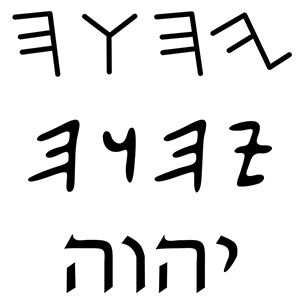
Ineffability [in-ef-fuh-bil-uh-tee] is concerned with ideas that cannot or should not be expressed in spoken words (or language in general), often being in the form of a taboo or incomprehensible term. Illogical statements, principles, reasons, and arguments are intrinsically ineffable along with impossibilities, contradictions, and paradoxes.
Terminology describing the nature of experience cannot be properly conveyed in symbolic language; it is believed that this knowledge is only held by the individual from which it originates. Obscene profanity and vulgarisms, however, can easily (and clearly) be stated – but they simply should not be and so are still considered ineffable.
Posted in Language, Philosophy |
Leave a Comment »
August 9, 2010

The Montessori [mon-tuh-sawr-ee] method is an approach to educating children based on the research of Italian physician and educator Maria Montessori (1870–1952). The focus of the method is on providing the student freedom to manage their own education. The role of the teacher (sometimes called director, directress, or guide) is to watch over the learning environment to remove any obstacles that would interfere with the student’s natural development.
The method is primarily applied with young children (2–6), due to the young child’s unique instincts and sensitivity to conditions in the environment. However, it is sometimes conducted with elementary age (6–12) children and occasionally with infants and toddlers, as well as at the middle and high school level.
Posted in Education, Philosophy |
Leave a Comment »
August 9, 2010

Zen is a school of Mahāyāna Buddhism (the larger of the two major traditions of Buddhism existing today, the other being Theravāda). The Japanese word zen is derived from the Chinese word chán, which in turn is derived from the Sanskrit word dhyāna, which means ‘meditation’ or ‘meditative state.’ Zen aims at enlightenment by direct intuition through meditation.
The emergence of Zen as a distinct school of Buddhism was first documented in China in the 7th century CE. From China, Zen spread south to Vietnam, and east to Korea and Japan. As a matter of tradition, the establishment of Zen is credited to the South Indian prince-turned-monk Bodhidharma, who came to China to teach a ‘special transmission outside scriptures, not founded on words or letters.’
Posted in Philosophy, World |
Leave a Comment »
August 9, 2010
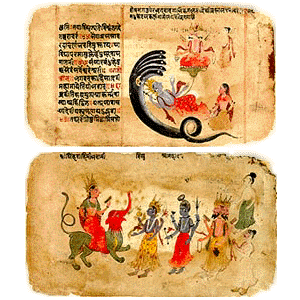
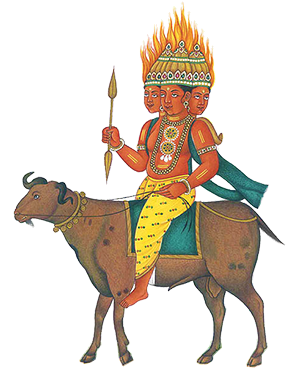
The Vedas [vey-duhs] (Sanskrit for ‘knowledge’) are a large body of texts originating in ancient India, which constitute the oldest Sanskrit literature (1500–1000 BCE) and the oldest scriptures of Hinduism. The texts are aggregated around the four canonical Vedas:.Rig Veda, Sama Veda, Yajur Veda, and Atharva Veda. Together they make up a sacred collection of hymns, incantations, and liturgical rites. The Atharva Veda is less predominant than other Vedas and is little used in solemn ritual. According to Hindu tradition, the Vedas are, ‘not of human agency.’ The individual verses contained in these compilations are known as mantras. Some selected Vedic mantras are still recited at prayers, religious functions and other auspicious occasions in contemporary Hinduism.
The various Indian philosophies and sects have taken differing positions on the Vedas. Schools of Indian philosophy which cite them as their scriptural authority are classified as orthodox. Other traditions, notably Buddhism, Sikhism, and Jainism, which did not regard the Vedas as authorities are referred to by traditional Hindu texts as heterodox schools.
Posted in Language, Philosophy, World |
Leave a Comment »
August 2, 2010

Omphaloskepsis [om-fuh-loh-skep-sis] is the contemplation of one’s navel as an aid to meditation. It can also be used as a pejorative referring to excessive introspection, self-absorption, or concentration on a single issue. This criticism is also often leveled at professions which are interested in themselves (e.g. movies about Hollywood or television shows about television writers). The word has several other forms, such as omphalism used to describe the spiritual practice; omphaloskeptic or omphaloskeptical, for someone who engages in navel-gazing; and omphalocentric meaning to be in a self-absorbed state.
Posted in Language, Philosophy |
Leave a Comment »
August 1, 2010
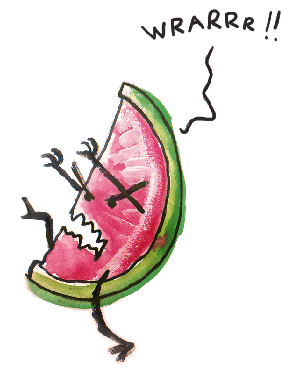
Vampire pumpkins and watermelons are a folk legend from the Balkans. The story is associated with the Roma people of the region, from whom much of traditional vampire folklore originate. The belief in vampire fruit is similar to the belief that any inanimate object left outside during the night of a full moon will become a vampire. According to tradition, watermelons or any kind of pumpkin kept more than ten days or after Christmas will become a vampire, rolling around on the ground and growling to pester the living. People have little fear of the vampire pumpkins and melons because of the creatures’ lack of teeth.
Posted in Food, Humor, Philosophy |
Leave a Comment »
July 17, 2010

A kōan [koh-ahn] is a fundamental part of the history and lore of Zen Buddhism. It consists of a story, dialogue, question, or statement, the meaning of which cannot be understood by rational thinking but may be accessible through intuition. One widely known kōan is ‘what is the sound of one hand clapping.’ The word kōan, the name by which practice is known to the West, comes from the Japanese pronunciation of the Chinese characters.
Posted in Language, Philosophy, World |
Leave a Comment »
July 17, 2010

The evil eye is a look that is superstitiously believed by many cultures to be able to cause injury or bad luck on the person at whom it is directed for reasons of envy or dislike. The idea appears several times in the Old Testament. It was a widely extended belief between many Mediterranean tribes and cultures: Classical Greece probably learned this belief from ancient Egypt, and later passed it to ancient Rome. The hamsa is a palm-shaped amulet popular throughout the Middle East and North Africa as a defense against the evil eye. It is believed to originate in ancient practices associated with the Phoenicians of Carthage.
Posted in Art, Philosophy, World |
Leave a Comment »
July 17, 2010


The Eye of Providence, or the all-seeing eye of God, is a symbol showing an eye often surrounded by rays of light or a glory and usually enclosed by a triangle. It is sometimes interpreted as representing the eye of God watching over humankind. Imagery of an all-seeing eye can be traced back to Egyptian mythology and the Eye of Horus. It also appears in Buddhism, where Buddha is also regularly referred to as the ‘Eye of the World,’ and is represented as a trinity in the shape of a triangle known as the Tiratna, or Triple Gem. In Medieval and Renaissance European iconography, the Eye (often with the addition of an enclosing triangle) was an explicit image of the Christian Trinity.
Posted in Art, Philosophy |
Leave a Comment »
June 29, 2010

A paradox is a true statement that leads to a contradiction or a situation which defies intuition.
Posted in Language, Philosophy |
Leave a Comment »
June 29, 2010

The technological singularity is the theoretical emergence of greater-than-human superintelligence through technological means. Since the capabilities of such intelligence would be difficult for an unaided human mind to comprehend, the occurrence of a technological singularity is seen as an intellectual event horizon, beyond which events cannot be predicted or understood.
Proponents of the singularity typically state that an ‘intelligence explosion,’ where superintelligences design successive generations of increasingly powerful minds, might occur very quickly and might not stop until the agent’s cognitive abilities greatly surpass that of any human. The term was popularized by astrophysicist and science fiction writer Vernor Vinge, who argues that artificial intelligence, human biological enhancement, or brain-computer interfaces could be possible causes of the singularity.
read more »
Posted in Philosophy, Technology |
Leave a Comment »
June 24, 2010

Namahage is a Japanese ritual which is observed throughout Oga Peninsula, Akita Prefecture in northern Honshu, Japan. On New Year’s Eve, a group of young men dressed up as fierce demons or bogeymen, Namahage, visit each house in the village, shouting, ‘any misbehaving kids live here?’ They then scare children in the houses, telling them not to be lazy or cry, though little children often do burst into tears. Then the parents will assure the Namahage that there is no bad child in their house, and give food or traditional Japanese alcoholic beverages to the demons.
Posted in Philosophy, World |
Leave a Comment »


 The Daily Omnivore