December 1, 2019
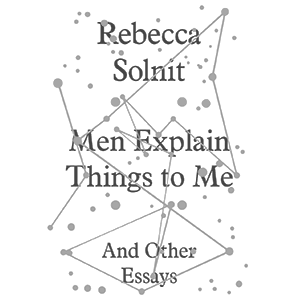
Mansplaining is a pejorative term meaning ‘(of a man) to comment on or explain something to a woman in a condescending, overconfident, and often inaccurate or oversimplified manner.’ Lily Rothman, of ‘The Atlantic,’ defines it as “‘explaining without regard to the fact that the explainee knows more than the explainer, often done by a man to a woman.’
In its original use, mansplaining differed from other forms of condescension in that it is rooted in the assumption that a man is likely to be more knowledgeable than a woman. However, it has come to be used more broadly, often applied when a man takes a condescending tone in an explanation to anyone, regardless of the age or gender of the intended recipients: a ‘man ‘splaining’ can be delivered to any audience.
read more »
Posted in Language, Politics |
Leave a Comment »
November 22, 2019

Luther Blissett is a multiple-use name, an ‘open pop star’ informally adopted and shared by hundreds of artists and activists all over Europe and the Americas since 1994. The pseudonym first appeared in Bologna, Italy, in mid-1994, when a number of cultural activists began using it for staging a series of urban and media pranks and to experiment with new forms of authorship and identity.
From Bologna the multiple-use name spread to other European cities, such as Rome and London, as well as countries such as Germany, Spain, and Slovenia. Sporadic appearances of Luther Blissett have been also noted in Canada, the United States, Finland and Brazil.
read more »
Posted in Art, Humor, Politics |
Leave a Comment »
November 18, 2019

Plausible deniability is the ability of people (typically senior officials in a chain of command) to deny knowledge of or responsibility for any damnable actions committed by others in an organizational hierarchy because of a lack of evidence that can confirm their participation, even if they were personally involved in or at least willfully ignorant of the actions.
In the case that illegal or otherwise disreputable and unpopular activities become public, high-ranking officials may deny any awareness of such acts to insulate themselves and shift blame onto the agents who carried out the acts, as they are confident that their doubters will be unable to prove otherwise.
read more »
Posted in Politics, War, World |
1 Comment »
November 12, 2019
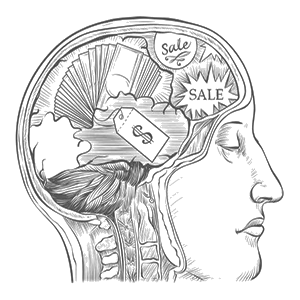
The term homo economicus, or economic man, is the sometimes satirical portrayal of humans as agents who are consistently rational, narrowly self-interested, and who pursue their subjectively-defined ends optimally.
In game theory, homo economicus is often modeled through the assumption of perfect rationality. It assumes that agents always act in a way that maximize utility as a consumer and profit as a producer, and are capable of arbitrarily complex deductions towards that end. They will always be capable of thinking through all possible outcomes and choosing that course of action which will result in the best possible result.
read more »
Posted in Money, Philosophy, Politics |
Leave a Comment »
November 7, 2019

Rationality is the quality or state of being rational, i.e. agreeable to reason. Rationality implies the conformity of a person’s beliefs with their reasons to believe and of their actions with their reasons for action. When a goal or problem requires making a decision, rationality factors in all information that is available (e.g. complete or incomplete knowledge).
It is meaningless to assert rationality without also specifying the background model assumptions describing how the problem is framed and formulated. Rationality is relative: in models that optimize for personal benefit, self-interested or even selfish behavior is rational; in models that favor benefiting the group over the individual, purely selfish behavior is deemed irrational.
read more »
Posted in Money, Philosophy, Politics |
Leave a Comment »
October 16, 2019
False equivalence is a logical fallacy in which two completely opposing arguments appear to be logically equivalent when in fact they are not. This fallacy is categorized as a fallacy of inconsistency.
False equivalence is a common result when an anecdotal similarity is pointed out as equal, but the claim of equivalence doesn’t bear because the similarity is based on oversimplification or ignorance of additional factors. False equivalence arguments are often used in journalism and in politics, where the minor flaws of one candidate may be compared to major flaws of another.
read more »
Posted in Language, Philosophy, Politics |
Leave a Comment »
October 15, 2019
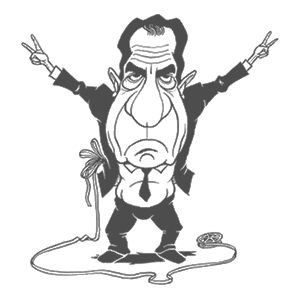
Rose Mary Woods (1917–2005) was Richard Nixon’s secretary from his days in Congress in 1951, through the end of his political career. Before H. R. Haldeman and John Ehrlichman became the operators of Nixon’s presidential campaign, Woods was Nixon’s gatekeeper.
Fiercely loyal to Nixon, Woods claimed responsibility in a 1974 grand jury testimony for inadvertently erasing up to five minutes of the 181⁄2 minute gap in a June 20, 1972, audio tape. Her demonstration of how this might have occurred—which depended upon her stretching to simultaneously press controls several feet apart (what the press dubbed the ‘Rose Mary Stretch’)—was met with considerable ridicule.
read more »
Posted in Politics |
Leave a Comment »
September 24, 2019

The firehose of falsehood is a propaganda technique in which a large number of messages are broadcast rapidly, repetitively, and continuously over multiple channels (such as news and social media) without regard for truth or consistency.
Since 2014, when it was successfully used by Russia during its annexation of Crimea, this model has been adopted by other governments and political movements around the world.
read more »
Posted in Language, Politics, War |
Leave a Comment »
August 29, 2019

QAnon is a far-right conspiracy theory detailing a supposed secret plot by an alleged ‘deep state’ against U.S. President Donald Trump and his supporters. The theory began with an October 2017 post on the anonymous imageboard 4chan by someone using the name Q, a presumably American individual that may have later grown to include multiple people, claiming to have access to classified information involving the Trump administration and its opponents in the United States.
Q has falsely accused numerous liberal Hollywood actors, Democratic politicians, and high-ranking officials of engaging in an international child sex trafficking ring, and has claimed that Donald Trump feigned collusion with Russians in order to enlist Robert Mueller to join him in exposing the ring and preventing a coup d’état by Barack Obama, Hillary Clinton, and George Soros.
read more »
Posted in Health, Politics |
Leave a Comment »
August 2, 2019
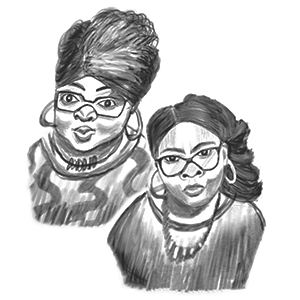
Lynnette Hardaway and Rochelle Richardson, popularly known as Diamond and Silk, are American live-stream video bloggers, social media personalities, political activists and Fox Nation hosts.
They are known for their commentary in support of United States President Donald Trump. Since 2018, Diamond and Silk have traveled the country on their Chit Chat Tour. Hardaway is notably more talkative, while Richardson often just expresses agreement.
read more »
Posted in Money, Politics |
Leave a Comment »
July 21, 2019

Fearless Girl is a bronze sculpture by American sculptor Kristen Visbal, commissioned by State Street Global Advisors (SSGA), a large asset management company. The statue was installed on March 7, 2017, in anticipation of International Women’s Day the following day.
The statue was originally installed in Bowling Green, a park in lower Manhattan, facing down the ‘Charging Bull’ (also known as ‘Wall Street Bull,’ a large bronze statue illegally placed there in 1989 by Sicilian artist Arturo Di Modica), but following complaints from Di Modica, ‘Fearless Girl’ was removed in November 2018 and relocated to a nearby spot across from the New York Stock Exchange. A plaque with footprints was placed on the original site.
read more »
Posted in Art, Money, Politics |
1 Comment »
June 29, 2019

Public art is art in any media that has been planned and executed with the intention of being staged in the physical public domain, usually outside and accessible to all. Public signifies a working practice of site specificity, community involvement and collaboration.
Public art may include any art which is exhibited in a public space including publicly accessible buildings, but the relationship between the content and audience, what the art is saying and to whom, is just as important if not more important than its physical location.
read more »
Posted in Art, Money, Politics |
Leave a Comment »


 The Daily Omnivore