December 10, 2015


Prolefeed is a Newspeak term in the novel ‘Nineteen Eighty-Four’ by George Orwell. It was used to describe the deliberately superficial literature, movies and music that were produced by Prolesec, a section of the Ministry of Truth, to keep the ‘proles’ (i.e., proletariat) content and to prevent them from becoming too knowledgeable. The ruling Party believes that too much knowledge could motivate the proles to rebel against them.
The term is used occasionally to describe shallow entertainment in the real world. For example, Theodore Dalrymple wrote in the ‘The Spectator’ that ‘France …. is less dominated by mass distraction (known here as popular culture, but in ‘Nineteen Eighty-Four’ as prolefeed) than Britain is.’ The term has also been applied to fast food, such as that of McDonald’s: ‘Once seen as the all-American corporation, ‘McDonald’s’ is now shorthand for a globalist mass culture that provides cheap, unhealthy food to lower-class people. McDonald’s is, quite literally, prolefeed. Part of this image was a deliberate choice by the corporation.’
read more »
Posted in Language, Money, Politics |
Leave a Comment »
December 7, 2015
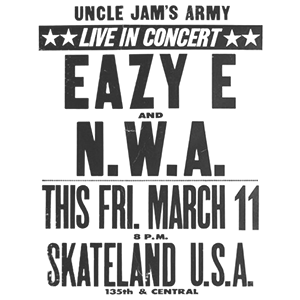
NWA (Niggaz Wit Attitudes) was an American hip hop group from Compton, California. It was one of the earliest and most significant popularizers of the gangsta rap and West Coast hip hop subgenres. Active from 1986 to 1991, the rap group endured controversy owing to their music’s explicit lyrics that many viewed as being disrespectful of women, as well as its glorification of drugs and crime.
The group was subsequently banned from many mainstream American radio stations. In spite of this, the group has sold over 10 million units in the US alone. The group was also known for their deep hatred of the police system, which sparked much controversy over the years. Their debut album ‘Straight Outta Compton’ marked the beginning of the new gangsta rap era as the production and social commentary in their lyrics were revolutionary within the genre.
read more »
Posted in Art, Politics |
Leave a Comment »
November 19, 2015

Afghanistanism is a term, first recorded in the US, for the practice of concentrating on problems in distant parts of the world while ignoring controversial local issues. In other contexts, it has referred to ‘hopelessly arcane and irrelevant scholarship,’ ‘fascination with exotic, faraway lands,’ or ‘railing and shaking your fist at an unseen foe who is quite unaware of your existence, much less your fury.’
The first known citation of the expression was a quote by newspaper editor J. Lloyd Jones in 1948: ‘I don’t wish to belabor this subject of Afghanistanism, this business of taking forthright stands on elections in Costa Rica, while the uncollected local garbage reeks beneath the editor’s window.’
read more »
Posted in Politics, War, World |
1 Comment »
November 17, 2015
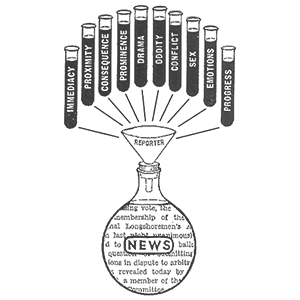
News values, or ‘news criteria,’ determine how much prominence a news story is given by a media outlet, and the attention it garners from its audience. These values are not universal and can vary widely between different cultures. In Western practice, decisions on the selection and prioritization of news are ostensibly made by editors on the basis of their experience and intuition.
However, a seminal analysis by Norwegian sociologists Johan Galtung and Mari Ruge in the ‘Journal of Peace Research’ in 1965 showed that several factors are common, such as familiarity (stories that ‘hit close to home’), negativity (‘if it bleeds, it leads’), and Unexpectedness (‘don’t report on fire in a furnace’). Basing his judgement on many years as a newspaper journalist Tim Hetherington has said that ‘anything which threatens people’s peace, prosperity, and well being is news and likely to make headlines.’
read more »
Posted in Language, Money, Politics |
1 Comment »
November 13, 2015


Political correctness (PC) means using words or behavior which will not offend any group of people. The term arose in the 1970s as a way of encouraging the replacement of bygone phrases such as ‘colored.’ By the 1990s, it had taken on pejorative and mocking overtones, and was described as symptomatic of excessive liberalism and the ‘nanny state.’ The phrase was widely used in the debate about the 1987 book ‘The Closing of the American Mind’ by philosopher Allan Bloom, and gained further currency in response to social commentator Roger Kimball’s ‘Tenured Radicals’ (1990).
Conservative author Dinesh D’Souza’s ‘Illiberal Education’ duology of books (1991, 1992) condemned what he saw as liberal efforts to advance victimization, multiculturalism through language, and affirmative action. Advocates of political correctness, however, argue that libertarians made an issue of the term in order to divert attention from more substantive matters of discrimination and as part of a broader culture war against liberalism. They have also said that the right wing has it own forms of political correctness.
read more »
Posted in Language, Politics |
Leave a Comment »
November 10, 2015

Jailhouse lawyer is a colloquial term in North American English to refer to an inmate in a jail or other prison who, though usually never having practiced law nor having any formal legal training, informally assists other inmates in legal matters relating to their sentence (e.g. appeal of their sentence, pardons, stays of execution, etc.) or to their conditions in prison. Sometimes, he or she also assists other inmates in civil matters of a legal nature. The term can also refer to a prison inmate who is representing themselves in legal matters relating to their sentence.
The important role that jailhouse lawyers play in the criminal justice system has been recognized by the US Supreme Court, which has held that jailhouse lawyers must be permitted to assist illiterate inmates in filing petitions for postconviction relief unless the state provides some reasonable alternative. Many states have ‘Jailhouse Lawyer Statutes,’ some of which exempt inmates acting as lawyers from the licensing requirements imposed on other attorneys when they are helping indigent inmates with legal matters. Cases brought by inmates have also called attention to the need for jailhouse lawyers to have access to law libraries.
Posted in Politics |
2 Comments »
November 1, 2015

Nudge theory is a concept in behavioral economics which argues that positive reinforcement and indirect suggestions promoting non-forced compliance can influence the motives, incentives, and decision making of groups and individuals, at least as effectively – if not more effectively – than direct instruction, legislation, or enforcement. The theory came to prominence with a 2008 book, ‘Nudge: Improving Decisions About Health, Wealth, and Happiness’ by behavioral economists Richard Thaler and Cass Sunstein.
They defined a ‘nudge’ as: ‘any aspect of the choice architecture that alters people’s behavior in a predictable way without forbidding any options or significantly changing their economic incentives. To count as a mere nudge, the intervention must be easy and cheap to avoid. Nudges are not mandates. Putting fruit at eye level counts as a nudge. Banning junk food does not.’ One of nudges’ most frequently cited examples is the etching of the image of a housefly into the men’s room urinals at Amsterdam’s Schiphol Airport, which is intended to ‘improve the aim.’
Posted in Money, Politics, Science |
Leave a Comment »
October 31, 2015


Pump and dump is a form of microcap stock fraud that involves artificially inflating the price of an owned stock through false and misleading positive statements, in order to sell the cheaply purchased stock at a higher price. Once the operators of the scheme ‘dump’ sell their overvalued shares, the price falls and investors lose their money. Stocks that are the subject of pump and dump schemes are sometimes called ‘chop stocks.’
While fraudsters in the past relied on cold calls made from ‘boiler rooms’ (outbound call centers selling questionable investments), the Internet now offers a cheaper and easier way of reaching large numbers of potential investors. Often the stock promoter will claim to have ‘inside’ information about impending news. They may also post messages in chat rooms or stock message boards urging readers to buy the stock quickly. Fraudsters frequently use this ploy with small, thinly traded companies—known as ‘penny stocks’ because it is easier to manipulate a stock when there is little or no independent information available about the company.
read more »
Posted in Money, Politics |
Leave a Comment »
October 20, 2015


Daniel Okrent (b. 1948) is an American writer and editor. He is best known for having served as the first public editor of the ‘New York Times’ newspaper, for inventing ‘Rotisserie League Baseball’ (fantasy baseball), and for writing several books, most recently ‘Last Call: The Rise and Fall of Prohibition,’ which served as a source for the 2011 Ken Burns miniseries on the subject.
The job of the public editor is to supervise the implementation of proper journalism ethics at a newspaper, and to identify and examine critical errors or omissions, and to act as a liaison to the public. At the ‘New York Times,’ the position was created in response to the Jayson Blair scandal. In an interview he made about his new job, Daniel formulated what has become known as ‘Okrent’s law‘: ‘The pursuit of balance can create imbalance because sometimes something is true.’ He was referring to the phenomenon of the press providing legitimacy to fringe or minority viewpoints in an effort to appear even-handed.
Posted in Language, Politics |
Leave a Comment »
October 16, 2015


Scam baiting is a form of Internet vigilantism, where the vigilante poses as a potential victim to the scammer in order to waste their time and resources, gather information that will be of use to authorities, and publicly expose the scammer. It is primarily used to thwart advance-fee fraud scams (e.g. ‘Nigerian Prince’ scams) and can be done out of a sense of civic duty (activism) by documenting scammers tools and methods, warning potential victims, or taking down fake websites.
A bait is very simply initiated, by answering a scam email, from a throwaway email account, i.e. one that is only used for baiting and untraceable back to the actual owner. The baiter then pretends to be receptive to the financial hook that the scammer is using, but requires increasingly ridiculous forms of security from the scammer before turning over funds. Scam baiters typically use jest in their attacks. However, some scam baiters have been accused of abject mockery, racism, and homophobia, and even scamming themselves.
Posted in Money, Politics, Technology |
Leave a Comment »
October 14, 2015

Ghetto fabulous refers to a fashion stereotype alluding to individuals living in an affluent materialistic style while not actually wealthy. It is part of a larger cultural trend of the 1990s where black, urban fashion was becoming a hot commodity through the rise of ‘hardcore’ rap. Because of the circumstances of many inner city families, poverty and consumerism became the focal point of artistic expression. With the rise of malls in the 1980s, this could be seen in the larger cultural context as well.
‘Excessive consumerism and an obsession with bling are certainly not confined to any particular demographic. We are a nation of excess and instant gratification. It has become the American way.’ For inner city youth, the ghetto fabulous life was about trying to outrun their socio-economic situations. For centuries, fashion has represented socio-economic status, so lower classes will buy outside their means in order to try and fit into an image of the upper classes.
read more »
Posted in Language, Money, Politics |
1 Comment »
October 12, 2015

Hamilton is a 2015 musical written and performed by Lin-Manuel Miranda, inspired by the biography ‘Alexander Hamilton,’ by Ron Chernow. ‘The New Yorker’ said the show was ‘Rooted in hip-hop, but also encompassing R&B, jazz, pop, Tin Pan Alley, and the choral strains of contemporary Broadway, the show is an achievement of historical and cultural reimagining.’
The play begins with Aaron Burr and others giving a summary of Alexander Hamilton’s early life and poses the question: How can a penniless immigrant from the Caribbean, abandoned by his father at age ten, who watched his mother die when he was 12 and his town destroyed by a hurricane at age 17, use the power of his writing and idealism to become a man who shaped a nation?
Posted in Art, Politics |
Leave a Comment »


 The Daily Omnivore