January 17, 2014
‘The Republican Brain: The Science of Why They Deny Science’ by journalist Chris Mooney is about the psychological basis for many Republicans’ rejection of mainstream scientific theories, as well as theories of economics and history.
The book was criticized by American conservative Jonah Goldberg, who called it ‘conservative phrenology.’ Mooney responded that Goldberg had misrepresented his book in several respects. He also stated that Goldberg exhibited ‘precisely the traits he seeks to deny: ideological defensiveness, a lack of nuance, and a deeply unwarranted and overconfident sense of certainty.’ Mooney later rebutted a similar criticism by Andrew Ferguson of ‘The Weekly Standard’ and stated that Ferguson dismissed science himself while attacking the book.
Posted in Language, Politics, Science |
Leave a Comment »
January 13, 2014
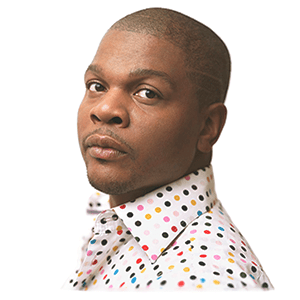
Kehinde [keh-hin-day] Wiley (b. 1977) is a New York-based portrait painter, who is known for his highly naturalistic paintings of people with black and brown skin in heroic poses. His portraits are based on photographs of young men who Wiley sees on the street. He painted men from Harlem’s 125th Street, then South Central neighborhood where he was born.
Dressed in street clothes, his models were asked to assume poses from the paintings of Renaissance masters, such as Tiziano Vecellio and Giovanni Battista Tiepolo. The artist describes his approach as ‘interrogating the notion of the master painter, at once critical and complicit.’ His figurative paintings ‘quote historical sources and position young black men within that field of power.’
read more »
Posted in Art, Politics, World |
Leave a Comment »
January 8, 2014

Fiat justitia ruat caelum is a Latin legal phrase, meaning ‘Let justice be done though the heavens fall.’ The maxim signifies the belief that justice must be realized regardless of consequences. In ‘De Ira (On Anger),’ Seneca tells of Gnaeus Calpurnius Piso, a Roman governor and lawmaker who ordered the execution of a soldier that had returned from a leave of absence without his comrade, on the grounds that he had presumably killed the latter. As the condemned man was presenting his neck to the executioner’s sword, there suddenly appeared the very comrade who was supposedly murdered.
The centurion overseeing the execution halted the proceedings and led the condemned man back to Piso, expecting a reprieve. But Piso mounted the tribunal in a rage, and ordered the three soldiers to be executed. He ordered the death of the man who was to have been executed, because the sentence had already been passed; he also ordered the death of the centurion who was in charge of the original execution, for failing to perform his duty; and finally, he ordered the death of the man who had been supposed to have been murdered, because he had been the cause of the death of two innocent men.
read more »
Posted in Philosophy, Politics |
Leave a Comment »
January 5, 2014

A format war describes competition between mutually incompatible proprietary formats that compete for the same market, typically for data storage devices and recording formats for electronic media.
It is often characterized by political and financial influence on content publishers by the developers of the technologies. Developing companies may be characterized as engaging in a format war if they actively oppose or avoid interoperable open industry technical standards in favor of their own.
read more »
Posted in Money, Politics, Technology |
Leave a Comment »
January 4, 2014
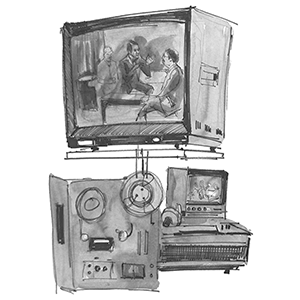
Abscam was an FBI sting operation run from the Bureau’s Long Island office in the late 1970s and early ’80s. The operation initially targeted trafficking in stolen property but was converted to a public corruption investigation. The investigation ultimately led to the conviction of a U.S. senator, six members of the House of Representatives, one member of the New Jersey State Senate, members of the Philadelphia City Council, the Mayor of Camden, New Jersey, and an inspector for the Immigration and Naturalization Service.
In 1978, the FBI hired Melvin Weinberg, a convicted con artist, to help plan and conduct the operation, forming Abdul Enterprises, Ltd., as its front company for the investigation. FBI employees posed as Karim Abdul Rahman, a fictional Middle Eastern sheikh, in videotaped meetings with targeted government officials. The agents posing as Rahman offered the officials money in return for political favors such as political asylum in the U.S., involvement in an investment scheme for a high-class hotel, and help in transferring money out of his country.
Posted in Money, Politics |
1 Comment »
January 4, 2014
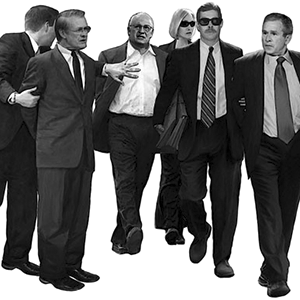
A perp walk, or walking the perp, is a common custom of American law enforcement (particularly NYC) where an arrested suspect is escorted through a public place, creating an opportunity for the media to take photographs and video of the event. The defendant is typically handcuffed or otherwise restrained, and is sometimes dressed in prison garb. Originally only those accused of violent street crimes were subjected to it, but since Rudolph Giuliani had accused white-collar criminals perp-walked in the 1980s, it has been extended to almost every defendant.
The perp walk arose incidentally from the need to transport a defendant from a police station to court after arrest, and the general prohibition of prior restraint (censorship) under the First Amendment. Law enforcement agencies often coordinate with the media in scheduling and arranging them. It has been criticized as a form of public humiliation that violates a defendant’s right to privacy and is prejudicial to the presumption of innocence. Courts have permitted it on the grounds that it arises from the limitations and necessity of police procedure, but have also limited it only to those times when it is actually necessary.
Posted in Language, Politics |
1 Comment »
December 20, 2013

Scareware, nowadays included into the class of malware known as FraudTool, comprises several classes of ransomware or scam software with malicious payloads, usually of limited or no benefit, that are sold to consumers via certain unethical marketing practices. The selling approach uses social engineering to cause shock, anxiety, or the perception of a threat, generally directed at an unsuspecting user. Some forms of spyware and adware also use scareware tactics.
A tactic frequently used by criminals involves convincing users that a virus has infected their computer, then suggesting that they download (and pay for) fake antivirus software to remove it. Usually the virus is entirely fictional and the software is non-functional or malware itself. Another approach is to trick users into uninstalling legitimate antivirus software, or disabling their firewall.
read more »
Posted in Money, Politics, Technology |
1 Comment »
December 19, 2013

Ransomware comprises a class of malware which restricts access to the computer system that it infects, and demands a ransom paid to the creator of the malware in order for the restriction to be removed.
Some forms of ransomware encrypt files on the system’s hard drive (cryptoviral extortion), while some may simply lock the system and display messages intended to coax the user into paying. While initially popular in Russia, the use of ransomware scams has grown internationally.
read more »
Posted in Money, Politics, Technology |
Leave a Comment »
December 17, 2013

‘Black Skinhead‘ (also stylized as ‘BLKKK SKKKN HEAD’) is a 2013 song by Kanye West, from his sixth studio album ‘Yeezus.’ It was produced by West alongside Daft Punk, Gesaffelstein, Brodinski, Mike Dean, Lupe Fiasco, No ID, Jack Donoghue and Noah Goldstein.
For five months leading up to the single’s announcement, West worked on a music video with photographer Nick Knight. An interactive portion of the video allows users to control the video’s speed down to almost one-sixteenth the normal rate, as well as take screenshots for use in social media platforms. The user’s cursor changes to that of a black hand giving the middle finger when interacting with the video.
Posted in Art, Politics |
Leave a Comment »
December 7, 2013

Tribalism [trahy-buh-liz-uhm] implies the possession of a strong cultural or ethnic identity that separates one member of a group from the members of another group. It is a precondition for members of a tribe to possess a strong feeling of identity for a true tribal society to form. While tribal society no longer strictly exists in the western world, tribalism is arguably undiminished. People have postulated that the human brain is hard-wired towards tribalism due to its evolutionary advantages.
Many tribes refer to themselves with their language’s word for ‘people,’ while referring to other, neighboring tribes with various epithets. For example, the term ‘Inuit’ translates as ‘people,’ but they were known to the Ojibwe by a name ‘Eskimo’ translating roughly as ‘eaters of raw meat.’
read more »
Posted in Politics, Science |
Leave a Comment »
December 6, 2013

Black Pete (‘Zwarte Piet‘) is the companion of Saint Nicholas (‘Sinterklaas,’ from which the English term ‘Santa Claus’ is derived) in the folklore of the Low Countries (primarily Belgium and the Netherlands). Like Santa Claus, Zwarte Piet is a hybrid stock character of pagan origin.
The characters of Zwarte Pieten appear only in the weeks before Saint Nicholas’s feast, first when the saint is welcomed with a parade as he arrives in the country (generally by boat, having traveled from Madrid, Spain). The tasks of the Zwarte Pieten are mostly to amuse children, and to scatter pepernoten, kruidnoten and strooigoed (special sinterklaas candies) for those who come to meet the saint as he visits stores, schools, and other places.
read more »
Posted in Philosophy, Politics, World |
3 Comments »
November 27, 2013

Fictional brands are used in artistic works to imitate or satirize corporate brands, and/or to avoid trademark or copyright infringement.
Such a device may be required where real corporations are unwilling to license their brand names for use in the fictional work, particularly where the work holds the product in a negative light.
read more »
Posted in Art, Money, Politics |
Leave a Comment »