March 6, 2013

The impact of Native American Gaming varies by tribe and location. In the 1970s, various tribes took unprecedented action to initiate gaming enterprises. In doing so, they created not only a series of legal struggles between the federal, state, and tribal governments but also a groundbreaking way to revitalize the Native American economy.
Native American gaming has grown from bingo parlors to high stakes gaming and is surrounded by controversy on many different levels. There are disputes concerning tribal sovereignty, negative effects of gaming, and a loss of Native American culture. In the US the ‘Indian Gaming Regulatory Act’ (IGRA) was passed in 1988 in order to secure collaboration between the states and tribes and also in order for the federal government to oversee gaming operations.
read more »
Posted in Games, Money, Politics |
Leave a Comment »
February 19, 2013

Live insect jewelry refers to jewelry, made from living creatures- usually bejeweled, large insects- which is worn as a fashion accessory. The use of insects as live jewelry has existed for many centuries, with the Egyptians believed to have been the first to have worn insects as jewelry. Ancient Egyptian soldiers commonly wore scarab beetles into battle as the beetles were considered to have supernatural powers of protection against enemies.
Although live jewelry has featured in Mayan cultural traditions for many centuries, it was not until the 1980s that the Mexican Maquech Beetle, a sub-species of the Zopherus beetle, achieved mainstream popularity as live jewelry. The Maquech Beetle is a large, docile, wingless insect which is decorated with gold and semi-precious gemstones and is attached to a decorative safety pin by a chain leash.
read more »
Posted in Money, Politics, World |
Leave a Comment »
February 19, 2013


Phishing is the act of attempting to acquire information such as usernames, passwords, and credit card details by masquerading as a trustworthy entity in an electronic communication. Communications purporting to be from popular social web sites, auction sites, online payment processors, or IT administrators are commonly used to lure the unsuspecting public. Phishing emails may contain links to websites that are infected with malware.
Phishing is typically carried out by e-mail spoofing (altering the sender address) or instant messaging, and it often directs users to enter details at a fake website whose look and feel are almost identical to the legitimate one. Phishing is an example of social engineering (manipulating people into performing actions or divulging confidential information), and exploits the poor usability of current web security technologies. Attempts to deal with the growing number of reported phishing incidents include legislation, user training, public awareness, and technical security measures.
read more »
Posted in Money, Politics, Technology |
Leave a Comment »
February 19, 2013


The Chaos Computer Club (CCC) is one of the world’s biggest hackers organizations. The CCC is based in Germany and other German-speaking countries. The CCC describes itself as ‘a galactic community of life forms, independent of age, sex, race or societal orientation, which strives across borders for freedom of information….’ In general, the CCC advocates more transparency in government, freedom of information, and the human right to communication.
Supporting the principles of the hacker ethic, the club also fights for free universal access to computers and technological infrastructure. The CCC was founded in Berlin in 1981 at a table which had previously belonged to the Kommune 1 (the first politically motivated commune in Germany) in the rooms of the newspaper ‘Die Tageszeitung’ by Wau Holland and others in anticipation of the prominent role that information technology would play in the way people live and communicate.
read more »
Posted in Politics, Technology, World |
Leave a Comment »
February 19, 2013


2600: The Hacker Quarterly is an American publication that specializes in publishing technical information on a variety of subjects including telephone switching systems, Internet protocols and services, as well as general news concerning the computer ‘underground’ and left wing, and sometimes (but not recently), anarchist issues.
The magazine’s name comes from the phreaker discovery in the 1960s that the transmission of a 2600 hertz tone (which could be produced perfectly with a plastic toy whistle given away free with Cap’n Crunch cereal—discovered by friends of John Draper) over a long-distance trunk connection gained access to ‘operator mode’ and allowed the user to explore aspects of the telephone system that were not otherwise accessible.
read more »
Posted in Language, Politics, Technology |
Leave a Comment »
February 18, 2013

The Pink Pistols are a gay gun rights organization in the United States and Canada. Their mottos are ‘Pick on someone your own caliber’ and ‘Armed gays don’t get bashed.’
Inspired by a Salon.com article written by Jonathan Rauch, Krikket (aka Doug Krick), a libertarian activist from Illinois while living in Massachusetts, founded the Pink Pistols in 2000. The organization now has 60 chapters in 33 states and three countries that are principally made up of gun-owning LGBT individuals, though neither status is mandatory for membership.
read more »
Posted in Politics, Sex |
Leave a Comment »
February 18, 2013

‘Private Guns, Public Health‘ is a 2004 non-fiction book by David Hemenway, an economist who has served as Professor of Health Policy at the Harvard School of Public Health as well as the Director of Harvard’s Injury Control Research Center. He argues that the widespread ownership of firearms in private hands in the U.S. promotes the spread of the ‘disease’ of gun violence, and he takes a collective interpretation of the Second Amendment while stating that increased regulations are absolutely necessary in the purposes of public safety. Hemenway makes the central case that ‘more guns in a community lead to more homicide.’
Hemenway interprets the issues of gun violence and gun politics in the U.S. through a public health lens, which he believes ’emphasizes prevention rather than fault-finding, blame, or revenge.’ He writes that he is not ‘anti-gun’ or ‘anti-gun owner’ any more than people who advocate for consumer safety measures in cars are ‘anti-cars.’ He sums the goal of the book up as ‘injury prevention.’
read more »
Posted in Health, Language, Politics |
Leave a Comment »
February 18, 2013

‘More Guns, Less Crime‘ is a book by economist John Lott that says violent crime rates go down when states permit the concealed carry of guns. He presents the results of his statistical analysis of crime data for every county in the United States during 29 years from 1977 to 2005. The book examines city, county and state level data from the entire United States and measures the impact of 11 different types of gun control laws on crime rates. The book expands on an earlier study published in 1997 by Lott and his co-author David Mustard in ‘The Journal of Legal Studies.’
Lott also examines the effects of gun control laws, including the Brady Law. His conclusion is that ‘shall issue’ laws, which allow citizens to carry concealed weapons, steadily decrease violent crime. He explains that this result makes sense because criminals are deterred by the risk of attacking an armed victim. As more citizens arm themselves, the danger to criminals increases. Lott also examines the effects of training requirements on crime rate and accident rate. He finds that training requirements have very little effect on both crime rates and accident rates.
read more »
Posted in Language, Politics |
Leave a Comment »
February 18, 2013

Concealed carry, or CCW (carrying a concealed weapon), refers to the practice of carrying a handgun or other weapon in public in a concealed manner, either on one’s person or in proximity. Concealed carry is legal in most areas of the United States. A handful of states and jurisdictions restrict or ban CCW, but all states except Illinois make provision for legal concealed carry via a permit or license, or via constitutional carry (CCW authorized by a State constitution).
Most states have ‘shall-issue’ statutes; that is, if a person meets the requirements to obtain a permit, the state must issue one. Some states, including California, New Jersey, New York, and Massachusetts have ‘may-issue’ statutes; these states may (or may not) issue permits to carry if a person meets the requirements to obtain one. States with may-issue statutes typically do not issue permits unless the applicant provides a documented need for a concealed weapon, such as for retired police officers, judges, and federal agents.
read more »
Posted in Death, Politics |
Leave a Comment »
February 18, 2013
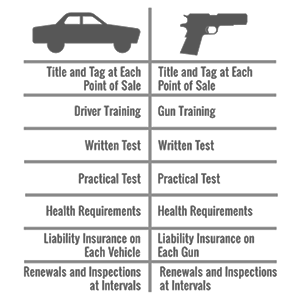
Gun control is any law, policy, practice, or proposal designed to restrict or limit the possession, production, importation, shipment, sale, and/or use of guns or other firearms by private citizens among others. Gun control laws and policy vary greatly around the world. Some countries, such as the United Kingdom and Austrailia, have very strict limits on gun possession while others, such as the United States, have relatively modest limits. In some countries, the topic remains a source of intense debate with proponents generally arguing the dangers of widespread gun ownership, and opponents generally arguing individual rights of self-protection as well as individual liberties in general.
High rates of gun mortality and injury are often cited as a primary impetus for gun control policies. There is general agreement that gun violence is a serious public health and economic concern. Yet, society remains deeply divided over whether more restrictive gun control policies would save lives and prevent injuries. Scholars agree the rate of gun violence in the United States is disproportionately high relative to other wealthy countries. Nevertheless, strong disagreement remains among academics on the question of whether a causal relationship between gun availability and violence exists, and which, if any, gun controls would effectively stem the violence.
read more »
Posted in Death, Politics, War |
2 Comments »
February 15, 2013

The Zeitgeist [tsahyt-gahyst] (spirit of the age or spirit of the time) is the intellectual fashion or dominant school of thought that typifies and influences the culture of a particular period in time. For example, the Zeitgeist of modernism typified and influenced architecture, art, and fashion during much of the 20th century. The German word ‘Zeitgeist’ is often attributed to the philosopher Georg Hegel, but he never actually used the word. In his works such as ‘Lectures on the Philosophy of History,’ he uses the phrase ‘der Geist seiner Zeit’ (‘the spirit of his time’)—for example, ‘no man can surpass his own time, for the spirit of his time is also his own spirit.’
Other philosophers who were associated with such ideas include Herder and Spencer and Voltaire. The concept counters the ‘Great Man theory’ popularized by Thomas Carlyle which sees history as the result of the actions of heroes and geniuses.
read more »
Posted in Art, Philosophy, Politics |
Leave a Comment »
February 14, 2013

‘The Rebel Sell: Why the culture can’t be jammed’ (published in the US as ‘Nation of Rebels: Why Counterculture Became Consumer Culture’) is a non-fiction book written by University of Toronto philosopher Joseph Heath and Canadian journalist Andrew Potter in 2004. Their central claim is that counter-cultural movements have failed, and that they all share a common fatal error in the way they understand society; thus counter-culture is not a threat to ‘the system.’
Following their claim that conformity isn’t something perpetuated by mainstream media, Potter and Heath identify other sources of conformity using work from Hobbes, Rousseau, and Freud. They describe conformity as often the byproduct of simple market preferences or, alternatively, as an attempt to resolve a collective action problem. For instance, they claim that school uniforms curb the fashion ‘arms race’ created between students when no restrictions are in place, and that they are not intended merely to stamp out individualism, as many counter-cultural figures have suggested.
read more »
Posted in Language, Money, Politics |
Leave a Comment »


 The Daily Omnivore