March 13, 2013

A power vacuum is, in its broadest sense, an expression for a condition that exists when someone has lost control of something and no one has replaced them. It is usually used to refer to a political situation that can occur when a government has no identifiable central authority.
The metaphor implies that, like a physical vacuum, other forces will tend to ‘rush in’ to fill the vacuum as soon as it is created, perhaps in the form of an armed militia or insurgents, military coup, warlord or dictator.
read more »
Posted in Language, Politics |
Leave a Comment »
March 12, 2013

A national myth is an inspiring narrative or anecdote about a nation’s past. Such myths often serve as an important national symbol and affirm a set of national values. A national myth may sometimes take the form of a national epic. A considerable amount of related material is at civil religion. A national myth may be a legend or fictionalized narrative, which has been elevated to serious mythological, symbolical and esteemed level so as to be true to the nation.
It might simply over-dramatize true incidents, omit important historical details, or add details for which there is no evidence; or it might simply be a fictional story that no one takes to be true literally, but contains a symbolic meaning for the nation. The national folklore of many nations includes a founding myth, which may involve a struggle against colonialism or a war of independence. In some cases, the meaning of the national myth may become disputed among different parts of the population.
read more »
Posted in Language, Politics, World |
Leave a Comment »
March 12, 2013

Lei Feng (1940 – 1962) was a soldier of the People’s Liberation Army of China. After his death, Lei was characterized as a selfless and modest person who was devoted to the Communist Party, Chairman Mao Zedong, and the people of China. In 1963, he became the subject of a nationwide, posthumous propaganda campaign ‘Follow the examples of Comrade Lei Feng.’ Lei was portrayed as a model citizen, and the masses were encouraged to emulate his selflessness, modesty, and devotion to Mao.
After Mao’s death, Lei Feng remained a cultural icon representing earnestness and service; his name entered daily speech and his imagery appeared on t-shirts and memorabilia. Although someone named Lei Feng probably existed, the accounts of his life as depicted by Party propaganda are heavily disputed, leading him to become a source of cynicism and subject of derision among segments of the Chinese population. Nevertheless, Lei’s image as a role model serviceman has survived decades of political change in China.
read more »
Posted in Politics, War, World |
Leave a Comment »
March 11, 2013

Owsley Stanley (1935 – 2011) was a figure of the San Francisco Bay Area counter-culture, playing a pivotal role in the counterculture of the 1960s. As a crafts-person, he became best known simply as ‘Owsley’ – the LSD ‘cook’ (underground chemist). Stanley was the first private individual to manufacture mass quantities of LSD. Between 1965 and 1967, Stanley produced more than 1.25 million doses of LSD.
Under the professional name of ‘Bear,’ he worked with the psychedelic rock band the Grateful Dead’s international fan ‘family.’ Bear was an early soundman for The Grateful Dead, a band he met when Ken Kesey invited them to an Owsley Acid test party. As their sound engineer, Bear frequently recorded live tapes behind his mixing board and helped The Dead become the first performers since Les Paul to custom-develop high-fidelity audio components and sound systems.
read more »
Posted in Drugs, Politics |
1 Comment »
March 10, 2013


AquAdvantage salmon is the trade name for a genetically modified Atlantic salmon developed by AquaBounty Technologies. It has been modified by the addition of a growth hormone regulating gene from a Pacific Chinook salmon and a gene from an ocean pout (the Atlantic salmon has 40,000 genes). These additions enable it to grow year-round instead of only during spring and summer.
The purpose of the modifications is to increase the speed at which the fish grows, without affecting its ultimate size or other qualities, though conventional salmon growers have publicly challenged the purported fast growth rates of AquaBounty’s salmon. The fish grows to market size in 16 to 18 months rather than three years. The latter figure refers to varieties whose growth rate has already been improved by 2:1 as a result of traditional selective breeding.
read more »
Posted in Food, Politics, Science |
Leave a Comment »
March 8, 2013
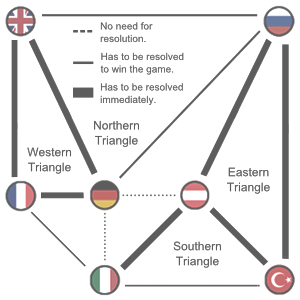
Diplomacy is a strategic board game created by American mail carrier Allan B. Calhamer in 1954 and released commercially in 1959. Its main distinctions from most board wargames are its negotiation phases (players spend much of their time forming and betraying alliances with other players and forming beneficial strategies) and the absence of dice or other game elements that produce random effects.
Set in Europe just before the beginning of World War I, Diplomacy is played by two to seven players, each controlling the armed forces of a major European Power (or, with few players, multiple powers). Each player aims to move his or her few starting units—and defeat those of others—to win possession of a majority of strategic cities and provinces marked as ‘supply centers’ on the map; these supply centers allow players who control them to produce more units.
read more »
Posted in Games, Politics, War |
Leave a Comment »
March 7, 2013

Payola [pey-oh-luh], in the American music industry, is the illegal practice of payment or other inducement by record companies for the broadcast of recordings on music radio in which the song is presented as being part of the normal day’s broadcast.
A radio station can play a specific song in exchange for money, but this must be disclosed on the air as being sponsored airtime, and that play of the song should not be counted as a ‘regular airplay.’ The term has come to refer to any secret payment made to cast a product in a favorable light (such as obtaining positive reviews). Some radio stations report spins of the newest and most popular songs to industry publications. The number of times the songs are played can influence the perceived popularity of a song.
read more »
Posted in Money, Politics |
Leave a Comment »
March 7, 2013

‘The Trap: What Happened to Our Dream of Freedom’ is a 2007 BBC documentary series by English filmmaker Adam Curtis, well known for other documentaries including ‘The Century of the Self’ and ‘The Power of Nightmares.’
The series consists of three one-hour programs which explore the concept and definition of freedom, specifically, ‘how a simplistic model of human beings as self-seeking, almost robotic, creatures led to today’s idea of freedom.’
read more »
Posted in Philosophy, Politics, War |
Leave a Comment »
March 6, 2013

Thomas Frank (b. 1965) is an American political analyst, historian, and journalist. He co-founded and edited ‘The Baffler magazine.’ He is a former columnist for the ‘Wall Street Journal,’ authoring ‘The Tilting Yard’ from 2008 to 2010. Frank is a historian of culture and ideas and analyzes trends in American electoral politics and propaganda, advertising, popular culture, mainstream journalism and economics.
With his writing, he explores the rhetoric and impact of the ‘Culture Wars’ in American political life, and the relationship between politics and culture in the United States. Frank started his political journey as a College Republican, but has come to be highly critical of conservatism, especially the presidency of George W. Bush. Frank summarized the thesis of his book ‘The Wrecking Crew: How Conservatives Rule’ as ‘Bad government is the natural product of rule by those who believe government is bad.’
Posted in Language, Money, Politics |
Leave a Comment »
March 6, 2013

The impact of Native American Gaming varies by tribe and location. In the 1970s, various tribes took unprecedented action to initiate gaming enterprises. In doing so, they created not only a series of legal struggles between the federal, state, and tribal governments but also a groundbreaking way to revitalize the Native American economy.
Native American gaming has grown from bingo parlors to high stakes gaming and is surrounded by controversy on many different levels. There are disputes concerning tribal sovereignty, negative effects of gaming, and a loss of Native American culture. In the US the ‘Indian Gaming Regulatory Act’ (IGRA) was passed in 1988 in order to secure collaboration between the states and tribes and also in order for the federal government to oversee gaming operations.
read more »
Posted in Games, Money, Politics |
Leave a Comment »
February 19, 2013

Live insect jewelry refers to jewelry, made from living creatures- usually bejeweled, large insects- which is worn as a fashion accessory. The use of insects as live jewelry has existed for many centuries, with the Egyptians believed to have been the first to have worn insects as jewelry. Ancient Egyptian soldiers commonly wore scarab beetles into battle as the beetles were considered to have supernatural powers of protection against enemies.
Although live jewelry has featured in Mayan cultural traditions for many centuries, it was not until the 1980s that the Mexican Maquech Beetle, a sub-species of the Zopherus beetle, achieved mainstream popularity as live jewelry. The Maquech Beetle is a large, docile, wingless insect which is decorated with gold and semi-precious gemstones and is attached to a decorative safety pin by a chain leash.
read more »
Posted in Money, Politics, World |
Leave a Comment »
February 19, 2013


Phishing is the act of attempting to acquire information such as usernames, passwords, and credit card details by masquerading as a trustworthy entity in an electronic communication. Communications purporting to be from popular social web sites, auction sites, online payment processors, or IT administrators are commonly used to lure the unsuspecting public. Phishing emails may contain links to websites that are infected with malware.
Phishing is typically carried out by e-mail spoofing (altering the sender address) or instant messaging, and it often directs users to enter details at a fake website whose look and feel are almost identical to the legitimate one. Phishing is an example of social engineering (manipulating people into performing actions or divulging confidential information), and exploits the poor usability of current web security technologies. Attempts to deal with the growing number of reported phishing incidents include legislation, user training, public awareness, and technical security measures.
read more »
Posted in Money, Politics, Technology |
Leave a Comment »



