January 6, 2013

Criticism of atheism is criticism of the concepts, validity, or impact of atheism, including associated political and social implications.
Criticism of atheism is complicated by the fact that there exist multiple definitions and concepts of atheism (and little consensus among fellow atheists), including practical atheism (apatheism), theoretical atheism (ignosticism), negative and positive atheism, implicit and explicit atheism, and strong and weak atheism, with critics not always specifying the subset of atheism being criticized. Arguments for atheism range from the philosophical to the social to the historical.
read more »
Posted in Philosophy, Politics |
Leave a Comment »
January 2, 2013

In his online essay ‘Digital Maoism: The Hazards of the New Online Collectivism,’ in ‘Edge’ magazine in 2006, futurist Jaron Lanier criticized the sometimes-claimed omniscience of collective wisdom (including examples such as the Wikipedia article about himself), describing it as ‘digital Maoism.’
He writes ‘If we start to believe that the Internet itself is an entity that has something to say, we’re devaluing those people [creating the content] and making ourselves into idiots.’ His criticism aims at several targets which are at different levels of abstraction: any attempt to create one final authoritative bottleneck which channels the knowledge onto society is wrong, regardless whether it is a Wikipedia or any algorithmically created system producing meta information.
read more »
Posted in Politics, Technology |
Leave a Comment »
December 29, 2012

The tragic mulatto [muh-lat-oh] is a stereotypical fictional character that appeared in American literature during the 19th and 20th centuries, from the 1840s.
The ‘tragic mulatto’ is an archetypical mixed-race person (a ‘mulatto’), who is assumed to be sad, or even suicidal, because they fail to completely fit in the ‘white world’ or the ‘black world.’ As such, the ‘tragic mulatto’ is depicted as the victim of the society they live in, a society divided by race.
read more »
Posted in Art, Language, Politics |
Leave a Comment »
December 24, 2012

Reclaim the Streets (RTS) is a collective with a shared ideal of community ownership of public spaces. Participants characterize the collective as a resistance movement opposed to the dominance of corporate forces in globalization, and to the car as the dominant mode of transport. Reclaim the Streets often stage non-violent direct action street reclaiming events such as the ‘invasion’ of a major road, highway or freeway to stage a party.
While this may obstruct the regular users of these spaces such as car drivers and public bus riders, the philosophy of RTS is that it is vehicle traffic, not pedestrians, who are causing the obstruction, and that by occupying the road they are in fact opening up public space. The events are usually spectacular and colorful with sand pits for children to play in, free food and music, however they have been known to degenerate into riots and violence. A Temporary Autonomous Zone sometimes results. The style of the parties in many places has been influenced by the rave scene in the UK, with sound systems playing dance music.
read more »
Posted in Money, Politics, Technology |
Leave a Comment »
December 24, 2012

‘No Logo: Taking Aim at the Brand Bullies’ is a book by Canadian author Naomi Klein.
First published in December 1999, shortly after the 1999 WTO Ministerial Conference protests in Seattle had generated media attention around such issues, it became one of the most influential books about the alter-globalization movement. The book focuses on branding, and often makes connections with the alter-globalization movement (also known as the the global justice movement).
read more »
Posted in Language, Money, Politics |
1 Comment »
December 23, 2012

Ad-creep refers to the gradual introduction of advertising into previously ad-free spaces. The earliest verified appearance of the term is in a 1996 article ‘Creeping Commercials: Ads Worming Way Into TV Scripts’ by Steve Johnson for the ‘Chicago Tribune,’ however it may have been coined by a subscriber to ‘Stay Free!’ magazine, according to another source.
While the virtues of advertising can be debated, ad-creep often especially refers to advertising which is invasive and coercive, such as ads in schools, doctor’s offices and hospitals, restrooms, elevators, on ATM’s, on garbage cans, on vehicles, and on restaurant menus. In Johnson’s piece, he criticizes product placement and ‘creative advertising enhancements’ as ‘one more manifestation of an environment in which the commercial assault is almost nonstop.’
read more »
Posted in Money, Politics |
Leave a Comment »
December 23, 2012

The Adbusters Media Foundation is a Canadian-based not-for-profit, anti-consumerist, pro-environment organization founded in 1989 by Kalle Lasn and Bill Schmalz in Vancouver. Adbusters describes itself as ‘a global network of artists, activists, writers, pranksters, students, educators and entrepreneurs who want to advance the new social activist movement of the information age.’
Characterized by some as anti-capitalist or opposed to capitalism, it publishes the reader-supported, advertising-free ‘Adbusters,’ an activist magazine with an international circulation of 120,000 devoted to challenging consumerism. Adbusters has launched numerous international campaigns, including ‘Buy Nothing Day,’ ‘TV Turnoff Week,’ and ‘Occupy Wall Street,’ and is known for their ‘subvertisements’ that spoof popular advertisements.
read more »
Posted in Language, Money, Politics |
Leave a Comment »
December 23, 2012

Culture jamming is a tactic used by many anti-consumerist social movements to disrupt or subvert media culture and its mainstream cultural institutions, including corporate advertising. It purports to ‘expose the methods of domination’ of mass society to foster progressive change.
Culture jamming is a form of subvertising (subversive advertising. Many culture jams are intended to expose apparently questionable political assumptions behind commercial culture. Common tactics include re-figuring logos, fashion statements, and product images as a means to challenge the idea of ‘what’s cool’ along with assumptions about the personal freedoms of consumption.
read more »
Posted in Humor, Money, Politics |
Leave a Comment »
December 21, 2012

Copyright Criminals is a 2010 documentary film directed and produced by Benjamin Franzen examining the creative and the commercial value of sampling including the related debates over artistic expression, copyright law, and money. Copyright Criminals was funded by the Ford Foundation, University of Iowa, and John D. and Catherine T. MacArthur Foundation. It premiered in 2010 at the Toronto Film Festival. Sampling is when musicians make an audio montage taking a portion, or sample, of a sound recording and reusing, remixing or reworking it as a separate instrumental layer or loop into another song.
The documentary contains interviews with several sampling artist pioneers, including hip-hop groups. A longtime area of contention from a legal perspective, early sampling used portions of other artists’ recordings without permission. Once hip-hop, rap and other music incorporating sampling began generating a noticeably substantial income, the original artists began to take legal action, claiming copyright infringement and demanding high-sum royalties. Sampling artists fought back, claiming fair use (an exception in copyright law).
Posted in Art, Money, Politics |
Leave a Comment »
December 15, 2012

Assault weapon is a political term, often used by gun control advocates, typically referring to firearms ‘designed for rapidly firing at human targets from close range,’ sometimes described as military-style features useful in combat. The term was most notably used in the language of the now-expired Public Safety and Recreational Firearms Use Protection Act of 1994, more commonly known as the Federal Assault Weapons Ban, which expired in 2004.
The federal assault weapons ban specifically prohibited 19 guns considered to be assault weapons. These were all semi-automatic firearms, meaning that they can eject spent shell casings and chamber the next round without additional human action, but (as opposed to automatic firearms) only one round is fired per pull of the trigger.
read more »
Posted in Death, Politics, War |
1 Comment »
December 13, 2012

Psychohistory [sahy-koh-his-tuh-ree] is the study of the psychological motivations of historical events. It attempts to combine the insights of psychotherapy with the research methodology of the social sciences to understand the emotional origin of the social and political behavior of groups and nations, past and present. Its subject matter is childhood and the family (especially child abuse), and psychological studies of anthropology and ethnology.
Psychohistory derives many of its concepts from areas that are perceived to be ignored by conventional historians as shaping factors of human history, in particular, the effects of childbirth, parenting practice, and child abuse. The historical impact of incest, infanticide and child sacrifice are considered. Psychohistory holds that human societies can change between infanticidal and non-infanticidal practices and has coined the term ‘early infanticidal childrearing’ to describe abuse and neglect observed by many anthropologists.
read more »
Posted in Education, Health, Politics |
Leave a Comment »
December 11, 2012
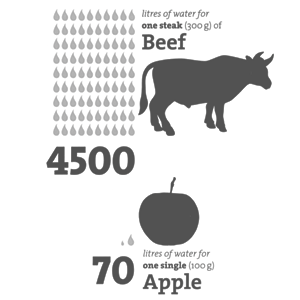
Virtual water (also known as embedded or embodied water) refers to the hidden flow of water if food or other commodities are traded from one place to another. For instance, it takes 1,600 cubic meters of water on average to produce one metric ton of wheat.
The precise volume can be more or less depending on climatic conditions and agricultural practice. Hoekstra and Chapagain have defined the virtual-water content of a product (a commodity, good or service) as ‘the volume of freshwater used to produce the product, measured at the place where the product was actually produced.’
read more »
Posted in Food, Money, Politics |
Leave a Comment »


 The Daily Omnivore