January 10, 2013

‘Don’t be evil‘ was the formal corporate motto (or slogan) of Google. It was first suggested either by Google employee Paul Buchheit at a meeting about corporate values that took place in early 2000, or by Google Engineer Amit Patel in 1999. Buchheit, the creator of Gmail, said he ‘wanted something that, once you put it in there, would be hard to take out,’ adding that the slogan was ‘also a bit of a jab at a lot of the other companies, especially our competitors, who at the time, in our opinion, were kind of exploiting the users to some extent.’
While the official corporate philosophy of Google does not contain the words ‘Don’t be evil,’ they were included in the prospectus of Google’s 2004 IPO (a letter from Google’s founders, later called the ”Don’t Be Evil’ manifesto’): ‘Don’t be evil. We believe strongly that in the long term, we will be better served — as shareholders and in all other ways — by a company that does good things for the world even if we forgo some short term gains.’
read more »
Posted in Money, Politics, Technology |
Leave a Comment »
January 9, 2013
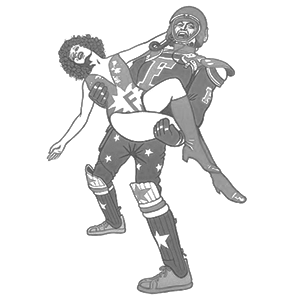
Mr. Freedom is a 1969 film by the expatriate American photographer and filmmaker William Klein. Starring the popular French actor Delphine Seyrig, this anti-imperialist satirical farce has cameos by the well-known actors Donald Pleasence and Philippe Noiret, as well as the musician Serge Gainsbourg. Under the command of Dr. Freedom, the crass superhero Mr. Freedom (John Abbey) goes to France to stave off the advances of the mysterious French Anti-Freedom (FAF) organization.
He joins forces with the femme fatale Marie-Madeleine to lead his own anti-communist Freedom organization. The Freedom mission is complicated by the machinations of communist foes — the Stalinist Moujik Man and the ferocious Maoist Red China Man (portrayed as a giant inflatable dragon). France, refusing to see the FAF as a threat, rebuffs Freedom, leading to an escalation of Cold War tactics. In the end, betrayed, Mr. Freedom destroys himself trying to save the ‘unappreciative’ nation.
read more »
Posted in Humor, Politics, World |
Leave a Comment »
January 9, 2013
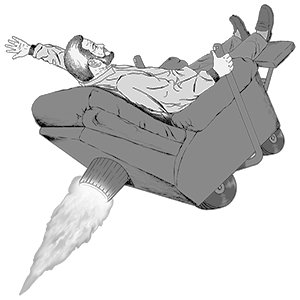
In 2009, Dennis LeRoy Anderson of Minnesota received widespread media attention for being arrested in a DWI case involving a motorized recliner. Riding a recliner which he had fitted with a motor, Anderson crashed into a car after leaving a local bar, where he had drunk a number of beers. The driver was convicted and the chair was confiscated by the police. The police auctioned the recliner away on Do-Bid.com for $3,700. 62-year-old Dennis LeRoy Anderson fitted his recliner with a lawnmower engine, wheels and steering wheel, which allowed the chair to reach up to 20 miles per hour. He had also installed a stereo, cup holders, headlights and a power antenna.
According to Minnesota law, a ‘motor vehicle’ is taken to mean ‘every vehicle that is self-propelled and every vehicle that is propelled by electric power obtained from overhead trolley wires. This means that a driver of any motorized vehicle, even a recliner, is liable under DWI legislation. Anderson’s blood alcohol content was three times over the legal limit for the state. In addition to this, vehicles can also be confiscated if the driver has a blood alcohol level over 0.2, or has a prior DWI conviction from the last 10 years. Anderson, in addition to having a blood alcohol level well over that limit, also had a prior conviction.
Posted in Humor, Politics, Technology |
Leave a Comment »
January 8, 2013

Fear and Loathing: On the Campaign Trail ’72 is a collection of articles covering the 1972 presidential campaign written by Hunter S. Thompson and illustrated by Ralph Steadman. The articles were first serialized in ‘Rolling Stone’ magazine throughout 1972 and later released as a book in early 1973. The book focuses almost exclusively on the Democratic Party’s primaries and the breakdown of the party as it splits between the different candidates.
Of particular focus is the manic maneuvering of the George McGovern campaign during the Miami convention as they sought to ensure the Democratic nomination despite attempts by the Hubert Humphrey campaign and other candidates to block McGovern. Thompson began his coverage of the campaign in December 1971, just as the race toward the primaries was beginning, from a rented apartment in Washington, DC (a situation he compared to ‘living in an armed camp, a condition of constant fear’). Over the next 12 months, in voluminous detail, he covered every aspect of the campaign, from the smallest rally to the raucous conventions.
read more »
Posted in Humor, Language, Politics |
Leave a Comment »
January 8, 2013
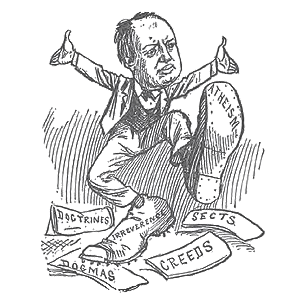
Robert Ingersoll (1833 – 1899) was a Civil War veteran, American political leader, and orator during the Golden Age of Freethought, noted for his broad range of culture and his defense of agnosticism. He was nicknamed ‘The Great Agnostic.’ He was born in upstate New York.
His father, John, was an abolitionist-leaning Congregationalist preacher, whose radical views forced his family to move frequently. For a time, Rev. Ingersoll filled the pulpit for American revivalist Charles G. Finney while Finney was on a tour of Europe. Upon Finney’s return, Rev. Ingersoll remained for a few months as co-pastor/associate pastor under Finney.
read more »
Posted in Language, Philosophy, Politics |
Leave a Comment »
January 8, 2013

The Story of Stuff is a 2007 short polemical animated documentary about the lifecycle of material goods. The documentary is critical of excessive consumerism and promotes sustainability. Filmmaker Annie Leonard wrote and narrated the film, which was funded by Tides Foundation, Funders Workgroup for Sustainable Production and Consumption, Free Range Studios and other foundations.
The video divides up the materials economy into a system composed of extraction, production, distribution, consumption, and disposal. To articulate the problems in the system, Leonard adds people, the government, and corporations. Leonard’s thesis, ‘you cannot run a linear system on a finite planet indefinitely’ is supported throughout the video by statistical data.
read more »
Posted in Money, Politics, Technology |
Leave a Comment »
January 8, 2013

Conspicuous consumption refers to monies spent and goods and services acquired to publicly display economic power—either the buyer’s income or the buyer’s accumulated wealth.
Sociologically, to the conspicuous consumer, such a public display of discretionary economic power is a means either of attaining or of maintaining a given social status. Moreover, ‘invidious consumption,’ a more specialized sociological term, denotes the deliberate conspicuous consumption of goods and services intended to provoke the envy of other people, as a means of displaying the buyer’s superior socio-economic status.
read more »
Posted in Money, Politics, Science |
Leave a Comment »
January 8, 2013

Packard Jennings (b. 1970) is an American artist who appropriates pop culture symbols and references to create new meaning using a variety of media including printmaking, sculpture, animation, video, and pamphleteering.
In his early career he modified billboards, a common practice of culture jammers. Jennings’s work often deals with the philosophy of anarchism, how it’s represented in the media, and the representation of a naive utopia primarily through primitivism, not to be confused with anarchism or anarchy.
read more »
Posted in Art, Money, Politics |
Leave a Comment »
January 6, 2013

Black propaganda is false information and material that purports to be from a source on one side of a conflict, but is actually from the opposing side. It is typically used to vilify, embarrass or misrepresent the enemy.
Black propaganda contrasts with grey propaganda, the source of which is not identified, and white propaganda, in which the real source is declared and usually more accurate information is given, albeit slanted, distorted and omissive. Black propaganda is covert in nature in that its aims, identity, significance, and sources are hidden.
read more »
Posted in Language, Politics, War |
Leave a Comment »
January 6, 2013

Criticism of atheism is criticism of the concepts, validity, or impact of atheism, including associated political and social implications.
Criticism of atheism is complicated by the fact that there exist multiple definitions and concepts of atheism (and little consensus among fellow atheists), including practical atheism (apatheism), theoretical atheism (ignosticism), negative and positive atheism, implicit and explicit atheism, and strong and weak atheism, with critics not always specifying the subset of atheism being criticized. Arguments for atheism range from the philosophical to the social to the historical.
read more »
Posted in Philosophy, Politics |
Leave a Comment »
January 2, 2013

In his online essay ‘Digital Maoism: The Hazards of the New Online Collectivism,’ in ‘Edge’ magazine in 2006, futurist Jaron Lanier criticized the sometimes-claimed omniscience of collective wisdom (including examples such as the Wikipedia article about himself), describing it as ‘digital Maoism.’
He writes ‘If we start to believe that the Internet itself is an entity that has something to say, we’re devaluing those people [creating the content] and making ourselves into idiots.’ His criticism aims at several targets which are at different levels of abstraction: any attempt to create one final authoritative bottleneck which channels the knowledge onto society is wrong, regardless whether it is a Wikipedia or any algorithmically created system producing meta information.
read more »
Posted in Politics, Technology |
Leave a Comment »
December 29, 2012

The tragic mulatto [muh-lat-oh] is a stereotypical fictional character that appeared in American literature during the 19th and 20th centuries, from the 1840s.
The ‘tragic mulatto’ is an archetypical mixed-race person (a ‘mulatto’), who is assumed to be sad, or even suicidal, because they fail to completely fit in the ‘white world’ or the ‘black world.’ As such, the ‘tragic mulatto’ is depicted as the victim of the society they live in, a society divided by race.
read more »
Posted in Art, Language, Politics |
Leave a Comment »



