July 27, 2012

Crypto-anarchism refers to the use of cryptographic software to evade prosecution and harassment while sending and receiving information over computer networks, thereby protecting privacy and political freedom. In a sense, the encrypted anonymous networks (the ‘cipherspace’) can be regarded as an independent lawless territory or as an autonomous zone. However, participants may in theory voluntarily create new laws using smart contracts (computer protocols that facilitate, verify, or enforce the negotiation or performance of a contract, or that obviate the need for a contractual clause) or, if the user is pseudonymous, depend on online reputation.
The ‘crypto’ in crypto-anarchism should not be confused with the use of the prefix ‘crypto-‘ to indicate an ideology or system with an intentionally concealed or obfuscated ‘true nature.’ For example, some would use the term ‘crypto-fascist’ to describe an individual or organization that holds fascist views and subscribes to fascist doctrine but conceals their agenda so long as these doctrines remain socially unacceptable. However, Timothy C. May’s ‘Cyphernomicon’ (one of the philosophy’s founding documents, posted in 1994) indicates that the term ‘crypto-anarchist’ was partially intended as a pun on this usage, even though he did not intend to conceal his beliefs or agenda.
read more »
Posted in Philosophy, Politics, Technology |
Leave a Comment »
July 26, 2012
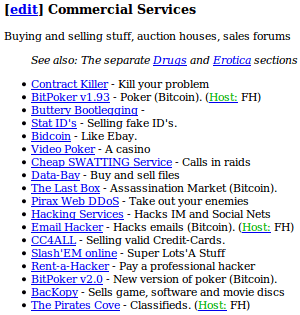
The Hidden Wiki is a website that uses hidden services available through the Tor network. The use of Tor to provide anonymity allows the site to advertise links to a range of other sites, including ones offering illegal drugs and child pornography. The site provides a range of links in a wiki format to other hidden services and sites on the clearnet (sites that can be accessed in a standard browser).
These include links to child pornography sites, sites selling drugs and other contraband such as the Silk Road. Scot Terban, an independent security researcher, commented: ‘It’s kind of like any black market operation except this one was in cyberspace and pretty much completely anonymous. Because it was anonymous, people felt free to trade openly in illegal things, mess around by putting up ads for services like hired assassins, and in the end, became a haven for pedophiles and their content.’
read more »
Posted in Money, Politics, Technology |
Leave a Comment »
July 26, 2012
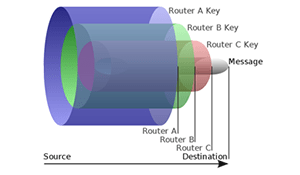

The Onion Router or Tor is a server that keeps users anonymous on the Internet. Tor client software directs internet traffic through a worldwide volunteer network of servers (making several ‘hops’) to conceal a user’s location or usage from anyone conducting network surveillance or traffic analysis.
Using Tor makes it more difficult to trace Internet activity, including visits to Web sites, online posts, and instant messages, IRC, and bittorrent and is intended to protect users’ personal freedom, privacy, and ability to conduct confidential business by keeping their internet activities from being monitored. The Tor client is free software and use of the Tor network is free of charge.
read more »
Posted in Politics, Technology, World |
Leave a Comment »
July 25, 2012

The Frontier Thesis is an argument by historian Frederick Jackson Turner in 1893 that the origin of the distinctive egalitarian, democratic, aggressive, and innovative features of the American character has been the American frontier experience. He stressed the process—the moving frontier line—and the impact it had on pioneers going through the process.
In the thesis, the frontier established liberty by releasing Americans from European mind-sets and ending prior customs of the 19th century. Turner first announced his thesis in a paper entitled ‘The Significance of the Frontier in American History,’ delivered to the American Historical Association in 1893 in Chicago. Turner elaborated on many points in a series of essays published over the next 25 years, but never a wrote a book on the frontier.
read more »
Posted in Politics, World |
Leave a Comment »
July 25, 2012

Truthiness is a quality characterizing a ‘truth’ that a person claims to know intuitively ‘from the gut’ or because it ‘feels right’ without regard to evidence, logic, intellectual examination, or facts. American television comedian Stephen Colbert coined the word in this meaning as the subject of a segment called ‘The Wørd’ during the 2005 pilot episode of his political satire program ‘The Colbert Report.’
By using this as part of his routine, Colbert satirized the misuse of appeal to emotion and ‘gut feeling’ as a rhetorical device in contemporaneous socio-political discourse. He particularly applied it to President George W. Bush’s nomination of Harriet Miers to the Supreme Court and the decision to invade Iraq in 2003. Colbert later ascribed truthiness to other institutions and organizations, including Wikipedia. Colbert has sometimes used a mock Latin version of the term, ‘Veritasiness.’
read more »
Posted in Humor, Language, Politics |
Leave a Comment »
July 24, 2012

Late modernity (or liquid modernity) is a term that has been used to describe the condition or state of some highly developed present day societies. It regards their state as a continuation or development of modernity, rather than as a distinct new state, post-modernity.
‘Late modernity is defined by complex, global capitalist economies and a shift from state support and welfare to the privatization of services…a process fuelled by the information revolution, the capacity to move capital and information around the world instantaneously.’ Social theorists, ‘criticize adherents of postmodernity that presume the ending of the modernization process and the dawning of a new era. Contemporary modernity, they argue, rather involves a continuation or even a radicalization of the modernization process.’
read more »
Posted in Money, Politics, World |
Leave a Comment »
July 23, 2012
The murders perpetrated by members of Charles Manson’s ‘Family’ were inspired in part by Manson’s prediction of Helter Skelter, an apocalyptic war he believed would arise from tension over racial relations between blacks and whites. This ‘chimerical vision’—as it was termed by the court that heard Manson’s appeal from his conviction for the Tate/LaBianca killings—involved reference to music of The Beatles (particularly songs from ‘The White Album’ of 1968) and to the New Testament’s Book of Revelation.
In its final form, which was reached by 1969, the scenario had Manson as not only the war’s ultimate beneficiary but its musical cause. He and the Family would create an album with songs whose messages concerning the war would be as subtle as those he had heard in songs of The Beatles. More than merely foretell the conflict, this would trigger it; for, in instructing ‘the young love,’ America’s white youth, to join the Family, it would draw the young, white female hippies out of San Francisco’s Haight-Ashbury.
read more »
Posted in Death, Philosophy, Politics |
1 Comment »
July 19, 2012

US energy independence relates to the goal of reducing the US imports of oil and other foreign sources of energy. If total energy is looked at, the US is over 70% self-sufficient. Energy independence is espoused by those who want to leave America unaffected by global energy supply disruptions, and to restrict a reliance upon politically unstable states for its energy purposes.
Energy independence is highly concerned with oil, being perhaps the most important imported energy sources for purposes of both transportation and electricity. The United States is the world’s third largest producer of oil, but it also relies on imported oil. More oil is imported from Canada than any other country. 19% of imported oil comes from the Middle East. Such resources are finite and decreasing, despite an increase in demand. World-wide demand for oil is projected to grow 60% over the next two decades.
read more »
Posted in Money, Politics, World |
Leave a Comment »
July 19, 2012

In economics, the Jevons [jev-uhnz] paradox is the proposition that technological progress that increases the efficiency with which a resource is used tends to increase (rather than decrease) the rate of consumption of that resource. In 1865, the English economist William Stanley Jevons observed that technological improvements that increased the efficiency of coal use led to increased consumption of coal in a wide range of industries. He argued that, contrary to intuition, technological improvements could not be relied upon to reduce fuel consumption.
The issue has been re-examined by modern economists studying consumption rebound effects from improved energy efficiency. In addition to reducing the amount needed for a given use, improved efficiency lowers the relative cost of using a resource, which tends to increase the quantity of the resource demanded, potentially counteracting any savings from increased efficiency. Additionally, increased efficiency accelerates economic growth, further increasing the demand for resources. The Jevons paradox occurs when the effect from increased demand predominates, causing resource use to increase.
read more »
Posted in Money, Politics, Technology |
Leave a Comment »
July 19, 2012

Women in Refrigerators (or WiR) is a website that was created in 1999 by a group of comic book fans. The website features a list of female comic book characters that had been injured, killed, or depowered as a plot device within various superhero comic books. Also, the site seeks to analyze why these plot devices are used disproportionately on female characters.
The term was coined by comic book writer Gail Simone as a name for the website in early 1999 during on-line discussions about comic books with friends. It refers to an incident in ‘Green Lantern’ in 1994, written by Ron Marz, in which Kyle Rayner, the titular hero, comes home to his apartment to find that his girlfriend, Alex DeWitt, had been killed by the villain Major Force and stuffed in a refrigerator.
read more »
Posted in Death, Politics, Sex |
1 Comment »
July 17, 2012


Abandonware are discontinued products for which no product support is available, or whose copyright ownership may be unclear for various reasons. Abandonware may be computer software or physical devices which are usually computerized in some fashion, such as personal computer games, productivity applications, utility software, or mobile phones.
Definitions of ‘abandoned’ vary; generally it refers to a product that is no longer available for legal purchase, over the age where the product creator feels an obligation to continue to support it, or where operating systems or hardware platforms have evolved to such a degree that the creator feels continued support cannot be financially justified. Software companies and manufacturers may change their names, go bankrupt, enter into mergers, or cease to exist for a variety of reasons. When this happens, product rights are usually transferred to another company that may elect not to sell or support products acquired.
read more »
Posted in Money, Politics, Technology |
Leave a Comment »
July 17, 2012

Sid Meier’s Civilization is a turn-based strategy video game created by Sid Meier and Bruce Shelley for MicroProse in 1991. It is a standard-bearer for the 4X genre: eXplore (reveal surrounding territories), eXpand (create new settlements), eXploit (gather resources), and eXterminate (eliminate rivals). The game’s objective is to ‘Build an empire to stand the test of time.’ It begins in 4000 BCE and the players attempt to expand and develop their empires through the ages from the ancient era until modern and near-future times. The game requires a fair amount of micromanagement (although less than a simulation game such as SimCity).
Along with the larger tasks of exploration, warfare, and diplomacy, the player has to make decisions about where to build new cities, which improvements or units to build in each city, which advances in knowledge should be sought (and at what rate), and how to transform the land surrounding the cities for maximum benefit. From time to time the player’s towns may be harassed by barbarians, units with no specific nationality and no named leader. These threats only come from unclaimed land or sea, so that over time there are fewer and fewer places from which barbarians will emanate.
read more »
Posted in Games, Politics, World |
Leave a Comment »



 The Daily Omnivore