August 9, 2012

Feminazi is a term popularized by radio talk-show host Rush Limbaugh to describe ‘an extreme or militant feminist.’ In 2004, Limbaugh named feminist activists Gloria Steinem, Susan Sarandon, Christine Lahti, and Camryn Manheim as ‘famous feminazis.’
Feminazi is a portmanteau of the nouns feminist and Nazi. The term is used pejoratively by some U.S. conservatives to criticize feminists that they perceive as extreme.
read more »
Posted in Language, Politics, Sex |
Leave a Comment »
August 9, 2012

The Manipulated Man (German: ‘Der Dressierte Mann’) is a 1971 book by author Argentinian-German writer Esther Vilar, which argues that, contrary to common feminist and women’s rights rhetoric, women in industrialized cultures are not oppressed, but rather exploit a well-established system of manipulating men.
A third edition of the book was released in 2009. Vilar writes, ‘Men have been trained and conditioned by women, not unlike the way Pavlov conditioned his dogs, into becoming their slaves. As compensation for their labors men are given periodic use of a woman’s vagina.’ The book contends that young boys are encouraged to associate their masculinity with their ability to be sexually intimate with a woman, and that a woman can control a man by socially empowering herself to be the gate-keeper to his sense of masculinity.
read more »
Posted in Language, Politics, Sex |
Leave a Comment »
August 6, 2012

The Wilson Quarterly is a magazine published by the Woodrow Wilson International Center for Scholars in Washington, D.C. The magazine was founded in 1976 by journalist Peter Braestrup and James H. Billington, the thirteenth Librarian of the United States Congress. The ‘Quarterly’ is noted for its nonpartisan, nonideological approach to current issues, with articles written from various perspectives.
Designed to make the research and debates of scholars and intellectuals accessible to a general audience, it covers a wide range of topics, from science policy and literature to foreign affairs. In 2012, the ‘Quarterly’ changed to a digital-only publishing model.
read more »
Posted in Language, Politics, World |
Leave a Comment »
August 6, 2012

‘Who Controls the Internet? Illusions of a Borderless World’ is a 2006 book by law professors Jack Goldsmith and Tim Wu that offers an assessment of the struggle to control the Internet. Starting with a discussion of the early vision of a borderless global community, the authors present some of the most prominent individuals, ideas, and movements that have played key roles in developing the Internet.
The book asserts the important role of government in maintaining Internet law and order while debunking the claims of techno-utopianism that have been espoused by theorists such as Thomas Friedman. In the 1990s the Internet was greeted as the ‘New New Thing’: It would erase national borders, give rise to communal societies that invented their own rules, undermine the power of governments. Goldsmith and Wu explain why these early assumptions were mostly wrong. The Internet turns out to illustrate the enduring importance of Old Old Things, such as law and national power and business logic.
read more »
Posted in Language, Politics, Technology |
Leave a Comment »
July 30, 2012

Bruce Conner (1933 – 2008) was an American artist renowned for his work in assemblage (artistic compositions made by putting together found objects) and film, among other disciplines. He attended Wichita University (now Wichita State), and received his B.F.A in Art at Nebraska University in 1956.
He then attended the University of Colorado on scholarship; also there was Jean Sandstedt, whom he had met at Nebraska and who would become his wife. In 1957 the two married and immediately flew to San Francisco. There, Conner quickly assimilated into the city’s famous Beat community and founded the Rat Bastard Protective Association, an underground, arts organization. His first solo shows in San Francisco, in 1958 and 1959, featured paintings, drawings, prints, collages, assemblages, and sculpture.
read more »
Posted in Art, Philosophy, Politics |
Leave a Comment »
July 30, 2012

Si vis pacem, para bellum is a Latin adage translated as, ‘If you wish for peace, prepare for war’ (usually interpreted as meaning peace through strength—a strong society being less likely to be attacked by enemies). The adage was adapted from a statement in ‘De Re Militari’ (‘Concerning Military Matters’) by Publius Flavius Vegetius Renatus, although the idea it conveys is also present in earlier works, such as Plato’s ‘Nomoi’ (‘Laws’).
With reference to the foreign policy of Napoleon Bonaparte, the historian, de Bourrienne, said: ‘Everyone knows the adage… Had Bonaparte been a Latin scholar he would probably have reversed it and said, ‘Si vis bellum para pacem.” Meaning that if you are planning a war, you should put other nations off guard by cultivating peace. Conversely, another interpretation could be that preparing for peace may lead another party to wage war on you.
read more »
Posted in Politics, War, World |
1 Comment »
July 30, 2012

‘Peace through strength‘ is a conservative slogan supporting military strength for the purpose of creating peaceful international relations. For supporters of the MX missile in the 1970s, the missile symbolized ‘peace through strength.’ The phrase was popular in political rallies during 1988.
The idea is a major justification cited for large militaries, and also served as the primary motivation behind the Cold War doctrine of mutually assured destruction. The logic here is that a strong military deters aggression and coercion (blackmail), and that no potential aggressor in his right mind would dare to attack or blackmail someone stronger than he is, because he knows he would be swiftly defeated if he tried to. Conservatives and neoconservatives argue that if an aggressor is irrational and cannot be deterred, he can be swiftly defeated by a large and strong standing military.
read more »
Posted in Politics, War, World |
Leave a Comment »
July 27, 2012


‘Cyber Rights: Defending Free speech in the Digital Age’ is a 1998 non-fiction book about cyberlaw, written by free speech lawyer Mike Godwin. Godwin graduated from the University of Texas School of Law in 1990 and was the first staff counsel for the Electronic Frontier Foundation (EFF). Written with a first-person perspective, ‘Cyber Rights’ gives the reader a background in legal issues and history pertaining to free speech on the Internet.
It documents the author’s experiences in defending free speech online, and puts forth the thesis that ‘the remedy for the abuse of free speech is more speech.’ Godwin emphasizes that decisions made about the expression of ideas on the Internet have an impact on freedom of speech in other mediums of communication as well, as granted by the First Amendment to the United States Constitution.
read more »
Posted in Language, Politics, Technology |
Leave a Comment »
July 27, 2012

Counter-economics is a term originally used by libertarian activists Samuel Edward Konkin III and J. Neil Schulman, defined as ‘the study and/or practice of all peaceful human action which is forbidden by the State.’ The term is short for ‘counter-establishment economics.’
Counter-economics was integrated by Schulman into Konkin’s doctrine of agorism (a philosophy that advocates the goal of the bringing about of a society in which all relations between people are voluntary exchanges). The first book to portray counter-economics as a strategy for achieving a libertarian society was Schulman’s novel ‘Alongside Night’ (1979).
read more »
Posted in Money, Philosophy, Politics |
Leave a Comment »
July 27, 2012

Crypto-anarchism refers to the use of cryptographic software to evade prosecution and harassment while sending and receiving information over computer networks, thereby protecting privacy and political freedom. In a sense, the encrypted anonymous networks (the ‘cipherspace’) can be regarded as an independent lawless territory or as an autonomous zone. However, participants may in theory voluntarily create new laws using smart contracts (computer protocols that facilitate, verify, or enforce the negotiation or performance of a contract, or that obviate the need for a contractual clause) or, if the user is pseudonymous, depend on online reputation.
The ‘crypto’ in crypto-anarchism should not be confused with the use of the prefix ‘crypto-‘ to indicate an ideology or system with an intentionally concealed or obfuscated ‘true nature.’ For example, some would use the term ‘crypto-fascist’ to describe an individual or organization that holds fascist views and subscribes to fascist doctrine but conceals their agenda so long as these doctrines remain socially unacceptable. However, Timothy C. May’s ‘Cyphernomicon’ (one of the philosophy’s founding documents, posted in 1994) indicates that the term ‘crypto-anarchist’ was partially intended as a pun on this usage, even though he did not intend to conceal his beliefs or agenda.
read more »
Posted in Philosophy, Politics, Technology |
Leave a Comment »
July 26, 2012
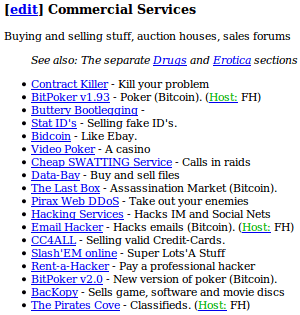
The Hidden Wiki is a website that uses hidden services available through the Tor network. The use of Tor to provide anonymity allows the site to advertise links to a range of other sites, including ones offering illegal drugs and child pornography. The site provides a range of links in a wiki format to other hidden services and sites on the clearnet (sites that can be accessed in a standard browser).
These include links to child pornography sites, sites selling drugs and other contraband such as the Silk Road. Scot Terban, an independent security researcher, commented: ‘It’s kind of like any black market operation except this one was in cyberspace and pretty much completely anonymous. Because it was anonymous, people felt free to trade openly in illegal things, mess around by putting up ads for services like hired assassins, and in the end, became a haven for pedophiles and their content.’
read more »
Posted in Money, Politics, Technology |
Leave a Comment »
July 26, 2012
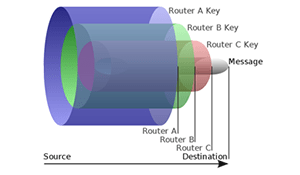

The Onion Router or Tor is a server that keeps users anonymous on the Internet. Tor client software directs internet traffic through a worldwide volunteer network of servers (making several ‘hops’) to conceal a user’s location or usage from anyone conducting network surveillance or traffic analysis.
Using Tor makes it more difficult to trace Internet activity, including visits to Web sites, online posts, and instant messages, IRC, and bittorrent and is intended to protect users’ personal freedom, privacy, and ability to conduct confidential business by keeping their internet activities from being monitored. The Tor client is free software and use of the Tor network is free of charge.
read more »
Posted in Politics, Technology, World |
Leave a Comment »



