July 12, 2012

Negativland is an experimental music and sound collage band which originated in San Francisco in the late 1970s. They took their name from a Neu! song. The current core of the band consists of Mark Hosler, Richard Lyons, Don Joyce, David Wills, and Peter Conheim. Negativland has released a number of albums ranging from pure sound collage to more musical expositions. These have mostly been released on their own label, Seeland Records.
In the late 1980s and early 1990s, they produced several recordings for SST Records, most notably ‘Escape from Noise,’ ‘Helter Stupid,’ and ‘U2.’ Negativland were sued by U2’s record label, Island Records, and by SST Records, which brought them widespread publicity and notoriety.
read more »
Posted in Art, Money, Politics |
Leave a Comment »
July 9, 2012

Phoenix Wright: Ace Attorney is an adventure video game developed by Capcom. It was first released as ‘Gyakuten Saiban’ (literally ‘Turnabout Trial’) in Japan exclusively for the Game Boy Advance in 2001. The game stars Phoenix Wright, a rookie defense attorney in the Fey and Co. Law Offices, owned by fellow defense attorney Mia Fey. Other characters include Maya Fey, Mia’s sister; Miles Edgeworth, a rival prosecutor; Dick Gumshoe, a scatterbrained detective, and Larry Butz, an old friend of Phoenix’s.
The game features five court cases divided into episodes. Each case flips between two game modes: investigation and the actual trial. In the investigation aspect of the game, Phoenix gathers evidence and speaks to characters involved in the case. In the trial aspect of the game, Phoenix defends his client using said evidence, cross examines witnesses, and solves the mystery surrounding each case. The court perspective is usually in the third person, while the perspective outside of court is in the first person. Since the release of the Game Boy Advance version, the Ace Attorney series has produced many sequels and spin-offs, in a variety of formats including Nintendo’s WiiWare and Apple iOS.
Posted in Games, Politics, World |
Leave a Comment »
July 9, 2012

The Atomic Cafe is a 1982 American documentary film produced and directed by Jayne Loader, Kevin Rafferty, and Pierce Rafferty.
The film covers the beginnings of the era of nuclear warfare, created from a broad range of archival film from the 1940s, 1950s, and early 1960s – including newsreel clips, television news footage, U.S. government-produced films (including military training films), advertisements, television and radio programs. News footage reflected the prevailing understandings of the media and public.
read more »
Posted in Humor, Politics, War |
Leave a Comment »
July 9, 2012

Ugly American is a pejorative term used to refer to perceptions of loud, arrogant, demeaning, thoughtless and ethnocentric behavior of American. Although the term is usually associated with or applied to travelers and tourists, it also applies to US corporate businesses in the international arena.
The term has been defined as: ‘Americans traveling or living abroad who remain ignorant of local culture and judge everything by American standards.’
read more »
Posted in Language, Politics, World |
Leave a Comment »
July 9, 2012

Futurism was a modern art and social movement which originated in Italy in the early 20th century. It was largely an Italian phenomenon, though there were parallel movements in Russia, England, and elsewhere.
The Futurists practiced in every medium of art, including painting, sculpture, ceramics, graphic design, industrial design, interior design, theater, cinema, fashion, textiles, literature, music, architecture, and even gastronomy.
read more »
Posted in Art, Politics, Technology |
Leave a Comment »
July 7, 2012
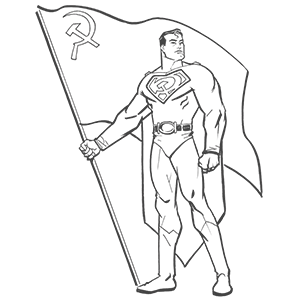
‘Superman: Red Son‘ is a comic book mini-series published by DC Comics that was released under their Elseworlds imprint in 2003. Author Mark Millar created the comic with the premise ‘what if Superman had been raised in the Soviet Union?’ The story mixes alternate versions of DC super-heroes with alternate-reality versions of real political figures such as Joseph Stalin and John F. Kennedy. The series spans approximately 1953-2001, save for a futuristic epilogue.
In ‘Red Son,’ Superman’s rocket ship lands on a Ukrainian collective farm rather than in Kansas, an implied reason being a small time difference (a handful of hours) from the original timeline, meaning Earth’s rotation placed the Ukraine in the ship’s path instead of Kansas. Instead of fighting for ‘…truth, justice, and the American Way,’ Superman is described in Soviet radio broadcasts ‘…as the Champion of the common worker who fights a never-ending battle for Stalin, socialism, and the international expansion of the Warsaw Pact.’ His ‘secret identity’ (i.e. the name his adoptive parents gave him) is a state secret.
read more »
Posted in Art, Politics, World |
4 Comments »
July 7, 2012


Prediction markets are speculative markets created for the purpose of making predictions; the current market prices can then be interpreted as predictions of the probability of the event or the expected value of the parameter. For example, a prediction market security might reward a dollar if a particular candidate is elected, such that an individual who thinks the candidate had a 70% chance of being elected should be willing to pay up to 70 cents for such a security.
People who buy low and sell high are rewarded for improving the market prediction, while those who buy high and sell low are punished for degrading the market prediction. Evidence so far suggests that prediction markets are at least as accurate as other institutions predicting the same events with a similar pool of participants.
read more »
Posted in Games, Money, Politics |
Leave a Comment »
July 5, 2012
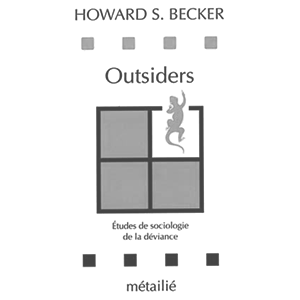
Labeling theory holds that deviance is not inherent to an act, but instead focuses on the tendency of majorities to negatively label minorities or those seen as deviant from standard cultural norms. It was developed by sociologists during the 1960s; Howard Saul Becker’s book ‘Outsiders’ was particularly influential. The theory is concerned with how the self-identity and behavior of individuals may be determined or influenced by the terms used to describe or classify them.
It is associated with the concepts of self-fulfilling prophecy and stereotyping. Unwanted descriptors or categorizations – including terms related to deviance, disability, or diagnosis of a mental disorder – may be rejected on the basis that they are merely ‘labels,’ often with attempts to adopt a more constructive language in its place. A stigma is defined as a powerfully negative label that changes a person’s self-concept and social identity.
read more »
Posted in Health, Language, Politics |
Leave a Comment »
July 3, 2012
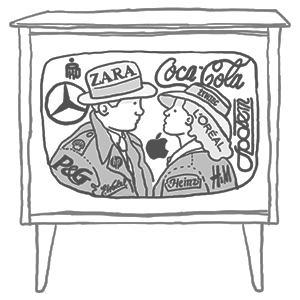
‘Four Arguments for the Elimination of Television‘ is a 1978 book written by liberal activist Jerry Mander which argues that there are a number of problems with the medium of television. Mander argues that many of the problems with television are inherent in the medium and technology itself, and thus cannot be reformed. Mander spent 15 years in the advertising business, including five as president and partner of Freeman, Mander & Gossage, San Francisco, a nationally-known advertising agency.
‘Four Arguments for the Elimination of Television’ argues that the technology of television is not a neutral or benign instrument or tool. The author argues that in varied technologies and institutions such as militaries, automobiles, nuclear power plants, mass production, and advertising, the basic form of the institution and the technology determines its interaction with the world, the way it will be used, the kind of people who use it, and to what ends.
read more »
Posted in Language, Politics, Technology |
2 Comments »
July 3, 2012

‘The medium is the message‘ is a phrase coined by Marshall McLuhan meaning that the form of a medium embeds itself in the message, creating a symbiotic relationship by which the medium influences how the message is perceived. The phrase was introduced in his most widely known book, ‘Understanding Media: The Extensions of Man,’ published in 1964.
McLuhan proposes that a medium itself, not the content it carries, should be the focus of study. He said that a medium affects the society in which it plays a role not only by the content delivered over the medium, but also by the characteristics of the medium itself. McLuhan frequently punned on the word ‘message’ changing it to ‘mass age,’ ‘mess age,’ and ‘massage’; a later book, ‘The Medium is the Massage’ was originally to be titled ‘The Medium is the Message,’ but McLuhan preferred the new title which is said to have been a printing error.
read more »
Posted in Language, Politics, Technology |
1 Comment »
July 3, 2012

Kim Dotcom, real name Kim Schmitz (b. 1974) is a German-Finnish businessman who rose to prominence during the dot-com bubble and was convicted of insider trading and embezzlement in its aftermath. He is the founder of Megaupload and its associated websites. He legally changed his surname to Dotcom in 2005. in 2012, the New Zealand Police placed him in custody in response to US charges of criminal copyright infringement in relation to his Megaupload Web site.
Dotcom has spoken out against his negative portrayal in the media, claiming to be a reformed character and a legitimate businessman who has been unfairly demonized by United States authorities and industry trade groups such as the RIAA and MPAA. He contends that the services offered by his Megaupload site were not significantly different from those of comparable services such as Rapidshare or YouTube, and he has just been used as a scapegoat because of his hacker past.
read more »
Posted in Money, Politics, Technology |
Leave a Comment »
June 29, 2012
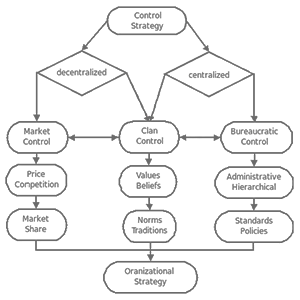
Control Theory is a theory of social order in sociology, which classifies control as centralized or decentralized or neither. Decentralized control is considered market control. Centralized control is considered bureaucratic control. Some types of control such as clan control are considered to be a mixture of both decentralized and centralized control.
Decentralized control or market control is typically maintained through factors such as price, competition, or market share. Centralized control such as bureaucratic control is typically maintained through administrative or hierarchical techniques such as creating standards or policies. Mixed control or clan control is typically maintained by keeping a set of values and beliefs or norms and traditions.
read more »
Posted in Politics, Science |
Leave a Comment »



