January 30, 2012
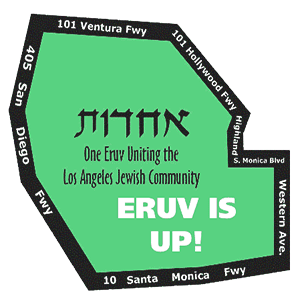
An eruv [air-oov] is a ritual enclosure that orthodox Jewish communities construct in their neighborhoods as a way to permit carrying objects outdoors on Shabbat, which they would otherwise understand to be prohibited by Jewish law (Halakha). There are 39 categories of activity prohibited on Shabbat including moving an object from one domain to another, no matter its weight or purpose. The prohibition is not found in the Torah, but in the Talmud (Rabbinical law and commentary).
The eruv permits traditionally observant Jews to, among other things, carry keys, tissues, medicines, or babies with them, and to use strollers and canes. According to tradition, the eruv must be made of walls or doorways at least one meter in height. In public areas where it is impractical to put up walls, doorways are constructed out of wire and posts. It is these doorways, which often serve no practical purpose, that are what is usually referred to as an eruv.
read more »
Posted in Philosophy, Politics |
Leave a Comment »
January 30, 2012

The Pareto [pah-re-taw] principle states that, for many events, roughly 80% of the effects come from 20% of the causes. Business-management consultant Joseph M. Juran suggested the principle and named it after Italian economist Vilfredo Pareto, who observed in 1906 that 80% of the land in Italy was owned by 20% of the population. He then carried out surveys on a variety of other countries and found to his surprise that a similar distribution applied. He even found that 20% of the pea pods in his garden contained 80% of the peas.
It is a common rule of thumb in business; e.g., ‘80% of your sales come from 20% of your clients.’ The Pareto principle is only tangentially related to Pareto efficiency, which was also introduced by the same economist. Pareto developed both concepts in the context of the distribution of income and wealth among the population.
Posted in Money, Politics, World |
Leave a Comment »
January 30, 2012

Barbara Kruger (b. 1945) is an American conceptual artist. Much of her work consists of black-and-white photographs overlaid with declarative captions—in white-on-red Futura Bold Oblique or Helvetica Ultra Condensed. The phrases in her works often include use of pronouns such as ‘you,’ ‘your,’ ‘I,’ ‘we,’ and ‘they.’ Much of Kruger’s work engages the merging of found photographs from existing sources with pithy and aggressive text that involves the viewer in the struggle for power and control that her captions speak to. In their trademark white letters against a slash of red background, some of her instantly recognizable slogans read ‘I shop therefore I am,’ and ‘Your body is a battleground.’
Much of her text questions the viewer about feminism, consumerism, and individual autonomy and desire, although her black-and-white images are culled from the mainstream magazines that sell the very ideas she is disputing. Kruger juxtaposes imagery and text critical of sexism; the circulation of power within cultures is a recurring motif in her work. A larger category that threads through her work is the appropriation and alteration of existing images. The importance of appropriation art in contemporary culture lay in its ability to play with preponderant imagistic and textual conventions: to mash up meanings and create new ones.
Posted in Art, Money, Politics |
Leave a Comment »
January 24, 2012


Americans for a Better Tomorrow, Tomorrow (also known as the Colbert Super PAC) is a United States political action committee (PAC) established by Stephen Colbert, who portrays a conservative political pundit on the television series ‘The Colbert Report.’ As a super PAC the organization can raise unlimited sums of money from corporations, unions and other groups, as well as wealthy individuals. Speaking in character, Colbert said the money will be raised not only for political ads, but also ‘normal administrative expenses, including but not limited to, luxury hotel stays, private jet travel, and PAC mementos from Saks Fifth Avenue and Neiman Marcus.’
During the January 12, 2012 episode of The Colbert Report, Colbert announced his plans to form an exploratory committee to lay the groundwork for his possible candidacy for ‘President of the United States of South Carolina.’ In the process, he transferred control of the Super PAC to Jon Stewart, renaming it The Definitely Not Coordinating With Stephen Colbert Super PAC.
read more »
Posted in Humor, Money, Politics |
Leave a Comment »
January 24, 2012


The 2010 midterm election marked the rise of a new political committee, dubbed ‘super PACs,’ and officially known as ‘independent-expenditure only committees,’ which can raise unlimited sums from corporations, unions and other groups, as well as individuals.
The super PACs were made possible by two judicial decisions. The first was the U.S. Supreme Court decision in Citizens United v. Federal Election Commission which held that government may not prohibit unions and corporations from making independent expenditures about politics. Soon after, in Speechnow.org v. FEC, the Federal Court of Appeals for the D.C. Circuit held that contributions to groups that only make independent expenditures could not be limited.
read more »
Posted in Money, Politics |
Leave a Comment »
January 24, 2012
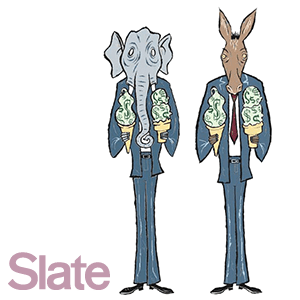
Political money in the United States is often divided into two categories, ‘hard’ money and ‘soft’ money. ‘Hard’ money is contributed directly to a candidate of a political party. It is regulated by law in both source and amount, and monitored by the Federal Election Commission (maximum $2500). ‘Soft’ money is contributed to the political party as a whole. Historically, ‘soft money’ referred to contributions made to political parties for purposes of party building and other activities not directly related to the election of specific candidates. Because these contributions were not used for specific candidate advocacy, they were not regulated by the Federal Election Campaign Act, as interpreted by the Supreme Court in Buckley v. Valeo. The Bipartisan Campaign Reform Act of 2002 (also known as McCain-Feingold) prohibited unregulated contributions to national party committees.
‘Soft money’ also refers to unlimited contributions to organizations and committees other than candidate campaigns and political parties (except, where legal, to state and local parties for use solely in state and local races). Organizations which receive ‘Soft money’ contributions are often called ‘527s,’ for the section of the tax code under which they operate. The term is generally used to refer to independent, nonprofit political organizations that are not regulated by the FEC or by a state elections commission, and are not subject to the same contribution limits as PACs. Such organizations can legally engage in political activity, but funds from ‘soft money’ contributions may not be spent on ads promoting the election or defeat of a specific candidate.
Posted in Money, Politics |
Leave a Comment »
January 24, 2012

A bait car, also called a decoy car, is a vehicle used by law enforcement agencies to capture car thieves. The vehicles are modified, with features including GPS tracking and audio/video surveillance technology, and can be remotely monitored and controlled. A ‘kill switch’ may be installed in the vehicle allowing police to remotely disable the engine and lock all doors from the inside, preventing escape.
The bait car, often filled with valuable items to draw attention to it, is parked in a high auto-theft area. In some cases, the vehicle may be simply left unlocked with the keys in the ignition. When the car is stolen, officers are immediately alerted, and can monitor the vehicle and send commands to control it such as disabling the engine, locking the doors or honking the horn. Live audio/video streaming devices may be installed allowing law enforcement personnel to determine how many suspects are in the car, what they are planning and if they are armed.
Posted in Money, Politics, Technology |
Leave a Comment »
January 24, 2012


The American Preppers Network (APN) is a non-profit corporation and part of a growing international movement of survivalists who call themselves ‘preppers.’ The social network is organized by state and regional blogs and forums. The members are volunteer contributors who are dedicated to providing free information on survival, preparedness, self-sufficiency and sustainability. The individuals involved in the prepper network prefer to be called preppers instead of survivalists because they are regular people with normal lifestyles and jobs who prepare for a variety of reasons whether natural or man-made.
The network of blogs is based on the concept originally created by Riverwalker of the ‘Stealth Survival’ blog, who founded the first Preppers Network. The organization has also formed alliances with independent affiliates such as ‘Pioneer Living Survival Magazine,’ a homesteading and survival skills website for a range of survivalist, from those who just want to store extra food in case of a power cut, to people who want to embrace the ‘off the grid’ lifestyle of America’s western pioneers.
Posted in Money, Politics |
Leave a Comment »
January 24, 2012

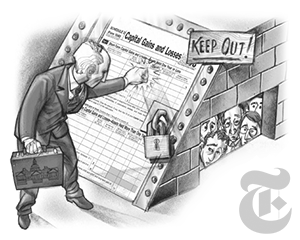
In North America, a tax shelter is generally defined as any method that recovers more than $1 in tax for every $1 spent, within 4 years. Some tax shelters are questionable or even illegal such as offshore companies that exploit differing tax rates and legislation. Others are part of financing arrangements; by paying unreasonably high interest rates to a related party, one may severely reduce the income of an investment (or even create a loss), but create a massive capital gain when one withdraws the investment. The tax benefit derives from the fact that capital gains are taxed at a lower rate than the normal investment income such as interest or dividend.
The offense of these questionable tax shelters are usually that transactions were not reported at fair market value or the interest rate was too high or too low. In general, if the purpose of a transaction is to lower tax liabilities but otherwise have no economic value, and especially when arranged between related parties, such transactions are often viewed as unethical.
read more »
Posted in Money, Politics |
Leave a Comment »
January 24, 2012


Private equity, in finance, is an asset class (investment strategy) consisting of equity securities (stocks) in operating companies that are not publicly traded on a stock exchange. A private equity investment will generally be made by a private equity firm (which specialize in just private equity), a venture capital firm (which invests in start-up companies), or an angel investor (an affluent individual who provides capital for start-ups). Each of these categories of investor has its own set of goals, preferences and investment strategies; each however providing working capital to a target company to nurture expansion, new product development, or restructuring of the company’s operations, management, or ownership.
Among the most common investment strategies in private equity are: leveraged buyouts, venture capital, growth capital, distressed investments, and mezzanine capital. In a typical leveraged buyout transaction, a private equity firm buys majority control of an existing or mature firm. This is distinct from a venture capital or growth capital investment, in which the investors (typically venture capital firms or angel investors) invest in young or emerging companies, and rarely obtain majority control.
Posted in Money, Politics |
Leave a Comment »
January 21, 2012

Bernie Sanders (b. 1941) is the junior United States Senator from Vermont. He previously represented Vermont’s at-large district in the United States House of Representatives. Sanders also served as mayor of Burlington, Vermont. Sanders is a self-described democratic socialist, and has praised European social democracy (though he has also criticized its contemporary ‘Third Way,’ center-left departure).
He is the first person elected to the U.S. Senate to identify as a socialist. Sanders caucuses with the Democratic Party and is counted as a Democrat for the purposes of committee assignments, but because he does not belong to a formal political party, he appears as an independent on the ballot. He has also been the only independent member of the House during much of his service there.
read more »
Posted in Politics |
2 Comments »
January 20, 2012
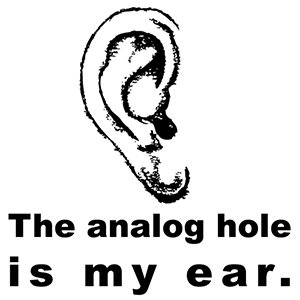
The analog hole is a fundamental and inevitable vulnerability in copy protection schemes. Once digital information is converted to a human-perceptible (analog) form, it is a relatively simple matter to digitally recapture that analog reproduction in an unrestricted form, thereby fundamentally circumventing any and all restrictions placed on copyrighted work.
Media publishers who use digital rights management (DRM), to restrict how a work can be used, perceive the necessity to make it visible and/or audible as a ‘hole’ in the control that DRM otherwise affords them.
read more »
Posted in Money, Politics, Technology |
Leave a Comment »


 The Daily Omnivore