February 9, 2012

Don’t Copy That Floppy was an anti-copyright infringement campaign run by the Software Publishers Association (SPA) beginning in 1992.
The video for the campaign, starring M. E. Hart as ‘MC Double Def DP,’ was filmed at Cardozo High School in Washington, D.C. The commercial’s mention of the game ‘Tetris’ is ironic given the original version was copied and smuggled out of the Soviet Union then commercialized without any legal rights or payment to its creators (or to the Soviet Union, which had the copyrights of what its scientist produced).
Posted in Money, Politics, Technology |
Leave a Comment »
February 7, 2012

New Historicism is a school of literary theory that developed in the 1980s, primarily through the work of the critic Stephen Greenblatt, and gained widespread influence in the 1990s. The goal of the theory is to understand information by its historical context, and to understand cultural and intellectual history through literature. Michel Foucault based his approach both on his theory of the limits of collective cultural knowledge and on his technique of examining a broad array of documents in order to understand a particular time. New Historicism is claimed to be a more neutral approach to historical events, and to be sensitive towards different cultures.
‘Sub-literary’ texts and uninspired non-literary texts all came to be read as documents of historical discourse, side-by-side with the ‘great works of literature.’ A typical focus of New Historicist critics, led by Stephen Orgel, has been on understanding Shakespeare less as an autonomous great author in the modern sense than as a clue to the conjunction of the world of Renaissance theater—a collaborative and largely anonymous free-for-all—and the complex social politics of the time. In this sense, Shakespeare’s plays are seen as inseparable from the context in which he wrote.
read more »
Posted in Language, Philosophy, Politics |
1 Comment »
February 7, 2012
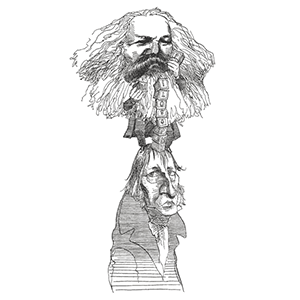
Historicism is doctrine that emphasizes the importance of history. It is a mode of thinking that assigns a central and basic significance to a specific context, such as historical period, geographical place and local culture. As such it is in contrast to individualist theories of knowledge such as empiricism and rationalism, which often discount the role of traditions. Historicism therefore tends to be hermeneutical (investigative of interpretations), because it places great importance on cautious, rigorous and contextualized interpretation of information and/or relativist (in support of the theory that knowledge is always relative to limitations of the mind), because it rejects notions of universal, fundamental and immutable interpretations.
The term has developed different and divergent, though loosely related, meanings. Elements of historicism appear in the writings of Italian philosopher G. B. Vico and French essayist Michel de Montaigne, and became fully developed with the dialectic of G. W. F. Hegel, influential in 19th-century Europe. The writings of Karl Marx, influenced by Hegel, also contain historicism. The term is also associated with the empirical social sciences and the work of Franz Boas. Historicism may be contrasted with reductionist theories, which suppose that all developments can be explained by fundamental principles (such as in economic determinism), or theories that posit historical changes as result of random chance. The theological use of the word denotes the interpretation of biblical prophecy as being related to church history. Post-structuralism uses the term New Historicism, which has some connections to both anthropology and Hegelianism.
Posted in Philosophy, Politics, Science |
1 Comment »
February 7, 2012

The phrase snake oil is as a derogatory term used to describe quackery, the promotion of fraudulent or unproven medical practices. The expression is also applied metaphorically to any product with questionable and/or unverifiable quality or benefit. By extension, the term ‘snake oil salesman’ may be applied to someone who sells fraudulent goods, or who is a fraud himself.
The phrase originates with a topical preparation made from the Chinese Water Snake. Chinese laborers on railroad gangs involved in building the First Transcontinental Railroad first gave snake oil to Europeans with joint pain. When rubbed on the skin at the painful site, snake oil was claimed to bring relief. This claim was ridiculed by rival medicine salesmen, and in time, snake oil became a generic name for many compounds marketed as panaceas or miraculous remedies whose ingredients were usually secret, unidentified, or mis-characterized and mostly inert or ineffective.
read more »
Posted in Drugs, Health, Politics |
Leave a Comment »
February 7, 2012

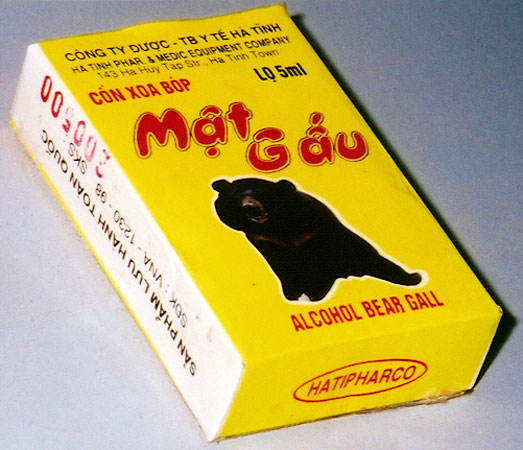
Bile bears or battery bears are Asiatic black bears kept in captivity in China and Vietnam to harvest bile, a digestive juice produced by the liver and stored in the gall bladder. When extracted, the bile is a valuable commodity for sale as an ingredient in traditional Chinese medicine (TCM).
The bears are also known as moon bears because of the cream-colored crescent moon shape on their chest. The Asiatic black bear, the one most commonly used on bear farms, is listed as vulnerable on the World Conservation Union’s (IUCN’s) Red List of Threatened Animals.
read more »
Posted in Health, Politics, World |
Leave a Comment »
February 6, 2012
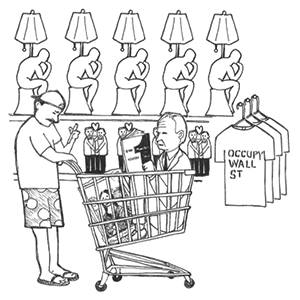
False consciousness is the Marxist thesis that material and institutional processes in capitalist society are misleading to the proletariat, and to other classes. These processes betray the true relations of forces between those classes, and the real state of affairs regarding the development of pre-socialist society (relative to the secular development of human society in general).
In Marxist theory, false consciousness is essentially a result of ideological control which the proletariat either do not know they are under or which they disregard with a view to their own POUM (probability/possibility of upward mobility). POUM or something like it is required in economics with its presumption of rational agency; otherwise wage laborers would be the conscious supporters of social relations antithetical to their own interests, violating that presumption.
read more »
Posted in Money, Politics |
1 Comment »
February 5, 2012

Parachuting Rat is an artwork in Melbourne, Australia created by Banksy in 2003. In 2010 it was painted over by council contractors, leading to local and international coverage and debate on the nature of street art and its preservation, and new measures for its protection. Parachuting Rat is a purple rat with aviator glasses descending by parachute. Banksy’s oeuvre is largely directed towards anti-capitalist and anti-war themes.
Banksy’s work is described as distinctive in style, satirical, and provocative. Banksy himself has written, in connection with his works involving rats, ‘they exist without permission. They are hated, hunted and persecuted … if you are dirty, insignificant and unloved then rats are the ultimate role model’; that ‘you can win the rat race but you’re still a rat’; and also that he had been painting rats for three years before someone told him that the word is an anagram of art.
read more »
Posted in Art, Money, Politics |
3 Comments »
February 4, 2012
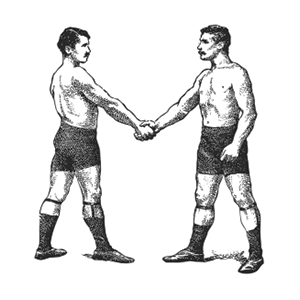
A gentlemen’s agreement is an informal agreement between two or more parties. It is typically oral, though may be written, or simply understood as part of an unspoken agreement by convention or through mutually beneficial etiquette.
The essence of a gentlemen’s agreement is that it relies upon the honor of the parties for its fulfillment, rather than being in any way enforceable. It is, therefore, distinct from a legal agreement or contract, which can be enforced if necessary. A variation on the gentlemen’s agreement is the gentlemen’s bet, wherein there is nothing to win or lose through the bet, other than the honor of winning and shame of losing.
read more »
Posted in Language, Money, Politics |
Leave a Comment »
February 3, 2012
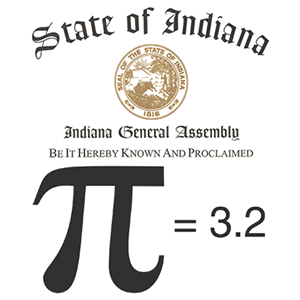
The Indiana Pi Bill is the popular name for bill #246 of the 1897 sitting of the Indiana General Assembly, one of the most famous attempts to establish scientific truth by legislative fiat. Despite that name, the main result claimed by the bill is a method to square the circle, rather than to establish a certain value for the mathematical constant π (pi), the ratio of the circumference of a circle to its diameter. However, the bill does contain text that appears to dictate various incorrect values of π, such as 3.2.
The bill never became law, due to the intervention of a mathematics professor who happened to be present in the legislature. The impossibility of squaring the circle using only compass and straightedge, suspected since ancient times, was rigorously proved in 1882 by Ferdinand von Lindemann. Better approximations of π than those inferred from the bill have been known since ancient times.
read more »
Posted in Humor, Politics, Science |
1 Comment »
January 30, 2012
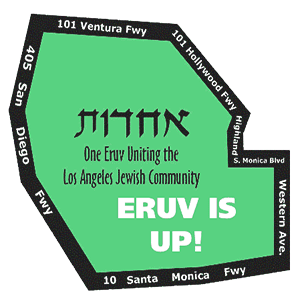
An eruv [air-oov] is a ritual enclosure that orthodox Jewish communities construct in their neighborhoods as a way to permit carrying objects outdoors on Shabbat, which they would otherwise understand to be prohibited by Jewish law (Halakha). There are 39 categories of activity prohibited on Shabbat including moving an object from one domain to another, no matter its weight or purpose. The prohibition is not found in the Torah, but in the Talmud (Rabbinical law and commentary).
The eruv permits traditionally observant Jews to, among other things, carry keys, tissues, medicines, or babies with them, and to use strollers and canes. According to tradition, the eruv must be made of walls or doorways at least one meter in height. In public areas where it is impractical to put up walls, doorways are constructed out of wire and posts. It is these doorways, which often serve no practical purpose, that are what is usually referred to as an eruv.
read more »
Posted in Philosophy, Politics |
Leave a Comment »
January 30, 2012

The Pareto [pah-re-taw] principle states that, for many events, roughly 80% of the effects come from 20% of the causes. Business-management consultant Joseph M. Juran suggested the principle and named it after Italian economist Vilfredo Pareto, who observed in 1906 that 80% of the land in Italy was owned by 20% of the population. He then carried out surveys on a variety of other countries and found to his surprise that a similar distribution applied. He even found that 20% of the pea pods in his garden contained 80% of the peas.
It is a common rule of thumb in business; e.g., ‘80% of your sales come from 20% of your clients.’ The Pareto principle is only tangentially related to Pareto efficiency, which was also introduced by the same economist. Pareto developed both concepts in the context of the distribution of income and wealth among the population.
Posted in Money, Politics, World |
Leave a Comment »
January 30, 2012
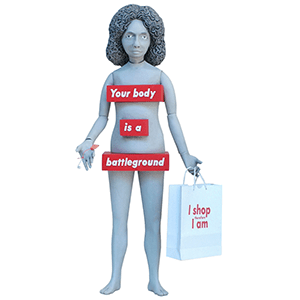
Barbara Kruger (b. 1945) is an American conceptual artist. Much of her work consists of black-and-white photographs overlaid with declarative captions—in white-on-red Futura Bold Oblique or Helvetica Ultra Condensed. The phrases in her works often include use of pronouns such as ‘you,’ ‘your,’ ‘I,’ ‘we,’ and ‘they.’ Much of Kruger’s work engages the merging of found photographs from existing sources with pithy and aggressive text that involves the viewer in the struggle for power and control that her captions speak to. In their trademark white letters against a slash of red background, some of her instantly recognizable slogans read ‘I shop therefore I am,’ and ‘Your body is a battleground.’
Much of her text questions the viewer about feminism, consumerism, and individual autonomy and desire, although her black-and-white images are culled from the mainstream magazines that sell the very ideas she is disputing. Kruger juxtaposes imagery and text critical of sexism; the circulation of power within cultures is a recurring motif in her work. A larger category that threads through her work is the appropriation and alteration of existing images. The importance of appropriation art in contemporary culture lay in its ability to play with preponderant imagistic and textual conventions: to mash up meanings and create new ones.
Posted in Art, Money, Politics |
Leave a Comment »