June 27, 2011

Inside Job is a 2010 documentary film about the financial crisis of 2007–2010 directed by Charles H. Ferguson, who has described the film as being about ‘the systemic corruption of the United States by the financial services industry and the consequences of that systemic corruption.’ In five parts the film explores how changes in the policy environment and banking practices helped create the 2008 financial crisis.
The film focuses on changes in the financial industry in the decade leading up to the crisis, the political movement toward deregulation, and how the development of complex trading such as the derivatives market allowed for large increases in risk taking that circumvented older regulations that were intended to control systemic risk.
read more »
Posted in Money, Politics |
Leave a Comment »
June 27, 2011
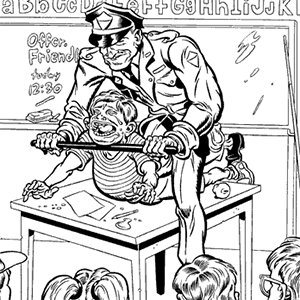
Loompanics Unlimited was an American book seller and publisher specializing in nonfiction on generally unconventional or controversial topics, with a philosophy arguably tending to a mixture of libertarian and left wing ideals, although Loompanics carried books expressing other political viewpoints (including far right) as well as outspokenly apolitical ones. The topics in their title list included drugs, weapons, anarchism, sex, and conspiracy theory, among others. Many of their titles describe some illicit or extralegal actions, such as ‘Counterfeit I.D. Made Easy,’ while others are purely informative, like ‘Opium for the Masses.’
Mike Hoy started Loompanics Unlimited in East Lansing, Michigan, in 1975. He later moved the business to Port Townsend, Washington, where his friend and fellow publisher R.W. Bradford had earlier located. The company’s name is a play on words inspired by Hoy’s fondness for National Lampoon.
read more »
Posted in Money, Philosophy, Politics |
Leave a Comment »
June 27, 2011

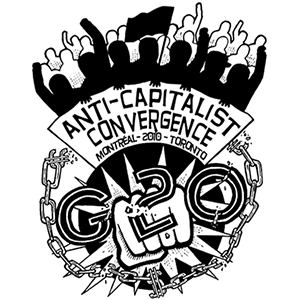
CrimethInc. is a decentralized anarchist collective of autonomous cells. It emerged in the mid-1990s, initially as the hardcore zine ‘Inside Front,’ and began operating as a collective in 1996. It has since published widely read articles and zines for the anarchist movement and distributed posters and books of its own publication.
In their own words, ‘Crimethought is not any ideology or value system or lifestyle, but rather a way of challenging all ideologies and value systems and lifestyles—and, for the advanced agent, a way of making all ideologies, value systems, and lifestyles challenging.’
read more »
Posted in Money, Politics |
Leave a Comment »
June 27, 2011

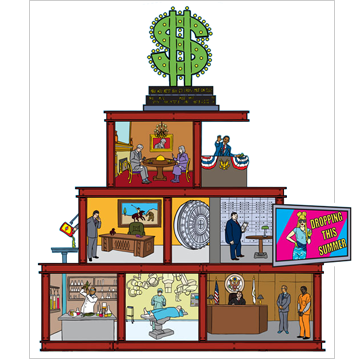
Work is a book published by Crimethinc Far East, a decentralized anarchist publishing collective. It covers a wide range of economic, political, and philosophical issues, mostly relating to the ethical and utilitarian implications of Capitalism. Central to the book’s theme is that Capitalism is inherently immoral and inevitably causes massive wealth inequality and degradation of general human experience.
The book focuses specifically on the causes and effects crises suffered by capitalist economies, such as the 2008 financial crisis, and how the people can subvert global Capitalism to create a better future. The book features an ‘updated’ version of the Pyramid of the Capitalist System, designed by American artist, Packard Jennings, on the inside flap.
Posted in Money, Philosophy, Politics |
Leave a Comment »
June 27, 2011

‘He who does not work, neither shall he eat‘ is a Biblical aphorism derived from Paul’s letter to the Thessalonians, which became a slogan for new colonies and socialist societies. The slogan was used by Captain John Smith in setting up the English colony of Jamestown, Virginia after his experiment with the common store system, or socialism, was abandoned. According to Soviet leader Vladimir Lenin, it is the first principle of socialism. The phrase is mentioned in his 1917 work, ‘State and Revolution.’ Through this slogan Lenin explains that in socialist states only productive individuals would be allowed access to the articles of consumption.
This is not really directed at lazy or unproductive workers, but rather the bourgeoisie. Marxist theory holds that the bourgeoisie buy the commodity labor-power of workers and enlists them in the process of production. Profits are then made by the expropriation of surplus value. Accordingly, in a communist society, with the abolition of property and the law of value, there would be no class of individuals that lives off the labor of others. The principle would not apply to those who could not work, such as the elderly or the lame. These groups would have a right to society’s products because they were not at fault for their condition. The elderly, furthermore had worked during their youth, and so could not be denied life’s basic necessities.
Posted in Money, Politics, World |
Leave a Comment »
June 27, 2011
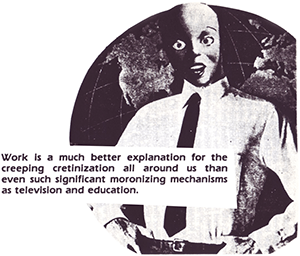
‘The Abolition of Work‘ is an essay written by American anarchist, Bob Black in 1985. The essay was part of an anthology of essays entitled ‘The Abolition of Work and Other Essays’ published by Loompanics (a publisher specializing in nonfiction on generally unconventional or controversial topics).
It is an exposition of Black’s ‘type 3 anarchism’ – a blend of post-Situationist theory and individualist anarchism – focusing on a critique of the work ethic. He adopted Situationist tropes that had recently been re-popularized (or recuperated) by pop bands of the time (Bow Wow Wow in particular having earlier featured ‘demolition of the work ethic’ and ‘there’s no need to work ever’ among similar lines in their lyrics).
read more »
Posted in Money, Philosophy, Politics |
Leave a Comment »
June 27, 2011


A flat tax is a tax system with a constant tax rate. A flat tax may also be called a tax in rem (‘against the thing’), such as an excise tax on gasoline of three cents per gallon. Usually the term flat tax refers to household income (and sometimes corporate profits) being taxed at one marginal rate, in contrast with progressive or regressive taxes that vary according to parameters such as income or usage levels. Flat taxes offer simplicity in the tax code, which has been reported to increase compliance and decrease administration costs. Proposals differ in how they define and measure what is subject to tax. A ‘true flat rate tax’ is a system of taxation where one tax rate is applied to all income with no exceptions.
Critics of the flat tax argue that the marginal dollar to low income individuals is vastly more vital than that of the high income earner, especially around the poverty level. In their view this justifies a progressive taxation system as the added income gained from a flat tax rate to the rich would not be spent on vital goods and services for survival as they might at the poverty level with reduced taxation. However, true Flat tax proponents necessarily contest the concept of the diminishing marginal utility of money and that a marginal dollar should be taxed differently.
read more »
Posted in Money, Politics, World |
Leave a Comment »
June 27, 2011
A consumption tax is a tax on spending on goods and services. Consumption taxes are usually indirect, such as a sales tax or a value added tax. However, a consumption tax can also be structured as a form of direct, personal taxation, such as an expenditure tax (a tax levied on the total consumption expenditure of an individual).
Consumption taxes do not tax savings, which allows invested assets to grow more quickly. Although personal and corporate income taxes provide the bulk of revenue to the federal government, consumption taxes continue to be a primary source of income for state and local governments.
read more »
Posted in Money, Politics |
Leave a Comment »
June 24, 2011

The candy desk is a tradition of the United States Senate established in 1968. The desk, located on the Republican side of the Senate chamber, was first stocked with candy and treats by Senator George Murphy. Those entrusted with the candy desk have included John McCain, Slade Gorton, Bob Bennett, and Rick Santorum. Most senators take advantage of the desk, even though eating is not allowed on the Senate floor. The desk is currently occupied by Senator Mark Kirk of Illinois.
The tenant of the candy desk is charged with stocking it with candy from his or her home state, but funding has been an issue. Originally senators would ask for a specific candy and leave a few dollars to keep the desk stocked with their favorites, but as time continued, and the candy desk became a more solid tradition of the Senate, lobby groups and organizations, specifically the National Confectioners Association, and the Chocolate Manufacturers Association, organized donations.
read more »
Posted in Food, Humor, Politics |
Leave a Comment »
June 21, 2011
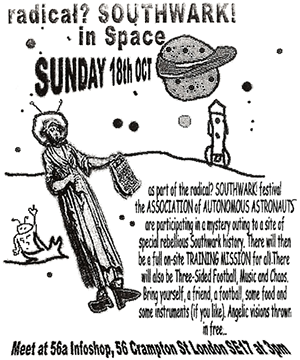
The Association of Autonomous Astronauts is a worldwide network of community based groups dedicated to building their own spaceships. The AAA was founded in 1995. Although many of their activities were reported as serious participation in conferences or protests against the militarization of space, some were also considered art pranks, media pranks, or just an elaborate spoof. The AAA had numerous local chapters which operated independently of one another, with the AAA effectively operating as a collective pseudonym along the lines of a nom de plume.
The Association’s ostensible five-year mission, a reference to Star Trek, was to ‘establish a planetary network to end the monopoly of corporations, governments and the military over travel in space.’ Artists who became involved were often connected to the zine scene or mail art movements. The five year mission’s completion was marked at the 2000 Fortean Times conference, although some chapters have continued activities to the present day. Several AAAers have experienced zero-gravity training flights.
read more »
Posted in Art, Politics, Technology |
Leave a Comment »
June 20, 2011

Scribing is a style of graffiti in which a sharp, metal scribe is used to tag a glass surfaces. Tagging refers to the application of a graffiti artist’s pseudonym to a surface, typically somewhere public and not permitted. There are two popular types: the ‘arrowhead scribe,’ held between the thumb and index finger, used for quick connectable-style tags on glass; and the ‘pen scribe,’ usually used for more detailed tagging. Scribing can be loud, especially when doing complicated pieces on glass. Etching is a related technique which uses acidic, caustic, or abrasive substances.
Scribing is also a technique used in the corporate world to visually-document concepts in a graphic format. Companies such as The WildWorks Group and Griot’s Eye take conversations and convert them in real time on whiteboard walls or storyboards surrounding participants. As the brainstorming session flows, ‘scribes’ translate the main ideas of the conversation into keywords and graphics. The exercise is dynamic in helping to capture concepts that are sometimes lost in a flow of words. It also helps to reinforce thoughts for people who are visual learners.
Posted in Art, Politics |
Leave a Comment »
June 15, 2011


David Eagleman (b. 1971) is a neuroscientist at Baylor College of Medicine, where he directs the Laboratory for Perception and Action and the Initiative on Neuroscience and Law. He is best known for his work on time perception, synesthesia, and neurolaw. He is also an internationally bestselling fiction writer.
An early experience of falling from a roof raised his interest in understanding the neural basis of time perception. Eagleman’s scientific work combines psychophysical, behavioral, and computational approaches to address the relationship between the timing of perception and the timing of neural signals.
read more »
Posted in Art, Politics, Science |
Leave a Comment »




 The Daily Omnivore