May 24, 2011

A progress trap is the condition human societies experience when, in pursuing progress through human ingenuity, they inadvertently introduce problems they do not have the resources or political will to solve, for fear of short-term losses in status, stability or quality of life. This prevents further progress and sometimes leads to collapse.
The central problem one of scale and political will. The error is often to extrapolate from what appears to work well on a small scale to a larger scale, which depletes natural resources and causes environmental degradation. Large-scale implementation also tends to be subject to diminishing returns. As overpopulation, erosion, greenhouse gas emissions or other consequences become apparent, society is destabilized.
read more »
Posted in Money, Politics, Technology |
Leave a Comment »
May 24, 2011
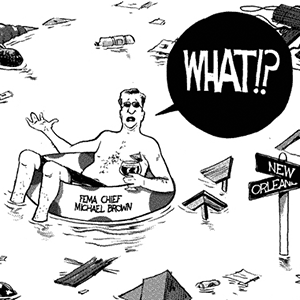
A sinecure [sahy-ni-kyoor] (Latin: sine ‘without,’ cura ‘care’) means an office that requires or involves little or no responsibility, labor, or active service. Sinecures have historically provided a potent tool for governments or monarchs to distribute patronage, while recipients are able to store up titles and easy salaries.
A sinecure is not necessarily a figurehead, which generally requires active participation in government, albeit with a lack of power. A sinecure, by contrast, has no real day-to-day responsibilities, but may have de jure power.
Posted in Language, Money, Politics |
Leave a Comment »
May 21, 2011

Robert Hare (b. 1934) is a Canadian researcher renowned in the field of criminal psychology. He developed the Psychopathy Checklist (PCL) and Psychopathy Checklist Revised (PCL-R), used to diagnose cases of psychopathy and also useful in predicting the likelihood of violent behavior, and is professor emeritus of the University of British Columbia where his studies center on psychopathology and psychophysiology.
In contemporary research and clinical practice, Robert D. Hare’s Psychopathy Checklist-Revised (PCL-R) is the psycho-diagnostic tool most commonly used to assess psychopathy.
read more »
Posted in Health, Politics, Science |
Leave a Comment »
May 20, 2011

Lawrence Lessig (b. 1961) is an American academic and political activist. He is best known as a proponent of reduced legal restrictions on copyright, trademark, and radio frequency spectrum, particularly in technology applications. He is a professor of law at Harvard Law School. Lessig is a founding board member of Creative Commons, a board member of the Software Freedom Law Center, an advisory board member of the Sunlight Foundation, and a former board member of the Electronic Frontier Foundation.
After graduating from law school, he clerked for a year for Judge Richard Posner, at the 7th Circuit Court of Appeals in Chicago, Illinois and another year for Justice Antonin Scalia at the Supreme Court. Lessig has emphasized in interviews that his philosophy experience at Cambridge radically changed his values and career path. Previously, he had held strong conservative or libertarian political views, desired a career in business, was a highly active Teenage Republican, and in 1978 and almost pursued a Republican political career.
Posted in Money, Politics |
Leave a Comment »
May 20, 2011

RiP!: A Remix Manifesto is a 2008 open source documentary film about the changing concept of copyright directed by Brett Gaylor.
Created over a period of six years, the documentary film features the collaborative remix work of hundreds of people who have contributed to the Open Source Cinema website, helping to create the ‘world’s first open source documentary.’ Gaylor encourages people to create their own remixes from this movie, using media available from the Open Source Cinema website, or other websites like YouTube, Flickr, Hulu, or MySpace.
Posted in Art, Money, Politics |
1 Comment »
May 20, 2011

RTMark is an activist collective that attempts to subverts the ‘Corporate Shield’ protecting US corporations.
The name is derived from ‘Registered Trademark.’ RTMark claimed as its first prank the ‘Barbie Liberation Organization,’ in which the voiceboxes of talking Barbie and G.I. Joe toys were swapped, and the toys then returned to the store (1993).
Posted in Humor, Money, Politics |
Leave a Comment »
May 20, 2011
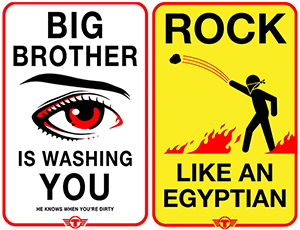

TrustoCorp is an artist or a group of artists based in New York City.
They are known for their humorous street signs and product labels, which can be found in New York City, San Francisco, San Diego, and Miami.
Posted in Art, Money, Politics |
Leave a Comment »
May 20, 2011

Illegal Art is a sampling label that was started by a person using the name Philo T. Farnsworth in 1998. Its first release was ‘Deconstructing Beck,’ a compilation made exclusively from sampling Beck’s music. This was followed by two other theme-based compilations, ‘Extracted Celluloid’ and ‘Commercial Ad Hoc.’
All three were co-released on Seeland Records, an independent record label created by experimental music band Negativland in 1979 to release their own recordings. The releases were also sponsored by RTMark, an activist collective formed to fight the unchecked growth of corporate interests. After these theme based compilations, Illegal Art focused on artist releases. One of the most popular artists on Illegal Art is Girl Talk (aka Gregg Gillis), who in 2006 released his third album, Night Ripper, to critical acclaim on the label. Illegal Art also released the Steinski Retrospective, spanning his work from 1983-2006.
Posted in Art, Money, Politics |
Leave a Comment »
May 20, 2011


Gregg Michael Gillis (b. 1981), better known by his stage name Girl Talk, is an American musician specializing in mashups and digital sampling. Gillis has released five LPs on the record label Illegal Art. He ended his career in biomedical engineering in 2007 to focus solely on music. He uses often a dozen or more unauthorized samples from different songs to create a new song. He cites fair use as a legal backbone for his sampling practices. After the success of his album Feed the Animals, for which listeners were asked to pay a price of their choosing, Gillis made all of his other albums similarly available via the Illegal Art website.
Regarding his stage name, Gillis has said, ‘the name Girl Talk is a reference to many things, products, magazines, books. It’s a pop culture phrase. The whole point of choosing the name early on was basically to just stir things up a little within the small scene I was operating from. I came from a more experimental background and there were some very overly serious, borderline academic type electronic musicians. I wanted to pick a name that they would be embarrassed to play with. You know Girl Talk sounded exactly the opposite of a man playing a laptop, so that’s what I chose.’
Posted in Art, Money, Politics |
Leave a Comment »
May 19, 2011
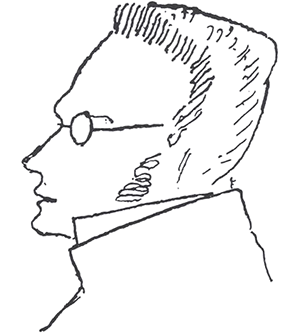
Johann Kaspar Schmidt (1806 – 1856), better known as Max Stirner (the nom de plume he adopted from a schoolyard nickname he had acquired as a child because of his high brow, in German ‘Stirn’), was a German philosopher, who ranks as one of the literary fathers of nihilism, existentialism, post-modernism and anarchism.
Stirner’s main work is ‘The Ego and Its Own’ (‘Der Einzige und sein Eigentum’), published in 1844 in Leipzig. It is a a radical anti-authoritarian and individualist critique of contemporary Prussian society, and modern western society.
read more »
Posted in Philosophy, Politics |
Leave a Comment »
May 18, 2011

Bitcoin is a digital currency created in 2009 by Satoshi Nakamoto. It is also the name of the open source software he designed that uses it, and the peer-to-peer network that it forms. Unlike most currencies, bitcoin does not rely on a central issuer, like a bank or government.Bitcoin uses a distributed database across a peer-to-peer computer network to record transactions, and uses cryptography to provide basic security functions, such as ensuring that bitcoins can only be spent once, and only by the person who owns them.
Bitcoin’s design allows for anonymous ownership and transfers of value. Bitcoins can be saved on a personal computer in the form of a wallet file or kept with a third party wallet service, and in either case Bitcoins can be sent over the Internet to anyone with a Bitcoin address. Bitcoin’s peer-to-peer topology and lack of central administration make it impossible for any government or other authority to change the value of bitcoins or induce inflation by producing more of them.
read more »
Posted in Money, Politics, Technology |
1 Comment »
May 18, 2011

The North American Currency Union is a theoretical economic and monetary union of three North American countries: Canada, the United States and Mexico. The hypothetical currency for the union is most often referred to as the amero. Conspiracy theorists contend that the governments of the United States, Canada, and Mexico are already taking steps to implement such a currency, as part of a ‘North American Union (NAU).’
In 2007, rumors and conspiracy theories began circulating across the Internet regarding alleged United States Treasury-issued amero coins. The inspiration behind these rumors may have been the posting of images of medallions created by coin designer Daniel Carr. Carr, who designed the New York and Rhode Island 2001 statehood quarters, sells medals and tokens of his own design on his commercial website, ‘Designs Computed.’ Among his designs are a series of gold, silver and copper fantasy issues of amero coins ranging in denomination from one to one thousand.
Posted in Money, Politics, World |
Leave a Comment »




 The Daily Omnivore