October 18, 2014

Bluma Zeigarnik (1901 – 1988) was a Soviet psychologist and psychiatrist who discovered the Zeigarnik [zy-gar-nik] effect, which states that people remember uncompleted or interrupted tasks better than completed tasks. She first studied the phenomenon after her professor, Gestalt psychologist Kurt Lewin, noticed that a waiter had better recollections of still unpaid orders. However, after the completion of the task – after everyone had paid – he was unable to remember any more details of the orders.
The advantage of remembrance can be explained by looking at Lewin’s field theory (a framework which examines patterns of interaction between the individual and the total field, or environment): a task that has already been started establishes a task-specific tension, which improves cognitive accessibility of the relevant contents. Task completion alleviates the tension. In case of task interruption the reduction of tension is impeded. Through continuous tension the content is easier accessible and it can be easily remembered.
read more »
Posted in Health, Science |
Leave a Comment »
October 17, 2014

The behavioral immune system is a phrase coined by psychologist Mark Schaller of the University of British Columbia to refer to a suite of psychological mechanisms that allow individual organisms to detect the potential presence of disease-causing parasites in their immediate environment, and to engage in behaviors that prevent contact with those objects and individuals (or remediate their effects).
These mechanisms include sensory processes through which cues connoting the presence of parasitic infections are perceived (e.g., the smell of a foul odor, the sight of pox or pustules), as well as stimulus–response systems through which these sensory cues trigger a cascade of aversive affective, cognitive, and behavioral reactions (e.g., arousal of disgust, automatic activation of cognitions that connote the threat of disease, behavioral avoidance).
read more »
Posted in Health, Science |
Leave a Comment »
September 30, 2014

Bayesian [bey-zee-uhn] probability is the likelihood that something will happen based on all available evidence. The more commonly understood concept of frequency probability is the chance that something will happen based only on past occurrences. Rather than interpreting probability as merely the propensity of some phenomenon, Bayesian probability is a quantity assigned for the purpose of representing a state of knowledge, or a state of belief. This allows the application of probability to all sorts of propositions rather than just ones that come with a reference class (historical data).
‘Prior probability’ is information about a hypothesis known before the experiment is undertaken (e.g. a flipped coin has a 50% chance of landing on heads), information learned afterwards is called ‘Posterior probability’ (e.g. if a coin lands on heads many times in a row it is probably improperly weighted). The term ‘Bayesian’ refers to 18th century mathematician and theologian Thomas Bayes, who summarized the theory thusly: ‘The probability of any event is the ratio between the value at which an expectation depending on the happening of the event ought to be computed, and the value of the thing expected upon its happening.’ (i.e. Likelihood equals Prior probability over Posterior probability.)
read more »
Posted in Science |
Leave a Comment »
September 24, 2014
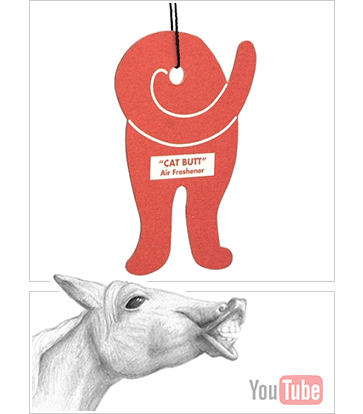
The flehmen [fley-muhn] response is a common animal behavior when investigating sites of particular interest (e.g. a male smelling female urine) characterized by curling back the top lips exposing the front teeth and gums, then inhaling and holding the posture for several seconds. The behavior may be performed over particular locations, in which case the animal may also lick the site of interest, or it may be performed with the neck stretched and head held high in the air.
Flehmen (German: ‘to bare the upper teeth’) is performed by a wide range of mammals including ungulates (hoofed animals) and felids (cats). The behavior facilitates the transfer of pheromones and other scents into the vomeronasal organ (pheromone detector) located above the roof of the mouth via a duct which exits just behind the front teeth of the animal.
read more »
Posted in Science, Sex |
Leave a Comment »
September 23, 2014
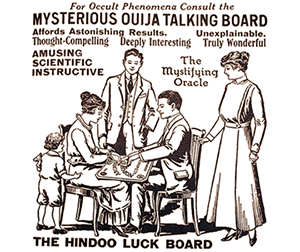

The ideomotor [id-ee-uh-moh-ter] effect is a psychological phenomenon wherein a subject makes motions unconsciously; for example, the body produces tears in response to powerful emotions without the person consciously deciding to cry. As in involuntary responses to pain, the body sometimes reacts reflexively to ideas alone without the person consciously deciding to take action.
The effects of automatic writing (an alleged psychic ability allowing a person to produce written words without consciously writing), dowsing (a type of divination employed in attempts to locate ground water without the use of scientific tools), facilitated communication (a process by which a person supports the hand or arm of a communicatively impaired individual while using a keyboard), and Ouija boards have been attributed to the phenomenon. Mystics have often attributed these effects to paranormal or supernatural force. Many subjects are unconvinced that their actions are originating solely from within themselves.
read more »
Posted in Health, Philosophy, Science |
Leave a Comment »
September 22, 2014
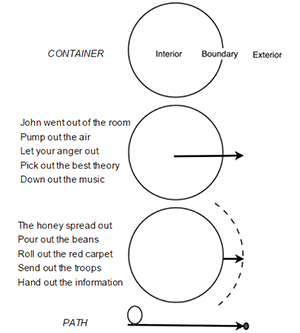
Embodied Cognition is a theory stating that the nature of the human mind is largely determined by the form of the human body. Philosophers, psychologists, cognitive scientists, and artificial intelligence researchers who study the ’embodied mind’ argue that all aspects of cognition are shaped by the body, such as high level mental constructs (e.g. concepts, categories) and performance on various intellectual tasks (e.g. reasoning, judgment). These mental processes are limited by physical ones, such as the motor and perceptual systems, the body’s interactions with the environment (situatedness), and the ontological assumptions about the world that are built into the body and the brain.
In social psychology, embodiment is relevant to studies of social interaction and decision-making. According to embodied cognition, the motor system influences our cognition, just as the mind influences bodily actions. For example, when participants hold a pencil in their teeth engaging the muscles of a smile, they comprehend pleasant sentences faster than unpleasant ones, while holding a pencil between their nose and upper lip to engage the muscles of a frown has the reverse effect.
read more »
Posted in Philosophy, Science |
Leave a Comment »
September 18, 2014

Mental rotation is the ability to rotate mental representations of two-dimensional and three-dimensional objects. The ability is somewhat localized to the right cerebral hemisphere, largely in the same areas as perception, and is associated with spatial processing and general intelligence but not verbal skills.
Mental rotation is the brain moving objects in order to understand what they are and where they belong. It has been studied to try to figure out how the mind recognizes objects in the environment. Researchers call these objects stimuli. A stimulus then would be any object or image seen in the person’s environment that has been altered in some way. Mental rotation then takes place for the person to figure out what the altered object is.
read more »
Posted in Education, Games, Science |
Leave a Comment »
September 17, 2014

Error Management (EM) is an extensive theory of perception and cognitive biases that was created by psychologists David Buss and Martie Haselton. They describe a set of heuristics (mental shortcuts) that have survived evolutionary history because they hold slight reproductive benefits. The premise of the theory is built around the drive to reduce or manage costly reproductive errors. According to the theory, when there are differences in the cost of errors made under conditions of uncertainty, selection favors ‘adaptive biases,’ which ensure that the less costly survival or reproductive error will be committed.
When faced with uncertainty, a subject can make two possible errors: type I (false-positive or playing it safe, e.g. a fire alarm that later turns out to be a false alarm) and type II (false-negative or siding with skepticism, e.g. ignoring an often faulty fire alarm during an actual emergency). Error Management Theory asserts that evolved ‘mind-reading’ agencies will be biased to produce more for the first type of error, which explains the ‘sexual overperception bias,’ the tendency for men to incorrectly assume a platonic gesture from a woman is a sexual signal.
read more »
Posted in Health, Science, Sex |
Leave a Comment »
September 16, 2014

Blonde hair has several stereotypes associated with it. In women is has been considered attractive and desirable, but is also associate with the negative stereotypes of the women ‘who relies on her looks rather than on intelligence.’ The latter stereotype of a ‘dumb blonde’ is exploited in ‘blonde jokes.’ In cognitive linguistics, the stereotype uses expressivity of words to affect an emotional response which determines a gender role of a certain kind. In feminist critique, stereotypes like the blonde bombshell or the dumb blonde’ are seen as negative images that undermine the power of women.
Some blonde jokes rely on sexual humor to portray or stereotype their subjects as promiscuous. Many of these are rephrased ‘Valley girl’ or ‘Essex girl’ jokes. Others are based on long-running ethnic jokes, such as humor denigrating the intelligence of Polish people. Similar jokes about stereotyped minorities have circulated since the seventeenth century with only the wording and targeted groups changed. In 20th century, a class of meta-jokes about blondes (i.e. jokes about blonde jokes) has emerged where a blonde person complains about the unfairness of the stereotype propagated by blonde jokes, with a punch line actually reinforcing the stereotype.
read more »
Posted in Humor, Science, Sex |
Leave a Comment »
September 8, 2014
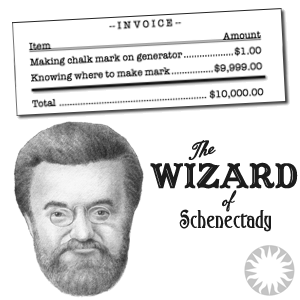
Charles Proteus Steinmetz (1865 – 1923) was a mathematician and electrical engineer known as the Wizard of Schenectady. He fostered the development of alternating current that made possible the expansion of the electric power industry in the US, formulating mathematical theories for engineers.
He made ground-breaking discoveries in the understanding of hysteresis (the lag time when magnetizing a ferromagnetic material) that enabled engineers to design better electromagnetic apparatus equipment, especially electric motors for use in industry.
read more »
Posted in Science, Technology |
Leave a Comment »
September 7, 2014
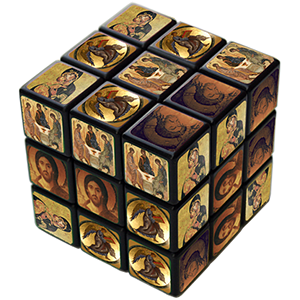
God’s algorithm is a notion originating in discussions of ways to solve the Rubik’s Cube puzzle, but which can also be applied to other combinatorial (sequential move) puzzles and mathematical games. It refers to any algorithm which produces a solution having the fewest possible number of moves, the idea being that an omniscient being would know an optimal step from any given configuration. The notion applies to puzzles that can assume a finite number of ‘configurations,’ with a relatively small, well-defined arsenal of ‘moves’ that may be applicable to configurations and then lead to a new configuration.
An algorithm for finding optimal solutions for Rubik’s Cube was published in 1997 by computer scientist Richard Korf. While it had been known since 1995 that 20 was a lower bound on the number of moves for the solution in the worst case, it was proved in 2010 through extensive computer calculations that no configuration requires more than 20 moves. Thus 20 is a sharp upper bound on the length of optimal solutions. This number is known as God’s number.
Posted in Games, Science |
1 Comment »
September 5, 2014
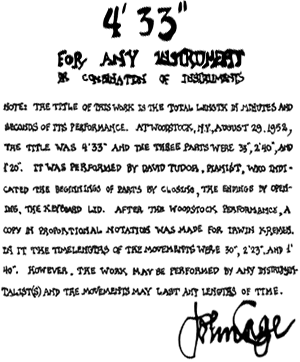
Silence is the lack of audible sound or presence of sounds of very low intensity. By analogy, the term also refers to an absence of communication, including in media other than speech. Silence is also used as ‘total communication,’ in reference to nonverbal communication and spiritual connection. It is an important factor in many cultural spectacles, as in rituals, both positive and negative. For example, in a Christian Methodist faith organization quiet reflection during a sermon might mean indicate assent, while in a Southern Baptist church, silence might mean disagreement with what is being said, or perhaps disconnectedness from the congregated community. A common way to remember a tragic incident is a commemorative moment of silence.
In discourse analysis, speakers use brief absences of speech to mark the boundaries of prosodic units (segments of speech that occurs with a single pitch and rhythm contour). Silence in speech can be hesitation, stutters, self-correction—or deliberate slowing of speech to clarify or aid processing of ideas. These are short silences; longer pauses in language occur in interactive roles, turn-taking, or reactive tokens (short utterance that indicate a listener is following a conversation).
read more »
Posted in Language, Philosophy, Science |
Leave a Comment »


 The Daily Omnivore