May 17, 2012

Social desirability bias is the tendency of respondents to answer questions in a manner that will be viewed favorably by others. It can take the form of over-reporting good behavior or under-reporting bad behavior. The tendency poses a serious problem with conducting research with self-reports, especially questionnaires. Topics of special concern are self-reports of abilities, personality, sexual behavior, and drug use.
When confronted with the question ‘How often do you masturbate?,’ for example, respondents may be pressured by the societal taboo against masturbation, and either under-report the frequency or avoid answering the question. Therefore the mean rates of masturbation derived from self-report surveys are likely to be severe underestimates.
read more »
Posted in Politics, Science, Sex |
Leave a Comment »
May 17, 2012

Emotional intelligence is a thought model that claims that to be successful, people must be able to know their own feelings. They must also be able to guess and influence the emotions of other people, and of groups of other people. There are several different models that disagree about the exact definition of the term. Criticisms have centered on whether the construct is a real intelligence and whether it has incremental validity over IQ and the Big Five personality dimensions.
The earliest roots of emotional intelligence can be traced to Charles Darwin’s work on the importance of emotional expression for survival and, second, adaptation. In the 1900s, even though traditional definitions of intelligence emphasized cognitive aspects such as memory and problem-solving, several influential researchers in the intelligence field of study had begun to recognize the importance of the non-cognitive aspects. For instance, as early as 1920, American psychologist E.L. Thorndike used the term ‘social intelligence’ to describe the skill of understanding and managing other people.
read more »
Posted in Health, Science |
Leave a Comment »
May 15, 2012

One of B.F. Skinner’s experiments examined the formation of superstition in one of his favorite experimental animals, the pigeon. Skinner placed a series of hungry pigeons in a cage attached to an automatic mechanism that delivered food to the pigeon ‘at regular intervals with no reference whatsoever to the bird’s behavior.’ He discovered that the pigeons associated the delivery of the food with whatever chance actions they had been performing as it was delivered, and that they subsequently continued to perform these same actions.
‘One bird was conditioned to turn counter-clockwise about the cage, making two or three turns between reinforcements. Another repeatedly thrust its head into one of the upper corners of the cage. A third developed a ‘tossing’ response, as if placing its head beneath an invisible bar and lifting it repeatedly. Two birds developed a pendulum motion of the head and body, in which the head was extended forward and swung from right to left with a sharp movement followed by a somewhat slower return.’
read more »
Posted in Philosophy, Science |
Leave a Comment »
May 11, 2012
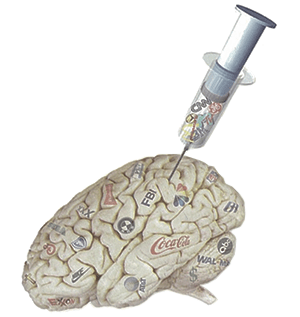
Memetics [meh-met-iks] is a controversial theory of mental content (e.g. thoughts, concepts, memories, emotions, percepts, intentions) based on an analogy with Darwinian evolution, originating from the popularization of Richard Dawkins’ 1976 book ‘The Selfish Gene.’ It purports to be an approach to evolutionary models of cultural information transfer. The meme, analogous to a gene, was conceived as a ‘unit of culture’ (an idea, belief, pattern of behavior, etc.) which is ‘hosted’ in one or more individual minds, and which can reproduce itself, thereby jumping from mind to mind.
Thus what would otherwise be regarded as one individual influencing another to adopt a belief is seen—when adopting the intentional stance—as an idea-replicator reproducing itself in a new host. As with genetics, particularly under a Dawkinsian interpretation, a meme’s success may be due to its contribution to the effectiveness of its host. Memetics is also notable for sidestepping the traditional concern with the truth of ideas and beliefs. Instead, it is interested in their success. The Usenet newsgroup alt.memetics was started in 1993.
read more »
Posted in Language, Philosophy, Science |
Leave a Comment »
May 9, 2012

The concept of geoengineering (or climate intervention) refers to the deliberate large-scale engineering and manipulation of the planetary environment to combat or counteract anthropogenic changes in atmospheric chemistry. The Intergovernmental Panel on Climate Change concluded in 2007 that geoengineering options, such as ocean fertilization to remove CO2 from the atmosphere, remained largely unproven. It was judged that reliable cost estimates for geoengineering had not yet been published.
Geoengineering accompanies Mitigation and Adaptation to form a three-stranded ‘MAG’ approach to tackling global warming, notably advocated by the Institution of Mechanical Engineers. Some geoengineering techniques are based on carbon dioxide removal (CDR), including direct methods (e.g. carbon dioxide air capture) and indirect methods (e.g. ocean iron fertilization). These techniques can be regarded as mitigation of global warming.
read more »
Posted in Science, Technology, World |
Leave a Comment »
May 8, 2012

Psychosomatic medicine is an interdisciplinary medical field studying the relationships of social, psychological, and behavioral factors on bodily processes and quality of life in humans and animals. The influence that the mind has over physical processes — including the manifestations of disabilities that are based on intellectual infirmities, rather than actual injuries or physical limitations — is manifested in treatment by phrases such as the power of suggestion, the use of ‘positive thinking,’ and concepts like ‘mind over matter.’
The academic forebear of the modern field of behavioral medicine and a part of the practice of consultation-liaison psychiatry, psychosomatic medicine integrates interdisciplinary evaluation and management involving diverse specialties including psychiatry, psychology, neurology, surgery, allergy, dermatology, and psychoneuroimmunology. Clinical situations where mental processes act as a major factor affecting medical outcomes are areas where psychosomatic medicine has competence.
read more »
Posted in Health, Philosophy, Science |
Leave a Comment »
May 7, 2012

The solar storm of 1859 was the most powerful solar storm in recorded history, and the largest flare; it was observed by British astronomer Richard Carrington. From August 28 to September 2 numerous sunspots and solar flares were observed on the sun.
Just before noon on September 1, Carrington observed the largest flare, which caused a massive coronal mass ejection (CME) to travel directly toward Earth, taking 17 hours. This is remarkable because such a journey normally takes three to four days. This second CME moved so quickly because the first one had cleared the way of the ambient solar wind plasma. The impact resulted in the largest geomagnetic storm ever recorded.
read more »
Posted in Science, World |
Leave a Comment »
May 7, 2012

Introversion [in-truh-vur-zhuhn] and Extroversion [ek-struh-vur-zhuhn] are terms popularized by Carl Jung in the 1920s to describes how a person gets energy from the world: introverts get energy from inside themselves (ideas and concepts in their own minds), and extroverts get energy from outside of themselves (interacting with other people).
The former can appear quiet and shy, and the latter loud and sociable; however, everyone has some parts of both traits in them, though one will usually dominate over the other. At one time, extroverts were thought to make up almost three-fourths of American society. Now, researchers typically assume that the number of extroverts is pretty much equal to the number of introverts in the country. Virtually all comprehensive models of personality include these concepts in various forms.
read more »
Posted in Health, Science |
1 Comment »
May 4, 2012

In visual perception, change blindness is the inability to detect changes in objects or scenes being viewed. It is a normal phenomenon of the brain which show in light that the brain does not have a precise representation of the world but a lacunar one, made of partial details. Despite the name, this phenomenon does not affect the eyes but the brain, and as such is bound to happen to all the human senses.
This phenomenon is still in research, but results suggests that the brain estimates the importance and usefulness of information prior to deciding to store them or not. Another issue is that the brain cannot see a change happening to an element that it has not yet stored. An example of change blindness can be seen in British illusionist Derren Brown’s ‘Person Swap’ sketch.
read more »
Posted in Health, Science |
1 Comment »
May 4, 2012

Inattentional blindness, also known as perceptual blindness, is when a person fails to notice some stimulus that is in plain sight. This stimulus is usually unexpected but fully visible. This typically happens when humans are overloaded with inputs. It is impossible to pay attention to every single input that is presented. A person’s attention cannot be focused on everything, and therefore, everyone experiences inattentional blindness. People can falsely believe that they do not experience inattentional blindness.
This is due to the fact that they are unaware that they are missing things. Inattentional blindness also has an effect on people’s perception. There have been multiple experiments performed that demonstrate this phenomenon. The term ‘inattentional blindness’ was coined by Arien Mack and Irvin Rock in 1992. It was used as the title of their book on the topic published by MIT Press in 1998.
read more »
Posted in Health, Humor, Science |
Leave a Comment »
May 3, 2012
Interlingua [in-ter-ling-gwuh] is a planned language using words that are found in most West-European languages. It was made by IALA – a group of people (the most known was Alexander Gode) that worked on it for more than 20 years, and they finished and published the first dictionary in 1951. Interlingua was created on the base of languages: English, French, Spanish, Portuguese, and Italian.
‘Inter’ means ‘between’ or ‘to each other’; ‘lingua’ means ‘language.’ The goal of the language was to enable people of different countries to talk to each other easily. Because Interlingua was made by people to be easy, it is easier than natural languages to learn. Many thousands of people know Interlingua, and Interlingua speakers say that millions can understand it (read texts in it and listen to someone talk in it) without having to learn it first.
read more »
Posted in Language, Science, World |
Leave a Comment »
May 3, 2012

Basic Color Terms: Their Universality and Evolution (1969) is a book by Brent Berlin and Paul Kay, who’s work proposed that the kinds of basic color terms a culture has, such as black, brown or red, are predictable by the number of color terms the culture has.
Berlin and Kay posit seven levels in which cultures fall, with Stage I languages having only the colors black (dark–cool) and white (light–warm). Languages in Stage VII have eight or more basic color terms. This includes English, which has eleven basic color terms.
read more »
Posted in Language, Science, World |
1 Comment »


 The Daily Omnivore