March 6, 2012

Eternal return is a concept which posits that the universe has been recurring, and will continue to recur, in a self-similar form an infinite number of times across infinite time or space. The concept, initially inherent in Indian philosophy, was later found in ancient Egypt and was subsequently taken up by the Pythagoreans and Stoics in Greece. With the decline of antiquity and the spread of Christianity, the concept fell into disuse in the western world, though Friedrich Nietzsche resurrected it as a thought experiment to argue for ‘amor fati’ (seeing everything that happens in one’s life, including suffering and loss, as good).
The basic premise proceeds from the assumption that the probability of a world coming into existence exactly like our own is finite. If either time or space are infinite, then mathematics tells us that our existence will recur an infinite number of times. In 1871, Louis Auguste Blanqui, assuming a Newtonian cosmology where time and space are infinite proceeded to show that the eternal recurrence was a mathematical certainty. In the post-Einstein period, there are doubts that time or space is in fact infinite, but many models exist which provide the notion of spatial or temporal infinity required by the eternal return hypothesis.
read more »
Posted in Death, Philosophy, Science |
Leave a Comment »
March 5, 2012

The Narwhal is a rarely seen Arctic whale known for the very long tooth that males have. The tusk’s function is uncertain, perhaps used as a formidable jousting weapon in courtship and dominance rivalry, in getting food, and/or for channeling and amplifying sonar pulses (which they emit), however the tusk is not used in hunting. Long ago, narwhal sightings probably reinforced (or started) the unicorn legends. At times, people found the horn of a dead narwhal washed up on shore and thought that they had found the horn of a unicorn. Narwhal can dive up to 1,500 meters; this makes them one of the deepest diving sea mammals.
Narwhals live in the icy waters of the Arctic seas. They do not go far away from ice and migrate in the summer closer to land where they can sometimes be seen in the estuaries, deep fjords, and bays of Greenland and Northern Canada. These groups can be as big as 10 or even as big as 100 sometimes. But when Winter comes around again, they move back to the icy waters, where they breath from small holes in the ice. Narwhals eat cod, shrimp and squid, and are hunted by polar bears and killer whales. The native Inuit people who are sometimes called the Eskimos, are allow to hunt the Narwhals for food.
Posted in Science |
Leave a Comment »
March 5, 2012

Active camouflage is camouflage which adapts to the actual surroundings of an object such as an animal or military vehicle. It is used in several groups of animals including cephalopods (e.g. squid, octopus) and flatfish in the sea, and reptiles on land (e.g. chameleon). Some sea creatures can counterilluminate (emit light to match the background) because in the sea, light comes down from the surface, so animals tend to appear dark when seen from below. Bioluminescence and color change also have other functions in animals including attracting prey and signalling mates.
In military usage, counterillumination camouflage was first investigated during the WWII for marine use. Current research aims at achieving crypsis (avoidance of detection) using cameras to sense the visible background, and panels or coatings which can vary their appearance. Military active camouflage has its origins in the diffused lighting camouflage tested on Canadian Navy corvettes during WWII. Later, a US Air Force program placed low-intensity blue lights on aircraft as counterillumination camouflage. As night skies are not pitch black, a 100 percent black-colored aircraft might be rendered visible.
Posted in Science, Technology, War |
1 Comment »
March 5, 2012
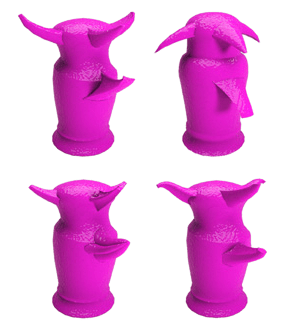
The Greebles refers to a category of novel objects used as stimuli in psychological studies of object and face recognition, created by Scott Yu at Yale University. They were named by the psychologist Robert Abelson. The greebles were created for Isabel Gauthier’s dissertation work at Yale, so as to share constraints with faces: they have a small number of parts in a common configuration.
This makes it difficult to distinguish any individual object on the basis of the presence of a feature, and this is thought to encourage the use of all features and the relationships between them. In other words, greebles, just like faces, can be processed configurally. Yu’s originals (both the symmetrical and asymmetrical sets) can be obtained from Michael Tarr.[1] Greebles appear in over 25 scientific articles.
Posted in Health, Science, Technology |
Leave a Comment »
March 5, 2012

PJ B Hancock and C Foster investigate the double face illusion, where the eyes and mouth are duplicated. On an identification task for briefly (80ms) presented faces, there are strong individual differences: doubling has little effect for the majority, but inhibits recognition for about a quarter of participants. A second experiment shows that some participants are unable to detect face doubling at this speed, while others are 100% correct at 50 ms.
Unlike the Thatcher illusion, a doubled face is still obvious when inverted, but it is less unsettling to look at and a third study found that participants were about 35 ms faster to decide that a face has been doubled when it is inverted. A final experiment tested visual search for normal and doubled faces; neither pops out from the other and the search time per item is again about 35 ms longer for double faces.
Posted in Science |
Leave a Comment »
March 4, 2012
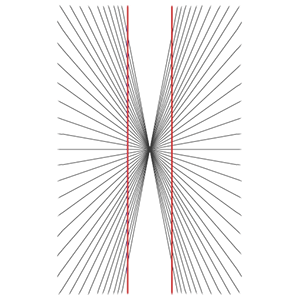
Researcher Mark Changizi of Rensselaer Polytechnic Institute in New York has a more imaginative take on optical illusions, saying that they are due to a neural lag which most humans experience while awake. When light hits the retina, about one-tenth of a second goes by before the brain translates the signal into a visual perception of the world. Scientists have known of the lag, yet they have debated how humans compensate, with some proposing that our motor system somehow modifies our movements to offset the delay.
Changizi asserts that the human visual system has evolved to compensate for neural delays by generating images of what will occur one-tenth of a second into the future. This foresight enables humans to react to events in the present, enabling humans to perform reflexive acts like catching a fly ball and to maneuver smoothly through a crowd. Illusions occur when our brains attempt to perceive the future, and those perceptions don’t match reality.
read more »
Posted in Science |
Leave a Comment »
March 1, 2012

A subtractive color model explains the mixing of paints, dyes, inks, and natural colorants to create a full range of colors, each caused by subtracting (that is, absorbing) some wavelengths of light and reflecting the others. The color that a surface displays depends on which colors of the electromagnetic spectrum are reflected by it and therefore made visible.
Subtractive color systems start with light, presumably white light. Next, colored inks, paints, or filters between the viewer and the light source subtract wavelengths from the light, giving it color. If the incident light is other than white, our visual mechanisms are able to compensate well, but not perfectly, often giving a flawed impression of the ‘true’ color of the surface. Conversely, additive color systems start without light (black). Light sources of various wavelengths combine to make a color. Often, three primary colors are combined to stimulate humans’ trichromatic color vision, sensed by the three types of cone cells in the eye, giving an apparently full range.
Posted in Science |
Leave a Comment »
March 1, 2012
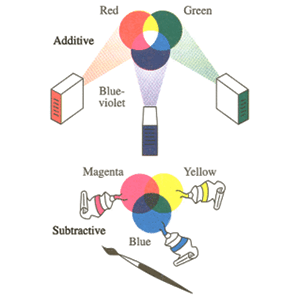
Additive color describes the situation where color is created by mixing the visible light emitted from differently colored light sources. This is in contrast to subtractive colors where light is removed from various part of the visible spectrum to create colors. Computer monitors and televisions are the most common form of additive light, while subtractive color is used in paints and pigments and color filters. The additive reproduction process usually uses red, green and blue light to produce the other colors. Combining one of these additive primary colors with another in equal amounts produces the additive secondary colors cyan, magenta, and yellow. The colored pixels in displays do not overlap on the screen, but when viewed from a sufficient distance, the light from the pixels diffuses to overlap on the retina.
Results obtained when mixing additive colors are often counterintuitive for people accustomed to the more everyday subtractive color system of pigments, dyes, inks and other substances which present color to the eye by reflection rather than emission. For example, in subtractive color systems green is a combination of yellow and blue; in additive color, red + green = yellow and no simple combination will yield green. Additive color is a result of the way the eye detects color, and is not a property of light. There is a vast difference between yellow light, with a wavelength of approximately 580 nm, and a mixture of red and green light. However, both stimulate our eyes in a similar manner, so we do not detect that difference.
Posted in Science |
Leave a Comment »
March 1, 2012

In academic publishing, the least publishable unit (LPU), colloquially ‘publon’ – the smallest measurable quantum of publication, is the minimum amount of information that can generate a publication in a peer-reviewed journal. The term is often used as a joking, ironic, or sometimes derogatory reference to the strategy of pursuing the greatest quantity of publications at the expense of their quality. Publication of the results of research is an essential part of science. The number of publications is sometimes used to assess the work of a scientist and as a basis for distributing research funds. In order to achieve a high rank in such an assessment, there is a trend to split up research results into smaller parts that are published separately, thus increasing the number of publications.
‘Salami publication’ or ‘salami slicing’ is a variant of the smallest-publishable-unit strategy. In salami slicing, data gathered by one research project is separately reported (wholly or in part) in multiple end publications. Salami slicing, apparently named by analogy with the thin slices made from larger pieces of salami meat, is generally considered questionable when not explicitly labeled, as it may lead to the same data being counted multiple times as apparently independent results in aggregate studies.
Posted in Education, Humor, Language, Science |
Leave a Comment »
March 1, 2012

An isometric illusion (also called an ambiguous figure or inside/outside illusion) is a type of optical illusion, specifically one due to multistable perception.
In general, any shape built entirely of same-length (i.e., isometric) lines that does not clearly indicate relative direction between its components will evoke such a perceptual ‘flip-flopping.’ The Necker Cube is a famous example of an isometric illusion.
Posted in Science |
Leave a Comment »
February 28, 2012

Cognitive inertia refers the tendency for beliefs or sets of beliefs to endure once formed. In particular, it describes the human inclination to rely on familiar assumptions and exhibit a reluctance and/or inability to revise them, even when supporting evidence no longer exists. The term is employed in the managerial and organizational sciences to describe the commonly observed phenomenon whereby managers fail to update and revise their understanding of a situation when that situation changes, a phenomenon that acts as a psychological barrier to organizational change.
However, not all instances of cognitive inertia result in negative outcomes. It is a key component of love, trust, and friendship. For instance, if evidence showed that a friend was dishonest, the cognitive inertia of the friendship would demand much more evidence to form an opinion than that required to form an opinion of a stranger.
Posted in Money, Science |
1 Comment »
February 28, 2012
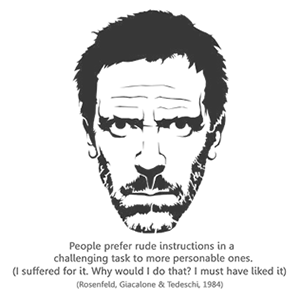
Effort Justification refers to the tendency to attribute greater value to outcomes that one put effort into achieving. It is an idea in social psychology stemming from psychologist Leon Festinger’s theory of ‘Cognitive Dissonance,’ which explains changes in people’s attitudes or beliefs as the result of an attempt to reduce a dissonance (discrepancy) between contradicting ideas or cognitions. In the case of effort justification, there is a dissonance between the amount of effort exerted into achieving a goal or completing a task (high effort – high ‘cost’) and the subjective reward for that effort (lower than was expected for such an effort). By adjusting and increasing one’s attitude or subjective value of the goal, this dissonance is resolved.
This theory is clearly implicated in the effect of rites of passage and hazing rituals on group solidarity and loyalty. The hazing rituals, prevalent in military units, sports teams and Academic fraternities and sororities, often include demanding and/or humiliating tasks which lead (according to dissonance theory) the new member to increase the subjective value of the group. This contributes to his/her loyalty and to the solidarity of the entire group.
Posted in Health, Science |
Leave a Comment »




