February 8, 2012

‘Manifold Destiny‘ is a 2006 article in ‘The New Yorker’ written by Sylvia Nasar (known for her biography of John Forbes Nash, ‘A Beautiful Mind’) and David Gruber. It gives a detailed account (including interviews with many mathematicians) of some of the circumstances surrounding the proof of the Poincaré conjecture, one of the most important accomplishments of 20th and 21st century mathematics, and traces the attempts by three teams of mathematicians to verify the proof given by Grigori Perelman.
Subtitled ‘A legendary problem and the battle over who solved it,’ the article concentrates on the human drama of the story, especially the discussion on who contributed how much to the proof of the Poincaré conjecture. Interwoven with the article is an interview with the reclusive mathematician Grigori Perelman, whom the authors tracked down to the St. Petersburg apartment he shares with his mother. The article describes Perelman’s disillusionment and withdrawal from the mathematical community and paints an unflattering portrait of the 1982 Fields Medalist, Shing-Tung Yau.
read more »
Posted in Language, Science |
1 Comment »
February 8, 2012

Grigori Perelman (b. 1966) is a Russian mathematician who has made landmark contributions to geometry and topology (the study of geometric deformation). In 1992, Perelman proved the soul conjecture. In 2002, he proved Thurston’s geometrization conjecture. This consequently solved in the affirmative the Poincaré conjecture, posed in 1904, which before its solution was viewed as one of the most important and difficult open problems in topology.
In 2006, Perelman was awarded the Fields Medal, but declined to accept the award or to appear at the congress, stating: ‘I’m not interested in money or fame, I don’t want to be on display like an animal in a zoo.’ In 2010, it was announced that he had met the criteria to receive the first Clay Millennium Prize for resolution of the Poincaré conjecture. He turned down the prize ($1 million), saying that he considers his contribution to proving the Poincaré conjecture to be no greater than that of U.S. mathematician Richard Hamilton.
read more »
Posted in Education, Money, Science |
Leave a Comment »
February 7, 2012

Historicism is doctrine that emphasizes the importance of history. It is a mode of thinking that assigns a central and basic significance to a specific context, such as historical period, geographical place and local culture. As such it is in contrast to individualist theories of knowledge such as empiricism and rationalism, which often discount the role of traditions. Historicism therefore tends to be hermeneutical (investigative of interpretations), because it places great importance on cautious, rigorous and contextualized interpretation of information and/or relativist (in support of the theory that knowledge is always relative to limitations of the mind), because it rejects notions of universal, fundamental and immutable interpretations.
The term has developed different and divergent, though loosely related, meanings. Elements of historicism appear in the writings of Italian philosopher G. B. Vico and French essayist Michel de Montaigne, and became fully developed with the dialectic of G. W. F. Hegel, influential in 19th-century Europe. The writings of Karl Marx, influenced by Hegel, also contain historicism. The term is also associated with the empirical social sciences and the work of Franz Boas. Historicism may be contrasted with reductionist theories, which suppose that all developments can be explained by fundamental principles (such as in economic determinism), or theories that posit historical changes as result of random chance. The theological use of the word denotes the interpretation of biblical prophecy as being related to church history. Post-structuralism uses the term New Historicism, which has some connections to both anthropology and Hegelianism.
Posted in Philosophy, Politics, Science |
1 Comment »
February 7, 2012

Butterflies are characterized by their scale-covered wings. These scales are pigmented with melanins that give them blacks and browns. Other colors like blues, greens, reds and iridescence are usually created not by pigments but the microstructure of the scales.
This structural coloration is the result of coherent scattering of light by the photonic crystal nature of the scales. The scales cling somewhat loosely to the wing and come off easily without harming the butterfly.
Posted in Science |
Leave a Comment »
February 6, 2012
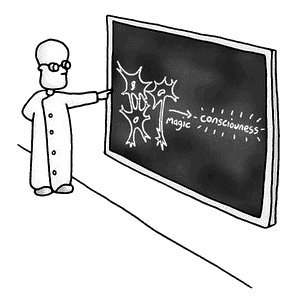
The explanatory gap is the difficulty that physicalist theories have in explaining how physical properties give rise to the way things feel when they are experienced. It is the claim that consciousness and human experiences such as qualia (individual instances of subjective, conscious experience) cannot be fully explained just by identifying the corresponding physical (neural) processes.
Bridging this gap is known as ‘the hard problem.’ The explanatory gap has vexed and intrigued philosophers and AI researchers alike for decades and caused considerable debate.
read more »
Posted in Education, Philosophy, Science |
1 Comment »
February 6, 2012
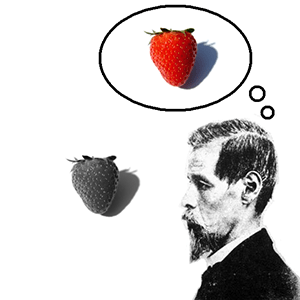
Qualia [kwah-lee-uh], singular ‘quale’ [kwah-lee], from a Latin word meaning for ‘what sort’ or ‘what kind,’ is a term used in philosophy to refer to subjective conscious experiences as ‘raw feels.’ Examples of qualia are the pain of a headache, the taste of wine, the experience of taking a recreational drug, or the perceived redness of an evening sky.
American philosopher Daniel Dennett writes that qualia is ‘an unfamiliar term for something that could not be more familiar to each of us: the ways things seem to us.’ Erwin Schrödinger, the famous physicist, had this counter-materialist take: ‘The sensation of color cannot be accounted for by the physicist’s objective picture of light-waves. Could the physiologist account for it, if he had fuller knowledge than he has of the processes in the retina and the nervous processes set up by them in the optical nerve bundles and in the brain? I do not think so.’
read more »
Posted in Language, Philosophy, Science |
1 Comment »
February 6, 2012

Mary’s room (also known as Mary the super-scientist) is a philosophical thought experiment proposed by Frank Jackson in his article ‘Epiphenomenal Qualia’ (1982) and extended in ‘What Mary Didn’t Know'(1986).
The argument is intended to motivate what is often called the ‘Knowledge Argument’ against physicalism — the view that the universe, including all that is mental, is entirely physical. The debate that emerged following its publication became the subject of an edited volume — ‘There’s Something About Mary’ (2004) — which includes replies from such philosophers as Daniel Dennett, David Lewis, and Paul Churchland.
read more »
Posted in Philosophy, Science |
Leave a Comment »
February 3, 2012

The Indiana Pi Bill is the popular name for bill #246 of the 1897 sitting of the Indiana General Assembly, one of the most famous attempts to establish scientific truth by legislative fiat. Despite that name, the main result claimed by the bill is a method to square the circle, rather than to establish a certain value for the mathematical constant π (pi), the ratio of the circumference of a circle to its diameter. However, the bill does contain text that appears to dictate various incorrect values of π, such as 3.2.
The bill never became law, due to the intervention of a mathematics professor who happened to be present in the legislature. The impossibility of squaring the circle using only compass and straightedge, suspected since ancient times, was rigorously proved in 1882 by Ferdinand von Lindemann. Better approximations of π than those inferred from the bill have been known since ancient times.
read more »
Posted in Humor, Politics, Science |
1 Comment »
February 3, 2012

Spirograph is a geometric drawing toy that produces mathematical curves of the variety technically known as hypotrochoids and epitrochoids. The term has also been used to describe a variety of software applications that display similar curves, and applied to the class of curves that can be produced with the drawing equipment (so in this sense it may be regarded as a synonym of hypotrochoid).
The name is a registered trademark of Hasbro, Inc. Drawing toys based on gears have been around since at least 1908, when The Marvelous Wondergraph was advertised in the Sears catalog. The ‘Boys Mechanic’ publication of 1913 had an article describing how to make a Wondergraph drawing machine. An instrument called a spirograph was invented by the mathematician Bruno Abakanowicz between 1881 and 1900 for calculating an area delimited by curves. The Spirograph toy was developed by the British engineer Denys Fisher, who exhibited it in 1965 at the Nuremberg International Toy Fair. In 1968, Kenner introduced Spirotot, a less complex version of Spirograph, for preschool-age children, too young for Spirograph.
Posted in Art, Games, Science |
Leave a Comment »
February 2, 2012

Richard Feynman (1918 – 1988) was an American physicist known for his work in quantum mechanics. For his contributions to the development of quantum electrodynamics, Feynman, jointly with Julian Schwinger and Sin-Itiro Tomonaga, received the Nobel Prize in Physics in 1965. He developed a widely used pictorial representation scheme for the mathematical expressions governing the behavior of subatomic particles, which later became known as Feynman diagrams.
During his lifetime, Feynman became one of the best-known scientists in the world. He assisted in the development of the atomic bomb and was a member of the panel that investigated the Space Shuttle Challenger disaster. In addition to his work in theoretical physics, Feynman has been credited with pioneering the field of quantum computing, and introducing the concept of nanotechnology.
read more »
Posted in Science, War |
Leave a Comment »
January 30, 2012


In psychology and cognitive science, the positivity effect is the tendency to make situational attributions about negative behaviors and dispositional attributions about positive behaviors for individuals one prefers.The term also refers to age differences in emotional attention and memory. Studies have found that older adults are more likely than younger adults to pay attention to positive than negative stimuli. In addition, compared with younger adults’ memories, older adults’ memories are more likely to consist of positive than negative information and more likely to be distorted in a positive direction. This version of the positivity effect was coined by Laura L. Carstensen’s research team.
Gender roles effect the behavior of the individual as well, and how they perceive others. Males tend to take more dominant roles, whereas females tend to be more nurturing and caregiving. Person-perception studies state that the characteristics of the perceiver are as important as the characteristics of the one being perceived. Since females are deemed to be the more nurturing and selfless by nature, they perceive others more favorably than men do. This is known as the ‘Female Positivity Effect.’ For example, women are more likely to be social and agreeable in a group task situation whereas the males are going to be mainly focused on the task at hand.
Posted in Health, Science |
1 Comment »
January 30, 2012

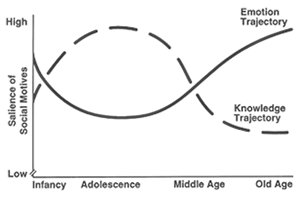
Socioemotional Selectivity Theory, developed by Stanford psychologist, Laura Carstensen, a life-span theory of motivation, maintains that as time horizons shrink, as they typically do with age, people become increasingly selective, investing greater resources in emotionally meaningful goals and activities.
According to the theory, motivational shifts also influence cognitive processing. Aging is associated with a relative preference for positive over negative information in attention and memory (called the ‘positivity effect’).
read more »
Posted in Death, Health, Science |
Leave a Comment »




 The Daily Omnivore