October 23, 2011

The liberal arts (Artes Liberales) are a curriculum that imparts general knowledge and develops the student’s rational thought and intellectual capabilities, unlike the professional, vocational, and technical curricula emphasizing specialization. The contemporary liberal arts comprise studying literature, languages, philosophy, history, mathematics, and science.
However, in classical antiquity, it denoted the education worthy of a free person (Latin: liber, ‘free’). Contrary to popular belief, freeborn girls were as likely to receive formal education as boys, especially during the Roman Empire—unlike the lack-of-education, or purely manual/technical skills, proper to a slave. The ‘liberal arts’ or ‘liberal pursuits’ were already so called in formal education during the Roman Empire.
read more »
Posted in Education, Philosophy, Science |
Leave a Comment »
October 23, 2011

The Independent Investigations Group (IIG) is a volunteer-based organization founded by James Underdown in 2000 at the Center for Inquiry’s Los Angles branch, a non-profit, secular educational organization. The IIG investigates fringe science, paranormal and extraordinary claims from a rational, scientific viewpoint, and disseminates factual information about such inquiries to the public.
IIG offers a $50,000 prize to anyone who can show, under proper observing conditions, evidence of any paranormal, supernatural, or occult power or event. The IIG is involved in designing the test protocol, approving the conditions under which a test will take place, and in administering the actual test. All tests are designed with the participation and approval of the applicant. In most cases, the applicant is asked to perform a simple preliminary demonstration of the claimed ability, which if successful is followed by the formal test. Associates of the IIG usually conduct both tests and preliminary demonstrations at their location in Hollywood or affiliates.
read more »
Posted in Money, Philosophy, Science |
Leave a Comment »
October 23, 2011

The Center for Inquiry(CFI) is a non-profit educational organization with headquarters in the United States whose primary mission is to encourage evidence-based inquiry into paranormal and fringe science claims, alternative medicine and mental health practices, religion, secular ethics, and society.
CFI is dedicated to promoting and defending science, reason, and free inquiry in all aspects of human interest.
read more »
Posted in Health, Philosophy, Science |
Leave a Comment »
October 18, 2011
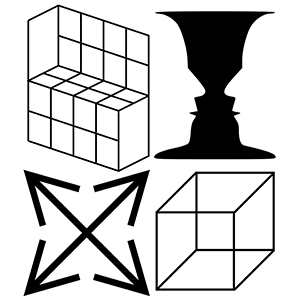
Multistable perceptual phenomena are a form of perceptual phenomena in which there are unpredictable sequences of spontaneous subjective changes. While usually associated with visual perception, such phenomena can be found for auditory and olfactory percepts. Perceptual multistability can be evoked by visual patterns that are too ambiguous for the human visual system to recognise with one unique interpretation.
Famous examples include the ‘Necker cube,’ ‘structure from motion,’ ‘monocular rivalry’ (two different images, optically superimposed), and ‘binocular rivalry’ (perception alternates between different images presented to each eye), but many more visually ambiguous patterns are known. Since most of these images lead to an alternation between two mutually exclusive perceptual states, they are sometimes also referred to as bistable perception.
read more »
Posted in Art, Language, Science |
Leave a Comment »
October 16, 2011

The Thomas theorem is a theory of sociology which was formulated in 1928 by W. I. Thomas (1863–1947): ‘If men define situations as real, they are real in their consequences.’ In other words, the interpretation of a situation causes the action. This interpretation is not objective. Actions are affected by subjective perceptions of situations. Whether there even is an objectively correct interpretation is not important for the purposes of helping guide individuals’ behavior. In 1923, Thomas stated more precisely that any definition of a situation will influence the present. Not only that, but—after a series of definitions in which an individual is involved—such a definition also ‘gradually [influences] a whole life-policy and the personality of the individual himself.’ Consequently, Thomas stressed societal problems such as intimacy, family, or education as fundamental to the role of the situation when detecting a social world ‘in which subjective impressions can be projected on to life and thereby become real to projectors.’
The 1973 oil crisis resulted in the so-called ‘toilet paper panic.’ The rumor of an expected shortage of toilet paper—resulting from a decline in the importation of oil—caused people to stockpile supplies of toilet paper and this caused a shortage. This shortage, seeming to validate the rumor, is also an example of a self-fulfilling prophecy. The Beauty Contest Theory, developed by John Maynard Keynes, justifies why the price of a share of stock does not necessarily develop according to rational expectations. He acts on the assumption that many investors make their decisions not according to their own computations of an asset’s worth but by predicting the conclusions of other market participants.
Posted in Money, Science |
Leave a Comment »
October 15, 2011


This article lists and discusses the usage and derivation of names of large numbers, together with their possible extensions. There are two main ways of naming a number: scientific notation and naming by grouping. For example, the number 500,000,000,000,000,000,000 can be called 5 x 10²⁰ in scientific notation since there are 20 zeros behind the 5. If the number is named by grouping, it is five hundred quintillion (American) or 500 trillion (European).
At times, the names of large numbers have been forced into common usage as a result of excessive inflation. The highest numerical value banknote ever printed was a note for 1 sextillion pengő (1021 or 1 milliard bilpengő as printed) printed in Hungary in 1946. In 2009, Zimbabwe printed a 100 trillion (1014) Zimbabwean dollar note, which at the time of printing was only worth about US$30.
read more »
Posted in Language, Money, Science |
Leave a Comment »
October 13, 2011

Hypnagogia [hip-nuh-gah-jee-uh] is a term coined by French physician Alfred Maury in the 19th century for the transitional state between wakefulness and sleep (i.e. the onset of sleep). It is characterized by dreamlike auditory, visual, or tactile sensations.
Sometimes the word hypnagogia is used in a restricted sense to refer to the onset of sleep, and contrasted with hypnopompia, Frederic Myers’s term for waking up. The hypnagogic state can provide insight into a problem, the best known example being August Kekulé’s realization that the structure of benzene was a closed ring after dozing in front of a fire and seeing atoms forming into snakes, one of who grabbed its tail in its mouth.
read more »
Posted in Health, Language, Science |
1 Comment »
October 13, 2011

A power nap is a short sleep which terminates before the occurrence of deep sleep or slow-wave sleep (SWS), intended to quickly revitalize the subject. The expression was coined by Cornell University social psychologist James Maas. The power nap is thought to maximize the benefits of sleep versus time. It is used to supplement normal sleep, especially when a sleeper has accumulated a sleep deficit. Scientific experiments and anecdotal evidence suggest that an average power nap duration of around 15–30 minutes is most effective. Any more time, and the body enters into its usual sleep cycle.
Various durations are recommended for power naps, which are very short compared to regular sleep. The short duration of a power nap is designed to prevent nappers from sleeping so long that they enter a normal sleep cycle without being able to complete it. Entering a normal sleep cycle, but failing to complete it, can result in a phenomenon known as sleep inertia, where one feels groggy, disoriented, and even more sleepy than before beginning the nap. In order to attain maximum post-nap performance, it is critical that a power nap be limited to the beginning of a sleep cycle, specifically sleep stages I and II.
read more »
Posted in Health, Language, Science |
Leave a Comment »
October 13, 2011

Binaural [bahy-nawr-uhl] beats or binaural tones are auditory processing artifacts, or apparent sounds, the perception of which arises in the brain for specific physical stimuli. This effect was discovered in 1839 by Heinrich Wilhelm Dove, and earned greater public awareness in the late 20th century based on claims that binaural beats could help induce relaxation, meditation, creativity and other desirable mental states. The effect on the brainwaves depends on the difference in frequencies of each tone, for example, if 300 Hz was played in one ear and 310 in the other, then the Binaural beat would have a frequency of 10 Hz.
The brain produces a phenomenon resulting in low-frequency pulsations in the amplitude and sound localization of a perceived sound when two tones at slightly different frequencies are presented separately, one to each of a subject’s ears, using stereo headphones. A beating tone will be perceived, as if the two tones mixed naturally, out of the brain. The frequencies of the tones must be below 1,000 hertz for the beating to be noticeable. The difference between the two frequencies must be small (less than or equal to 30 Hz) for the effect to occur; otherwise, the two tones will be heard separately and no beat will be perceived. Binaural beats reportedly influence the brain in more subtle ways through the entrainment of brainwaves and have been claimed to reduce anxiety and provide other health benefits such as control over pain.
read more »
Posted in Health, Science, Technology |
1 Comment »
October 13, 2011
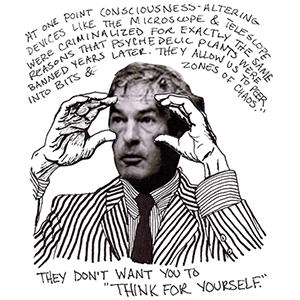
Psychonautics [sahy-kuh-naw-tiks] (Greek: psyche ‘soul/spirit/mind’ and naut ‘sailor/navigator’) refers both to a methodology for describing and explaining the subjective effects of altered states of consciousness, including those induced by mind altering substances, and to a research framework for voluntarily immersing oneself into an altered state by means of such techniques, to explore human experience and existence.
The term has been applied diversely, to cover all activities by which altered states are induced and utilized for spiritual purposes or the exploration of the human condition, including shamanism, lamas of the Tibetan Buddhist tradition, sensory deprivation, and archaic/modern drug users who use entheogenic substances in order to gain deeper insights and spiritual experiences.
read more »
Posted in Drugs, Philosophy, Science |
Leave a Comment »
September 29, 2011

The sleeping position is the body configuration assumed by a person during or prior to sleeping. It has been shown to have health implications, particularly for babies. In the 1958 edition of his best-selling book ‘The Common Sense Book of Baby and Child Care,’ pediatrician Dr. Benjamin Spock warned against placing a baby on its back, writing, ‘if [an infant] vomits, he’s more likely to choke on the vomitus.’ However, later studies have shown that placing a young baby in a prone position increases the risk of sudden infant death syndrome (SIDS).
Pregnancy.org champions ‘SOS’ (sleep on side), particularly the left side, for pregnant women, claiming this ‘will increase the amount of blood and nutrients that reach the placenta and your baby.’ It is recommended that people at risk of obstructive sleep apnea sleep on their side and with a 30° or higher elevation of the upper body. Snoring, which may be (but is not necessarily) an indicator of obstructive sleep apnea, may also be alleviated by sleeping on one’s side.
read more »
Posted in Health, Science, Sex |
Leave a Comment »
September 27, 2011

The concept of multiple discovery is the hypothesis that most scientific discoveries and inventions are made independently and more or less simultaneously by multiple scientists and inventors. The concept of multiple discovery opposes a traditional view—the ‘heroic theory’ of invention and discovery. When Nobel laureates are announced annually—especially in physics, chemistry, physiology-or-medicine, and economics—increasingly, in the given field, rather than just a single laureate, there are two or the maximally-permissible three, who often have independently made the same discovery.
Commonly cited examples of multiple independent discovery are the 17th-century independent formulation of calculus by Isaac Newton, Gottfried Wilhelm Leibniz and others, described by British historian A. Rupert Hall; the 18th-century discovery of oxygen by Carl Wilhelm Scheele, Joseph Priestley, Antoine Lavoisier and others; and the theory of evolution of species, independently advanced in the 19th century by Charles Darwin and Alfred Russel Wallace.
read more »
Posted in Science, Technology |
Leave a Comment »


 The Daily Omnivore