May 24, 2011
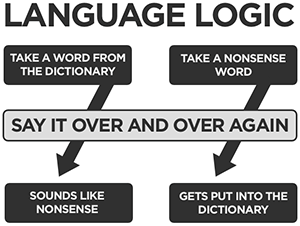

Semantic satiation is a cognitive neuroscience phenomenon in which repetition causes a word or phrase to temporarily lose meaning for the listener, who can only process the speech as repeated meaningless sounds. The explanation for the phenomenon was that verbal repetition repeatedly aroused a specific neural pattern in the cortex which corresponds to the meaning of the word. Rapid repetition causes both the peripheral sensorimotor activity and the central neural activation to fire repeatedly, which is known to cause reactive inhibition, hence a reduction in the intensity of the activity with each repetition.
Several activities demonstrate the operation of the semantic satiation effect in various cognitive tasks such as rating words and figures that are presented repeatedly in a short time, verbally repeating words then grouping them into concepts, adding numbers after repeating them out loud, and bilingual translations of words repeated in one of the two languages. In each case subjects would repeat a word or number for several seconds, then perform the cognitive task using that word. It was demonstrated that repeating a word prior to its use in a task made the task somewhat more difficult.
Posted in Language, Science |
1 Comment »
May 21, 2011

Robert Hare (b. 1934) is a Canadian researcher renowned in the field of criminal psychology. He developed the Psychopathy Checklist (PCL) and Psychopathy Checklist Revised (PCL-R), used to diagnose cases of psychopathy and also useful in predicting the likelihood of violent behavior, and is professor emeritus of the University of British Columbia where his studies center on psychopathology and psychophysiology.
In contemporary research and clinical practice, Robert D. Hare’s Psychopathy Checklist-Revised (PCL-R) is the psycho-diagnostic tool most commonly used to assess psychopathy.
read more »
Posted in Health, Politics, Science |
Leave a Comment »
May 21, 2011

Amygdala [uh-mig-duh-luh] hijack is a term coined by psychologist Daniel Goleman in his 1996 book ‘Emotional Intelligence: Why It Can Matter More Than IQ.’ Goleman uses the term to describe emotional responses from people which are out of measure with the actual threat because it has triggered a much more significant emotional threat. The brain processes stimuli by having the thalamus direct sensory information to the neocortex (the ‘thinking brain’). The cortex then routes the signal to the amygdala (the ’emotional brain’) for the proper emotional reaction. The amygdala then triggers a flood of peptides and hormones to create emotion and action.
Perceived potential threats, however, can disrupt this smooth flow; the thalamus bypasses the cortex and routes the signal directly to the amygdala, which is the trigger point for the primitive fight-or-flight response; when the amygdala feels threatened, it can react irrationally and destructively. Goleman states that ‘Emotions make us pay attention right now – this is urgent – and give us an immediate action plan without having to think twice. The emotional component evolved very early: Do I eat it, or does it eat me?’ The emotional response ‘can take over the rest of the brain in a millisecond if threatened.’ An amygdala hijack exhibits three signs: strong emotional reaction, sudden onset, and post-episode realization that the reaction was inappropriate.
Posted in Health, Language, Science |
Leave a Comment »
May 21, 2011
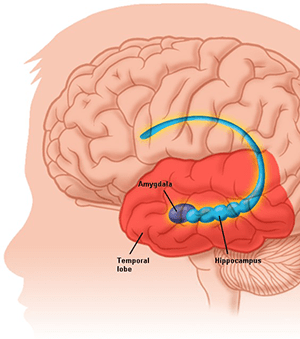
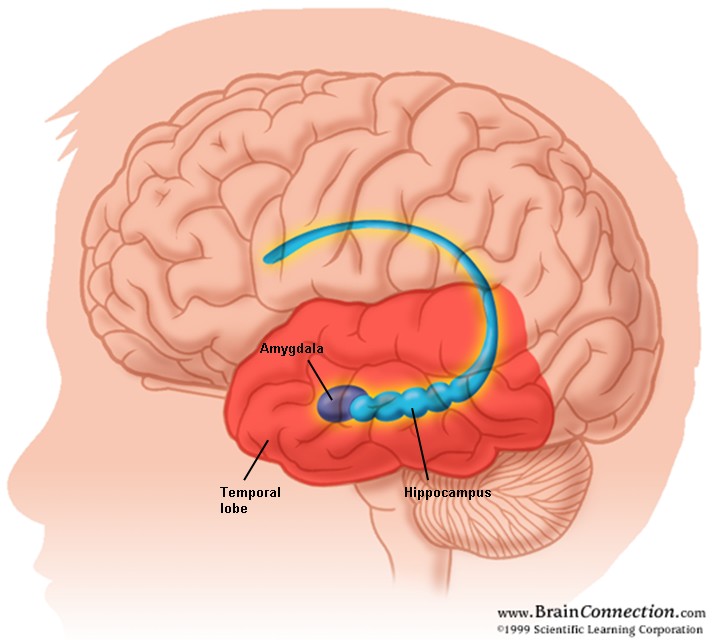
The amygdala [uh-mig-duh-luh] (Latin: ‘almond’) are almond-shaped groups of nuclei (clusters of neurons) located deep within the temporal lobes of the brain in complex vertebrates, including humans. Shown in research to perform a primary role in the processing and memory of emotional reactions, the amygdalae are considered part of the limbic system.
The amygdala sends impulses to the hypothalamus for activation of the sympathetic nervous system to trigger a fight or flight response, to the thalamic reticular nucleus for increased reflexes, to the nuclei of the trigeminal nerve and the facial nerve, and to the ventral tegmental area, locus coeruleus, and laterodorsal tegmental nucleus for activation of dopamine, norepinephrine and epinephrine (adrenalin).
read more »
Posted in Health, Science |
Leave a Comment »
May 21, 2011
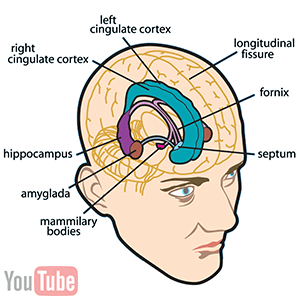
The limbic system (or Paleomammalian brain) is a set of brain structures including the hippocampus, amygdala, anterior thalamic nuclei, septum, limbic cortex and fornix, which seemingly support a variety of functions including emotion, behavior, long term memory, and olfaction (smell). The term ‘limbic’ comes from the Latin limbus, for ‘border’ or ‘edge.’ Some scientists have suggested that the concept of the limbic system should be abandoned as obsolete, as it is grounded more in transient tradition than in facts.
The limbic system operates by influencing the endocrine system (hormones) and the autonomic nervous system (visceral functions, e.g. breathing, urinating, salivating). It is highly interconnected with the nucleus accumbens, the brain’s pleasure center, which plays a role in sexual arousal and the ‘high’ derived from certain recreational drugs. In a 1954 experiment, rats with metal electrodes implanted into their nucleus accumbens as well as their septal nuclei repeatedly pressed a lever activating this region, and did so in preference to eating and drinking, eventually dying of exhaustion.
read more »
Posted in Health, Science |
2 Comments »
May 21, 2011

The Dragons of Eden: Speculations on the Evolution of Human Intelligence is a Pulitzer Prize winning 1977 book by Carl Sagan. In it, he combines the fields of anthropology, evolutionary biology, psychology, and computer science to give a perspective of how human intelligence evolved.
The opening quote is by Greek philosopher Plotinus: ‘Mankind is poised midway between the Gods and the Beasts.’
read more »
Posted in Language, Science |
Leave a Comment »
May 21, 2011

The triune brain is a model of the evolution of the vertebrate forebrain and behavior proposed by the American physician and neuroscientist Paul D. MacLean. MacLean originally formulated his model in the 1960s and propounded it at length in his 1990 book ‘The Triune Brain in Evolution.’ The triune brain consists of the reptilian complex, the paleomammalian complex (limbic system), and the neomammalian complex (neocortex), viewed as structures sequentially added to the forebrain in the course of evolution.
The triune brain hypothesis became familiar to a broad popular audience through Carl Sagan’s Pulitzer prize winning 1977 book ‘The Dragons of Eden.’ Though embraced by some psychiatrists and at least one leading affective neuroscience researcher, the model never won wide acceptance among comparative neurobiologists. Comparative evolutionary neuroanatomists currently regard its claims about brain evolution to be outdated.
read more »
Posted in Health, Science |
Leave a Comment »
May 19, 2011


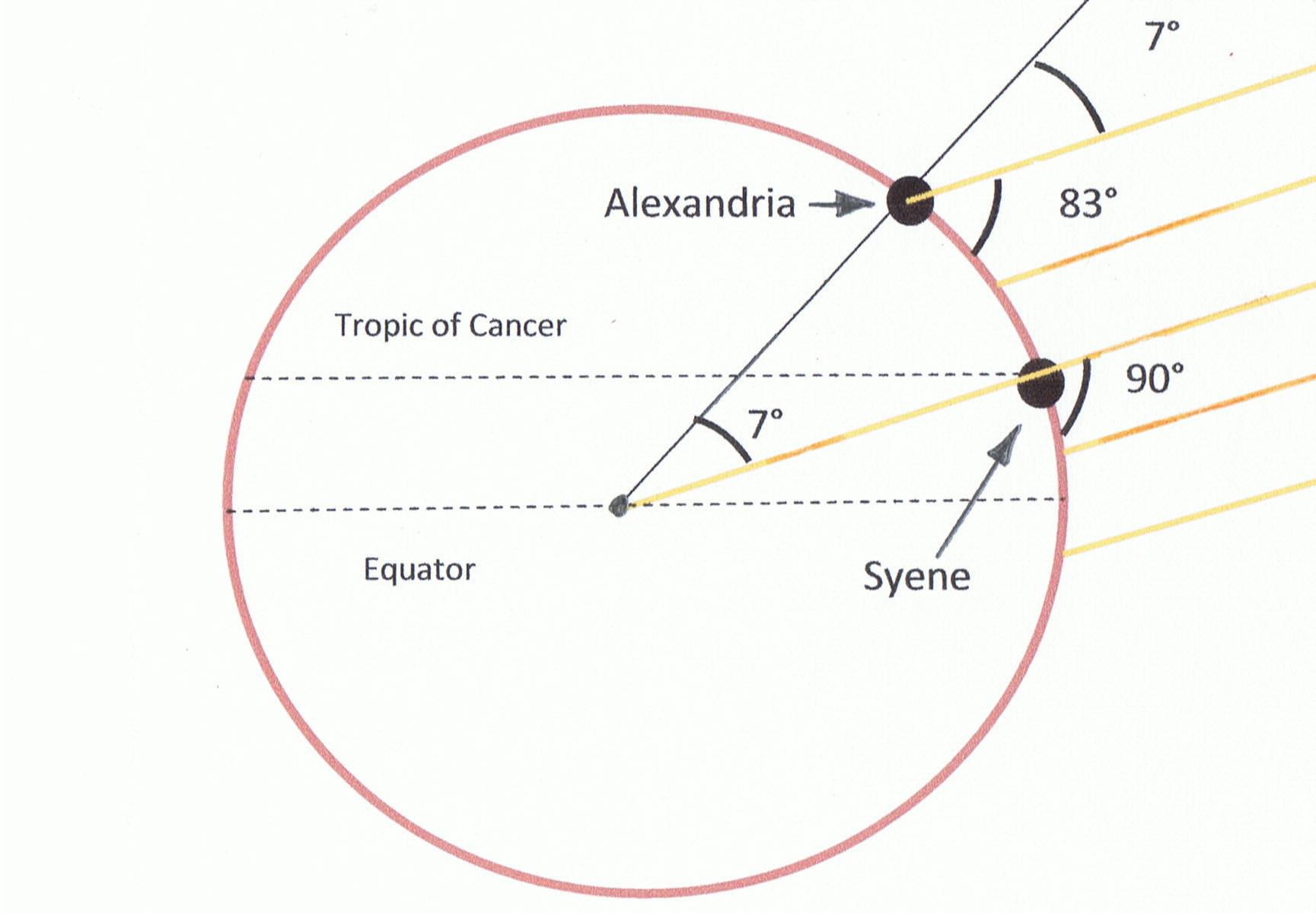
Eratosthenes [er-uh-tos-thuh-neez] of Cyrene (276BCE–194BCE) was a Greek mathematician, geographer and astronomer. He was head of the Library of Alexandria from 240BC until his death: this was the most important library of the ancient world.
According to the Suda (a 10th century Byzantine encyclopedia) his contemporaries nicknamed him Beta, (the second letter of the Greek alphabet), because he was the second best in the world in almost any field. Eratosthenes was a friend of Archimedes, who also lived and worked in Alexandria. Archimedes was the greatest mathematician and inventor of the age, so perhaps the Beta nickname was not unjust.
read more »
Posted in Philosophy, Science |
Leave a Comment »
May 17, 2011
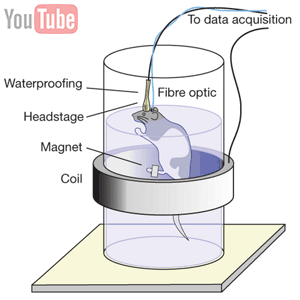
Optogenetics is a neuromodulation technique employed in neuroscience where light pulses are used to activate and deactivate neurons which have been genetically sensitized to photons. It employs a combination of techniques from optics and genetics to control and monitor the activities of individual neurons in living tissue—even within freely-moving animals—and to precisely measure the effects of those manipulations in real-time. The key reagents used in optogenetics are light-sensitive proteins.
The earliest approaches were developed and applied in the lab of Gero Miesenböck, now Waynflete Professor of Physiology at the University of Oxford, and Richard Kramer and Ehud Isacoff at the University of California, Berkeley; these methods conferred light sensitivity but were never reported to be useful by other laboratories due to the multiple components these approaches required. A distinct single-component approach involving microbial opsin genes introduced in 2005 turned out to be widely applied. Optogenetics is known for the high spatial and temporal resolution that it provides in altering the activity of specific types of neurons to control a subject’s behavior.
Posted in Health, Science, Technology |
Leave a Comment »
May 17, 2011

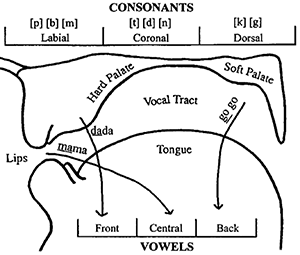
The International Phonetic Alphabet (IPA) is an alphabetic system of phonetic notation based primarily on the Latin alphabet. It was devised as a standardized representation of the sounds of all spoken languages. The IPA is designed to represent only those qualities of speech that are distinctive in spoken language: phonemes (‘a sound uttered,’ the smallest segmental unit of sound – e.g. the ‘k’ sound in ‘kite’), intonation (variation of pitch while speaking which is not used to distinguish words, unlike tone, which is), and the separation of words and syllables.
To represent additional qualities of speech such as tooth gnashing, lisping, and sounds made with a cleft palate, an extended set of symbols called the Extensions to the IPA may be used. The IPA currently contains 107 letters derived from thousands of languages.
Posted in Language, Science |
Leave a Comment »
May 11, 2011

Stephen Hawking (b. 1942) is an English theoretical physicist and cosmologist, whose scientific books and public appearances have made him an academic celebrity. He is known for his contributions to the fields of cosmology and quantum gravity, especially in the context of black holes (he first predicted that black holes emit radiation, which is today known as Hawking radiation).
He has also achieved success with works of popular science in which he discusses his own theories and cosmology in general. Hawking has a motor neurone disease that is related to ALS (Lou Gehrig’s disease), a condition that has progressed over the years and has left him almost completely paralyzed.
read more »
Posted in Language, Science |
Leave a Comment »
May 10, 2011

‘A Briefer History of Time‘ is a popular-science book published in 2005 from the English physicist Stephen Hawking and the American physicist Leonard Mlodinow. It is an update and rewrite of Hawking’s 1988 ‘A Brief History of Time.’
In this book Hawking and Mlodinow present quantum mechanics, string theory, the big bang theory, and other topics in a more accessible fashion to the general public. The book is updated with newly discovered topics, and informs of recurring subjects throughout the book in greater detail.
Posted in Education, Language, Science |
Leave a Comment »




 The Daily Omnivore