March 23, 2011


A strange loop arises when, by moving up or down through a hierarchical system, one finds oneself back where one started. Strange loops may involve self-reference and paradox.
The concept of a strange loop was proposed and extensively discussed by Douglas Hofstadter in ‘Gödel, Escher, Bach,’ and is further elaborated in Hofstadter’s book ‘I Am a Strange Loop,’ published in 2007. A tangled hierarchy is a hierarchical system in which a strange loop appears.
Posted in Language, Science |
Leave a Comment »
March 17, 2011

Charley Harper (1922 – 2007) was a Cincinnati-based American Modernist artist. He was best known for his highly stylized wildlife prints, posters and book illustrations. During his career, Charley Harper illustrated numerous books, notably ‘The Golden Book of Biology,’ magazines such as ‘Ford Times,’ as well as many prints, posters, and other works.
As his subjects are mainly natural, with birds prominently featured, Charley often created works for many nature-based organizations, among them the National Park Service and the Cincinnati Zoo.
Posted in Art, Science |
Leave a Comment »
March 17, 2011

The endurance running hypothesis is the theory that the evolution of certain human characteristics can be explained as adaptations to long-distance running. The theory states that prior to the invention of the spear, the first projectile weapon, 200,000 years ago, ancient humans would use persistence hunting as their method of hunting animals, whereby, rather than outpacing animals, they would chase the animals over long distances until the animals would overheat.
Thus, adaptations favoring long-distance running ability would have been favored in humans. After projectile weapons were developed – in evolutionarily recent times – the importance of long-distance running became lessened but the traits remained.
Posted in Games, Science |
Leave a Comment »
March 17, 2011

The aquatic ape hypothesis (AAH), an alternative explanation of some characteristics of human evolution, theorizes that the common ancestors of modern humans spent a period of time adapting to life in a partially-aquatic environment. The theory is based on differences between humans and other great apes, and apparent similarities between humans and some aquatic mammals. First proposed in 1942 and expanded in 1960, its greatest proponent has been the writer Elaine Morgan, who has spent more than forty years discussing the AAH.
While there are theories suggesting protohumans underwent some adaptations due to interaction with water, the sort of radical specialization posited by the AAH has not been accepted within the scientific community as a valid explanation for human divergence from related primates. It has been criticized for possessing a variety of theoretical problems, for lacking evidentiary support, and for there being alternative explanations for many of the observations suggested to support the theory.
Posted in Science |
Leave a Comment »
March 17, 2011

‘The Naked Ape: A Zoologist’s Study of the Human Animal’ is a 1967 book by ethologist Desmond Morris which examines human behavior (he wrote a followup, ‘The Human Zoo,’ about urban behavior in 1969). Ethology is the scientific study of animal behavior, a sub-topic of zoology. Morris attempted to frame human behavior in the context of evolution, but his explanations failed to convince academics because they were based on a teleological (goal-oriented) understanding of evolution. However, the book was revolutionary for its time and has found fans among anthropologists and zoologists alike.
‘The Naked Ape’ depicts human behavior as largely evolved, to meet the challenges of prehistoric life as a hunter-gatherer. Morris made a number of claims in the book, including that not only does Homo sapiens have the largest brain of all primates but also the largest penis. He further claimed that our fleshy ear-lobes, which are unique to humans, are erogenous zones, the stimulation of which can cause orgasm in both sexes. Morris stated that the more rounded shape of human female breasts means they are mainly a sexual signalling device rather than simply for providing milk for infants.
Posted in Language, Science |
Leave a Comment »
March 15, 2011
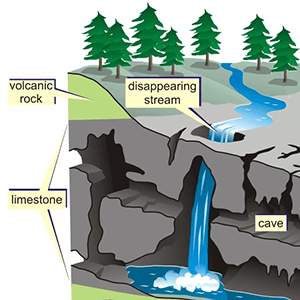
Karst [kahrst] topography is characterized by subterranean limestone caverns, carved by groundwater. It is a landscape shaped by the dissolution of a layer or layers of soluble bedrock, usually carbonate rock such as limestone or dolomite. Due to subterranean drainage, there may be very limited surface water, even to the absence of all rivers and lakes. Many karst regions display distinctive surface features, with sinkholes or dolines being the most common.
Some karst regions include thousands of caves, even though evidence of caves that are big enough for human exploration is not a required characteristic of karst. Serbian geographer, Jovan Cvijić (1865–1927) is recognized as the father of karst geomorphology. The international community has settled on ‘karst,’ the German name for Kras, a region in Slovenia partially extending into Italy, where it is called ‘Carso’ and where the first scientific research of a karst topography was made. The name has an Indo-European origin (from ‘karra’ meaning ‘stone’).
Posted in Language, Science |
Leave a Comment »
March 15, 2011

Phong Nha – Ke Bang is a national park in north-central Vietnam, about 500 km south of the nation’s capital, Hanoi. The park was created to protect one of the world’s two largest karst regions (landscapes shaped by the dissolution of a layer soluble bedrock) with 300 caves and grottoes and also protects the ecosystem of limestone forest of the Annamite Range region in north central coast of Vietnam.
Phong Nha-Ke Bang area is noted for its cave and grotto systems as it is composed of 300 caves and grottos with a total length of about 126 km, of which only 20 have been surveyed by Vietnamese and British scientists; 17 of these are in located in the Phong Nha area and three in the Ke Bang area. Before discovery of the nearby, Son Doong Cave in 2009, Phong Nha was the largest cave in the world.
Posted in Science, World |
Leave a Comment »
March 15, 2011

Cassini–Huygens is a joint NASA/ European Space Agency (ESA) spacecraft mission currently studying the planet Saturn and its many natural satellites. The spacecraft consists of two main elements: the NASA-designed and -constructed Cassini orbiter, named for the Italian-French astronomer Giovanni Domenico Cassini, and the ESA-developed Huygens probe, named for the Dutch astronomer, mathematician and physicist Christiaan Huygens. Cassini is the fourth space probe to visit Saturn and the first to enter orbit.
The complete spacecraft was launched in 1997 and entered into orbit around Saturn in 2004. Shortly after arrival, the Huygens probe separated from the orbiter and headed for Saturn’s moon Titan. In 2005, it descended into Titan’s atmosphere, and downward to the surface, radioing scientific information back to the Earth by telemetry. This was the first landing in the outer solar system.
Posted in Science, Technology |
Leave a Comment »
March 14, 2011

A placebo is a sham or simulated medical intervention. Sometimes patients given a placebo treatment will have a perceived or actual improvement in a medical condition, a phenomenon commonly called the placebo effect. In medical research, placebos are given as control treatments and depend on the use of measured deception. Common placebos are inert tablets, sham surgery, and other procedures based on false information. Since the publication of Henry K. Beecher’s ‘The Powerful Placebo’ in 1955 the phenomenon has been considered to have clinically important effects.
The word ‘placebo,’ Latin for ‘I will please,’ dates back to a Latin translation of the Bible. In 1785 it was defined as a ‘commonplace method or medicine’ and in 1811 it was defined as ‘any medicine adapted more to please than to benefit the patient,’ sometimes with a derogatory implication but not with the implication of no effect. Placebos were widespread in medicine until the 20th century, and they were sometimes endorsed as necessary deceptions.
read more »
Posted in Drugs, Health, Science |
Leave a Comment »
March 14, 2011

An excitable medium is a mathematic concept in dynamics (the study of the behavior of complex systems). An excitable medium has the capacity to propagate a wave of some description, and cannot support the passing of another wave until a certain amount of time has passed (known as the refractory time).
A forest is an example of an excitable medium: if a wildfire burns through the forest, no fire can return to a burnt spot until the vegetation has gone through its refractory period and regrown. In Chemistry, oscillating reactions are excitable media, for example the Belousov-Zhabotinsky reaction and the Briggs-Rauscher reaction. Pathological activities in the heart and brain can be modelled as excitable media. A group of spectators at a sporting event are an excitable medium, as can be observed in a Mexican wave (so-called from its initial appearance in the 1986 World Cup in Mexico).
Posted in Science |
Leave a Comment »
March 14, 2011

The Blue Brain Project is an attempt to create a synthetic brain by reverse-engineering the mammalian brain down to the molecular level. The aim of the project, founded in 2005 by the Brain and Mind Institute of the École Polytechnique in Lausanne, Switzerland, is to study the brain’s architectural and functional principles, and is headed by the Institute’s director, Henry Markram. Using an IBM Blue Gene supercomputer running Michael Hines’s NEURON software, the simulation does not consist simply of an artificial neural network, but involves a biologically realistic model of neurons.
It is hoped that it will eventually shed light on the nature of consciousness. A longer term goal is to build a detailed, functional simulation of the physiological processes in the human brain: ‘It is not impossible to build a human brain and we can do it in 10 years,” Markram said at the 2009 TED conference in Oxford. In a BBC World Service interview he said: ‘If we build it correctly it should speak and have an intelligence and behave very much as a human does.’
Posted in Philosophy, Science, Technology |
Leave a Comment »
March 11, 2011
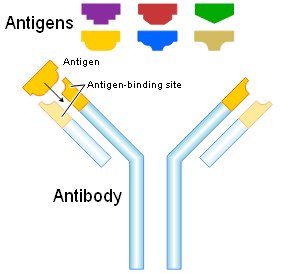

An antigen [ann-tuh-jen] is a protein expressed by a bacteria or virus that is recognized by an immune system as foreign which can stimulate the production of antibodies and combine specifically with them. Usually an antibody is a molecule, perhaps on the cell surface of a bacterium or virus. Antibodies are always ‘foreign’; except in rare cases the system is tolerant of its own molecules. Autoimmune diseases are caused when this safeguard fails. When an antigen is introduced into the body it causes the production of antibodies. Antigens include bacteria, cells of transplanted organs, plant pollen and toxins.
The first time that a new antigen comes into contact with the body the response of the immune system will be a complete immune response. During this first response, the antigen will cause antibodies to be made. The next time the same antigen contacts the body, a full scale immune response is not needed as the body already has a specific antibody available instantly for that antigen. This means that the body can begin fighting an infection much sooner for illnesses it has encountered before, and takes more time to begin to fight an infection in new illnesses.
Posted in Health, Language, Science |
Leave a Comment »




 The Daily Omnivore