October 28, 2010

The Mimic Octopus is a species of octopus that has a strong ability to mimic other creatures. It grows up to 60 cm (2 feet) in length. Its normal coloring consists of brown and white stripes or spots. Living in the tropical seas of South East Asia, it was not discovered officially until 1998, off the coast of Sulawesi. The octopus mimics the physical likeness and movements of more than fifteen different species, including sea snakes, lionfish, flatfish, brittle stars, giant crabs, sea shells, stingrays, flounders, jellyfish, sea anemones, and mantis shrimp. It accomplishes this by contorting its body and arms, and changing color.
Although all octopuses can change color and texture, and many can blend with the sea floor, appearing as rocks, the mimic octopus is the first octopus species ever observed to impersonate other animals. Based on observation, the mimic octopus may decide which animal to impersonate depending on local predators. For example, when the octopus was being attacked by damselfish, it often mimics a banded sea snake, a damselfish predator. The octopus impersonates the snake by turning black and yellow, burying six of its arms, and waving its other two arms in opposite directions. The mimic octopus is often confused with Wunderpus photogenicus, another recently discovered species. The Wunderpus can be distinguished by the pattern of strong, fixed white markings on its body.
Posted in Science |
Leave a Comment »
October 26, 2010

A Calabi-Yau space is a mathematical construction used by physicists to describe parts of nature that are too small to see with the human eye. Physicists use Calabi-Yau spaces in studying high energy physics of which string theory is a part. These structures add 6, 7, or more dimensions to the four dimension (three for space, one for time) model of the universe.
The study of Calabi-Yau spaces is part of a mathematical theory known as ‘manifold theory.’ These tiny parts are interesting because although they are small, they are also very high in energy. It is like they are compressed like a spring, or like a very long rubber band wrapped around a golf ball. And the smaller we go the more energy the tiny particles contain. These models are named for mathematicians Eugenio Calabi and Shing-Tung Yau.
Posted in Science |
Leave a Comment »
October 26, 2010

In anatomy, heterochromia [het-uh-roh-kroh-me-uh] refers to a difference in coloration, usually of the iris but also of hair or skin. Heterochromia is a result of the relative excess or lack of melanin (a pigment). It may be inherited or due to disease or injury. Eye color, specifically the color of the irises, is determined primarily by the concentration and distribution of melanin. The affected eye may be hyperpigmented (hyperchromic) or hypopigmented (hypochromic).
Heterochromia of the eye (heterochromia iridis or heterochromia iridum) is of two kinds. In complete heterochromia, one iris is a different color from the other. In partial heterochromia or sectoral heterochromia, part of one iris is a different color from its remainder. Partial or sectoral heterochromia is much less common than complete heterochromia and is typically found in autosomally inherited disorders such as Hirschsprung’s disease and Waardenburg syndrome.
Posted in Health, Science |
1 Comment »
October 26, 2010

Propolis [prop-uh-lis] is a resinous mixture that honey bees collect from tree buds, sap flows, or other botanical sources. It is used as a sealant for unwanted open spaces in the hive. Propolis is used for small gaps (approximately 6 millimeters or less), while larger spaces are usually filled with beeswax.
Its color varies depending on its botanical source, the most common being dark brown, but it can be found in green, red, black and white hues. Propolis is sticky at and above room temperature. At lower temperatures it becomes hard and very brittle. Propolis is also marketed by health food stores as a traditional medicine with a variety of uses.
read more »
Posted in Health, Science |
Leave a Comment »
October 19, 2010

Seed bombing or aerial reforestation is a technique of introducing vegetation to land by throwing or dropping compressed clods of soil containing live vegetation. Often, seed bombing projects are done with arid or off-limits (for example, privately-owned) land. The term ‘seed grenade’ was first used by NY artist, Liz Christy in 1973 when she started the ‘Green Guerrillas.’ The first seed grenades were made from condoms filled with local wildflower seeds, water and fertilizer. They were tossed over fences onto empty lots in New York City in order to make the neighborhoods look better. It was the start of the guerrilla gardening movement.
The earliest records of aerial reforestation date back from 1930. In this period, planes were used to distribute seeds over certain inaccessible mountains in Honolulu after forest fires. Seed bombing is also widely used in Africa in barren or simply grassy areas. Newer seed bombs use biodegradable shells which feed the sprout as it grows. Barren land can be turned into a garden in a little over a month. A variant of seed bombing, called tree bombing, involves dropping saplings from military aircraft, but has yet to be attempted.
Posted in Politics, Science |
Leave a Comment »
October 19, 2010

Cortisol [kawr-tuh-sawl], also known as hydrocortisone, is a steroid hormone or glucocorticoid produced by the adrenal gland, and is one of the best known ‘stress hormones.’ Stress hormones act by mobilizing energy from storage to muscles, increasing heart rate, blood pressure and breathing rate and shutting down metabolic processes such as digestion, reproduction, growth and immunity.
Posted in Health, Science |
Leave a Comment »
October 10, 2010

The lion’s mane jellyfish (Cyanea capillata) is the largest known species of jellyfish. Its range is confined to the cold waters of the Arctic, northern Atlantic, and northern Pacific Oceans, seldom found farther south than 42°N latitude. Similar jellyfish, which may be the same species, are known to inhabit seas near Australia and New Zealand. The largest recorded specimen found, washed up on the shore of Massachusetts Bay in 1870, had a bell (body) with a diameter of 2.3 m (7 feet 6 inches) and tentacles 36.5 m (120 feet) long.
Posted in Science |
Leave a Comment »
September 27, 2010
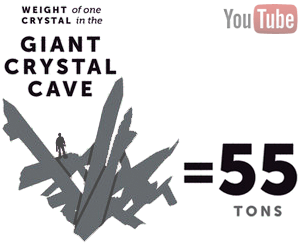

Cave of the Crystals (Cueva de los Cristales) is a cave connected to the Naica Mine 300 metres (980 ft) deep in Chihuahua, Mexico, discovered in 2000. The main chamber contains giant selenite crystals, some of the largest natural crystals ever found. The cave’s largest crystal found to date is 11 m (36 ft) in length, 4 m (13 ft) in diameter and 55 tons in weight. The cave is extremely hot with air temperatures reaching up to 58 °C (136 °F) with 90 to 100 percent humidity.
The cave is relatively unexplored due to the extreme temperatures and high humidity. Without proper protection people can only endure approximately ten minutes of exposure at a time. Additionally, the caves are accessible today only because the mining company’s pumping operations keep them clear of water. If the pumping were stopped, the caves would be submerged.
Posted in Science, World |
Leave a Comment »
September 26, 2010

The Ahnenerbe was a Nazi German think tank that promoted itself as a ‘study society for Intellectual Ancient History.’ Founded on July 1, 1935, by Heinrich Himmler, Herman Wirth, and Richard Walther Darré, the Ahnenerbe’s goal was to research the anthropological and cultural history of the Aryan race, and later to experiment and launch voyages with the intent of proving that prehistoric and mythological Nordic populations had once ruled the world.
The Ahnenerbe had several different research institutions. Most of these were archeological and anthropological but others included a meteorology department, devoted to ‘Welteislehre’ (World Ice Theory), a pseudoscientific cosmological theory proposed by Hans Hörbiger, an Austrian engineer and inventor. According to his theory, ice was the basic substance of all cosmic processes, and ice moons, ice planets, and the ‘global ether’ (also made of ice) had determined the entire development of the universe. There was also a section devoted to musicology, whose aim was to determine ‘the essence’ of German music. The section made sound recordings, transcribed manuscripts and songbooks, and photographed and filmed instrument use and folk dances. The lur, a Bronze Age musical instrument, became central to this research, which concluded that Germanic consonance was in direct conflict to Jewish atonalism.
Posted in Science, War |
Leave a Comment »
September 25, 2010

The Flat Earth Society is an organization that seeks to further the belief that the Earth is flat rather than the scientifically accepted view that it is a sphere or a geoid. The modern organization was founded by Englishman Samuel Shenton in 1956. The belief that the Earth was flat was typical of ancient cosmologies until about the 4th century BC, when the Ancient Greek philosophers proposed the idea that the Earth was a sphere, or at least rounded in shape. Aristotle was one of the first thinkers to propose a spherical Earth in 330 BC. By the early Middle Ages, it was widespread knowledge throughout Europe that the Earth was a sphere.
Modern hypotheses supporting a flat Earth originated with English inventor Samuel Rowbotham (1816–1884). Based on his interpretation of certain biblical passages, Rowbotham published a 16-page pamphlet, which he later expanded into a 430-page book, ‘Earth Not a Globe,’ expounding his views. According to Rowbotham’s system, which he called ‘Zetetic Astronomy,’ the earth is a flat disc centered at the North Pole and bounded along its southern edge by a wall of ice (Antarctica), with the sun and moon 3000 miles (4800 km) and the ‘cosmos’ 3100 miles (5000 km) above earth. As of September 2009, two web-based discussion forums exist devoted to the Flat Earth Society is also represented on Twitter and Facebook.
Posted in Humor, Science, World |
Leave a Comment »
September 24, 2010
Helium-3 (He-3) is a light, non-radioactive isotope of helium with two protons and one neutron. It is rare on Earth, and is sought for use in nuclear fusion research. The abundance of helium-3 is thought to be greater on the Moon (embedded in the upper layer of regolith by the solar wind over billions of years) and the solar system’s gas giants (left over from the original solar nebula), though still low in quantity.
Its existence was first proposed in 1934 by the Australian nuclear physicist Mark Oliphant. Helium-3 is proposed as a second-generation fusion fuel for fusion power uses. Tritium, with a 12-year half-life, decays into helium-3, which can be recovered. Irradiation of lithium in a nuclear reactor — either a fusion or fission reactor — can also produce tritium, and thus (after decay) helium-3.
Posted in Science |
Leave a Comment »
September 23, 2010

The Journal of Recreational Mathematics is an American journal dedicated to recreational mathematics, started in 1968. It is published quarterly by the Baywood Publishing Company. The journal contains original articles, book reviews, alphametics (verbal arithmetic), problems, conjectures, and solutions.
Posted in Education, Language, Science |
Leave a Comment »




 The Daily Omnivore