August 16, 2010

Svalbard Global Seed Vault is a secure seedbank located on the Norwegian island of Spitsbergen in the remote Arctic Svalbard archipelago, about 1,300 kilometres from the North Pole. The facility preserves a wide variety of plant seeds in an underground cavern. The seed vault will provide insurance against the loss of seeds in genebanks, as well as a refuge for seeds in the case of large scale regional or global crises. The seed vault is managed under terms spelled out in a tripartite agreement between the Norwegian government, the Global Crop Diversity Trust (GCDT) and the Nordic Genetic Resource Center.
Construction of the seed vault, which cost approximately $9 million, was funded entirely by the Government of Norway. Storage of seeds in the vault is free of charge. Operational costs are paid by Norway and the Global Crop Diversity Trust. The primary funding of the Trust came from the Bill & Melinda Gates Foundation, United Kingdom, Norway, Australia, Switzerland, and Sweden, though funding has been received from a wide variety of sources including four developing countries: Brazil, Colombia, Ethiopia, and India.
Posted in Money, Science, World |
Leave a Comment »
August 16, 2010

A chipper is an occasional drug user who does not use drugs with the regularity or frequency typical of addicts. It is used particularly to refer to opiate users and tobacco smokers. Above a certain threshold they develop regular cravings and become addicted. The term dates at least to the 1970s, where it is used in reference to opiate use and was used notably in reference to tobacco by psychologist Saul Shiffman and journalist Malcolm Gladwell.
Posted in Drugs, Health, Science |
Leave a Comment »
August 12, 2010

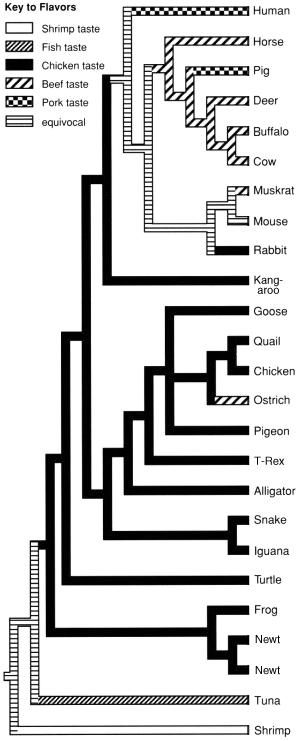
Umami [oo-mah-mee], also referred to as savoriness, has been proposed as one of the basic tastes sensed by specialized receptor cells present on the human and animal tongue. Umami is a loanword from Japanese meaning ‘good flavor’ or ‘good taste.’ In English, however, ‘brothy,’ ‘meaty,’ or savory’ have been proposed as alternative translations. Inasmuch as it describes the flavor common to savory products such as meat, cheese, and mushrooms, umami is similar to French gastronome Brillat-Savarin’s concept of osmazome, an early attempt to describe the main flavoring component of meat as extracted in the process of making stock.
The umami taste is due to the detection of the carboxylate anion of glutamic acid, a naturally occurring amino acid common in meat, cheese, broth, stock, and other protein-heavy foods. Salts of glutamic acid, known as glutamates, easily ionize to give the same carboxylate form and therefore the same taste. For this reason, they are used as flavor enhancers. The most commonly used of these is monosodium glutamate (MSG).
Posted in Food, Science, World |
Leave a Comment »
August 11, 2010

Fecal bacteriotherapy, also known as fecal transfusion, fecal transplant, or human probiotic infusion (HPI), is a medical treatment for patients with gastrointestinal conditions which require restoration of normal bacterial flora from stool obtained from a healthy donor.
Posted in Health, Science |
Leave a Comment »
August 10, 2010
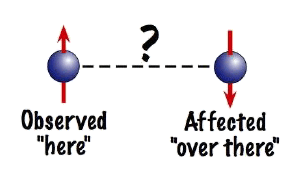
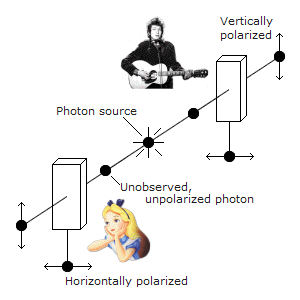
Quantum entanglement is a property of physics where two particles will act together and become a system. They behave like one object, but remain two separate objects. It is as if they now sit on the same teeter-totter seesaw. No matter how long the seesaw is, even if it is one million miles long, if one end is down the other end must be up, and this happens instantly. Even though each particle can tell what the other is doing, they do not send messages back and forth. There are no messages between the particles saying, ‘I’m going down, therefore, you must go up’ and waiting for the particle to receive the message. Yet, the particles are always connected and can behave as one.
Quantum Entanglement is one of the concepts that led Albert Einstein to dislike the theory of Quantum Mechanics. Along with his colleagues, Boris Podolsky and Nathan Rosen, Einstein used entanglement to try to disprove quantum mechanics. Einstein called entanglement ‘spooky action at a distance.’ Years later, however, John Bell proved with his theorem that entanglement is real and actually happens to tiny particles. Bell’s theorem was experimentally verified for the first time in 1980 by the French physicist Alain Aspect. Although one can probe a nearby particle to instantly affect its partner particle, it is impossible to control how they end up. In other words, probing the particle will influence its partner particle, but it is impossible to choose how to influence them. Therefore it is impossible to use quantum entanglement to send messages.
Posted in Science |
Leave a Comment »
August 10, 2010

The Higgs Boson [boh-son] is a very small particle, which interacts with a field called the Higgs Field. This field creates a ‘drag’ on particles, and this drag gives the particles mass. An easy way to think of it is that this field grabs onto many other particles, giving them a resistance to being moved. This resistance is observed as the particle’s mass. This field only interacts with particles that have mass, which is why some particles can go the speed of light like photons and some cannot, like neutrons.
As it is much smaller than other particles, it is difficult to detect. The Large Hadron Collider at CERN is the tool that scientists are now using to try to find it. Its existence is required in the Standard Model of particle physics, but it is the only particle in that model which has not yet been observed. If the the results of the work at CERN cannot show that the Higgs Boson exists, then a rewrite of our entire understanding of physics will be required.
Posted in Science, Technology |
Leave a Comment »
August 10, 2010

The Capgras delusion is a disorder in which a person holds a delusion that a friend, spouse, parent or other close family member has been replaced by an identical-looking impostor. The Capgras delusion is classed as a delusional misidentification syndrome, a class of delusional beliefs that involves the misidentification of people, places, or objects. It can occur in acute, transient, or chronic forms.
The delusion is most common in patients diagnosed with schizophrenia, although it can occur in connection with a number of conditions, including brain injury and dementia. It occurs more frequently in females by a ratio of three for every two men. Although the Capgras delusion is commonly called a syndrome, because it can occur as part of, or alongside, various other disorders and conditions, some researchers have argued that it should be considered a symptom, rather than a syndrome or classification in its own right. The condition is named after Joseph Capgras, a French psychiatrist who first described the disorder in 1923.
Posted in Health, Science |
Leave a Comment »
August 3, 2010
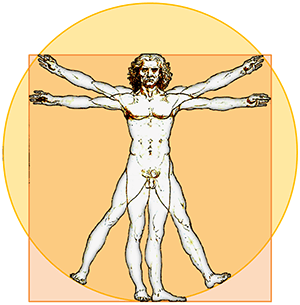
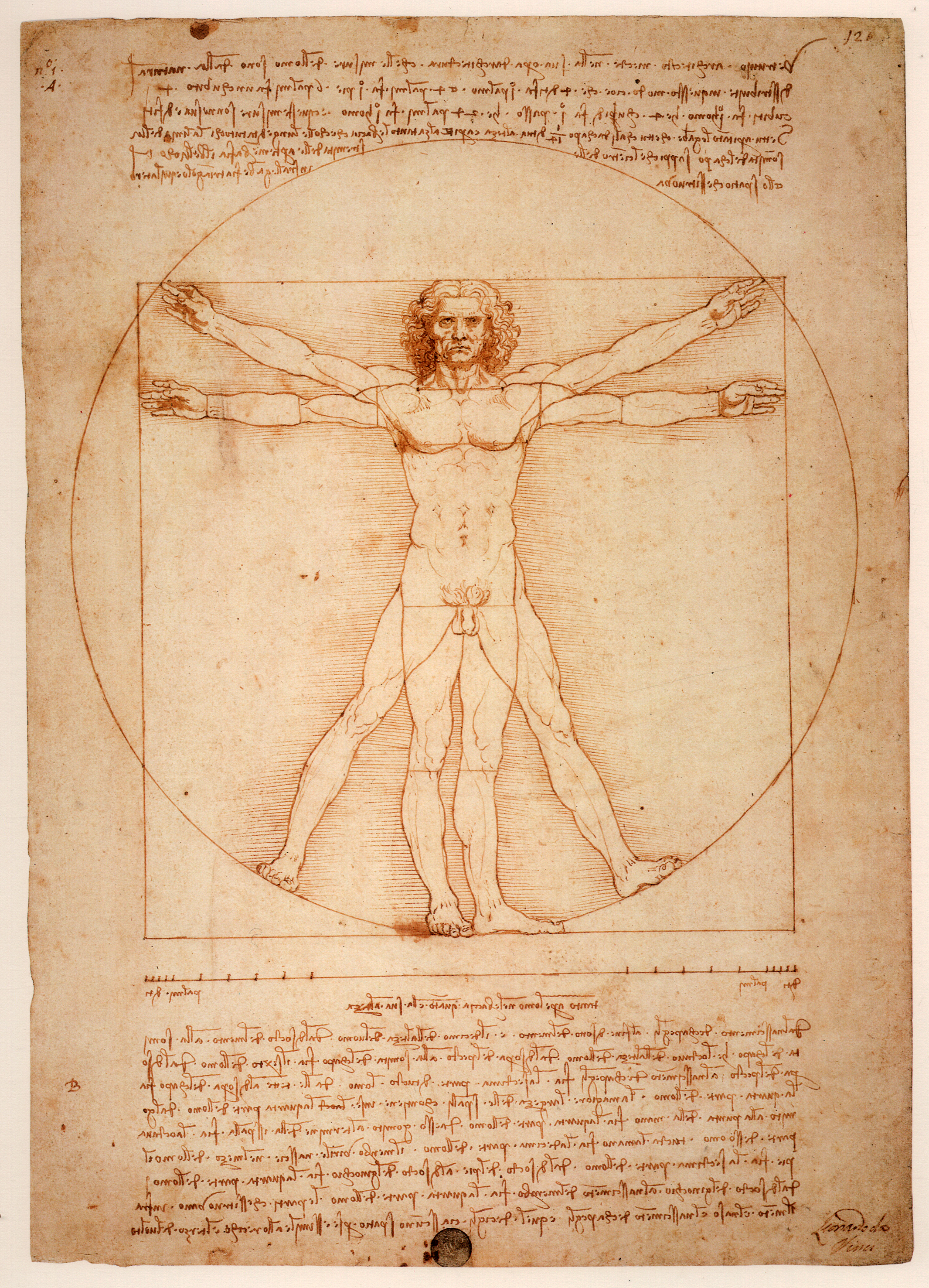
The Vitruvian [vi-troo-vee-uhn] Man is a world-renowned drawing created by Leonardo da Vinci around the year 1487. It is accompanied by notes based on the work of the famed architect, Vitruvius. The drawing, which is in pen and ink on paper, depicts a male figure in two superimposed positions with his arms and legs apart and simultaneously inscribed in a circle and square. The drawing and text are sometimes called the Canon of Proportions or, less often, Proportions of Man. It is stored in the Gallerie dell’Accademia in Venice, Italy, and, like most works on paper, is displayed only occasionally.
The drawing is based on the correlations of ideal human proportions with geometry described by the ancient Roman architect Vitruvius in Book III of his treatise De Architectura. Vitruvius described the human figure as being the principal source of proportion among the Classical orders of architecture. Other artists had attempted to depict this concept, with less success. Leonardo’s drawing is traditionally named in honor of the architect.
Posted in Art, Science |
Leave a Comment »
August 2, 2010
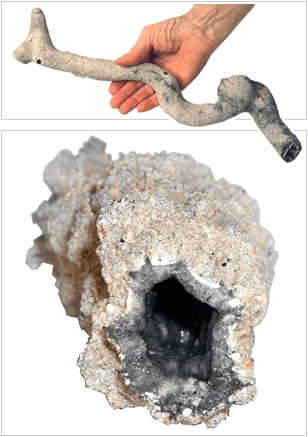
Fulgurites [fuhl-gyuh-rahyts] (from the Latin fulgur meaning thunderbolt) are natural hollow glass tubes formed in quartzose sand, or silica, or soil by lightning strikes. They are formed when lightning with a temperature of at least 3,270 °F instantaneously melts silica on a conductive surface and fuses grains together; the fulgurite tube is the cooled product. This process occurs over a period of around one second, and leaves evidence of the lightning path and its dispersion over the surface. Fulgurites can also be produced when a high voltage electrical lines break and fall onto a conductive surface with sand beneath. The glass formed is called lechatelierite which may also be formed by meteorite impact and volcanic explosions.
The tubes can be up to several centimeters in diameter, and meters long. Their color varies depending on the composition of the sand they formed in, ranging from black or tan to green or a translucent white. The interior is normally very smooth or lined with fine bubbles; the exterior is generally coated with rough sand particles and is porous.
Posted in Science |
Leave a Comment »
August 2, 2010

Manhattanhenge (sometimes referred to as the Manhattan Solstice) is a semiannual occurrence in which the setting sun aligns with the east–west streets of the main street grid in the borough of Manhattan in New York City. The term is derived from Stonehenge, at which the sun aligns with the stones on the solstices. It was coined in 2002 by Neil deGrasse Tyson, an astrophysicist at the American Museum of Natural History. It applies to those streets that follow the Commissioners’ Plan of 1811, which laid out a grid offset 28.9 degrees from true east–west.
The same phenomenon occurs in other cities with a uniform street grid. In Toronto, Ontario, Canada, for instance, the setting sun lines up with the east–west streets on October 25 and Feb 16, a phenomenon known locally as Torontohenge. In Chicago, Illinois, the sun lines up with the grid system on September 25, a phenomenon known similarly as Chicagohenge.
Posted in Science |
Leave a Comment »
August 1, 2010

A hypnic jerk, sleep start, or kick is an involuntary muscle twitch which occurs during hypnagogia, just as a person is beginning to fall asleep. Physically, hypnic jerks resemble the jump made when a person is startled, often accompanied by a falling sensation. It is commonly caused by irregular sleep schedules.
Posted in Health, Science |
Leave a Comment »
August 1, 2010
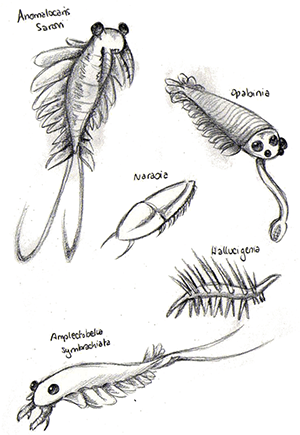
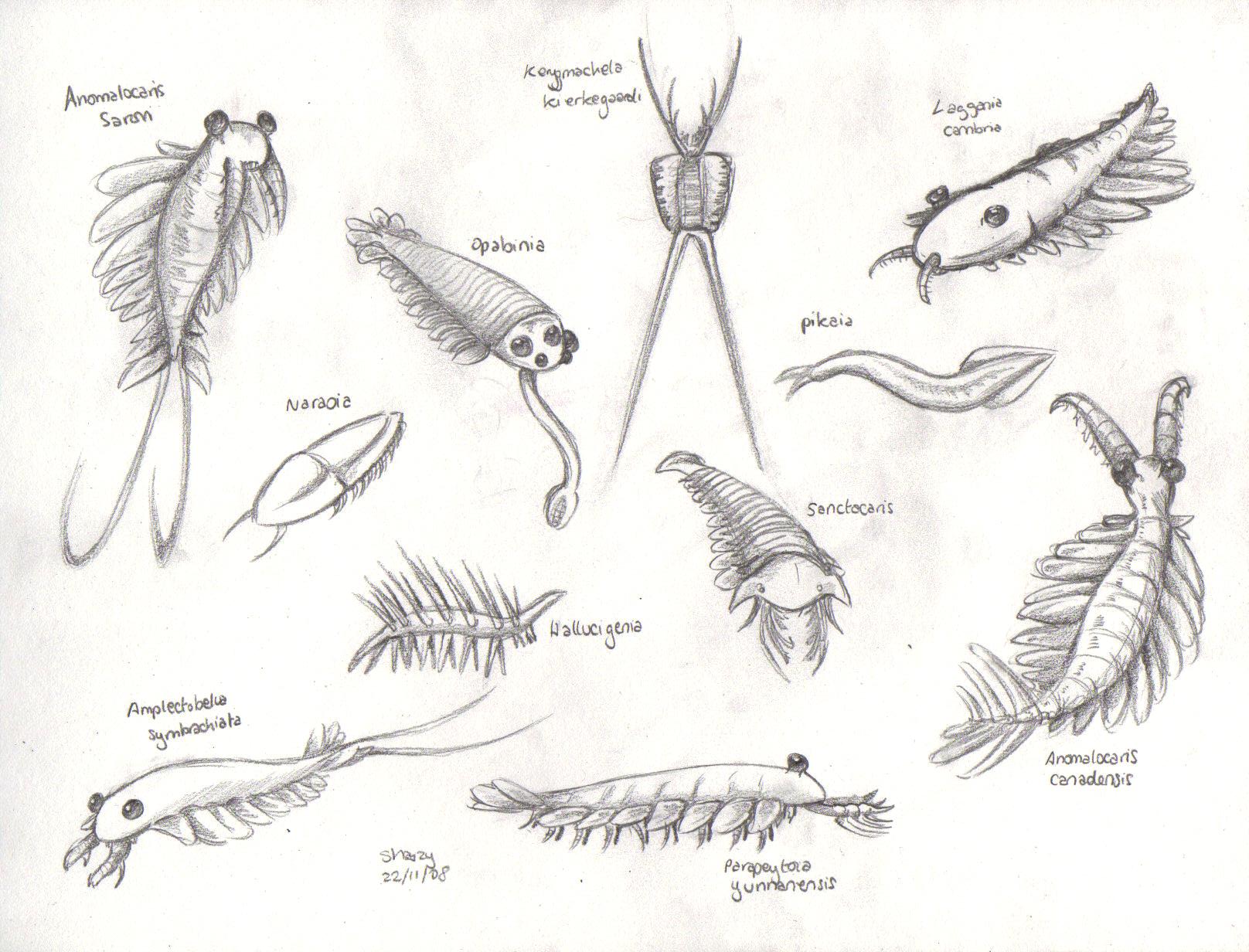
The Cambrian [kam-bree-uhn] explosion or Cambrian radiation was the relatively rapid appearance, over a period of many million years, of most major groups of complex animals around 530 million years ago, as found in the fossil record. Before about 580 million years ago, most organisms were simple, composed of individual cells occasionally organized into colonies. Over the following 70 or 80 million years the rate of evolution accelerated by an order of magnitude (as defined in terms of the extinction and origination rate of species) and the diversity of life began to resemble today’s.
The long-running puzzlement about the appearance of the Cambrian fauna, seemingly abruptly and from nowhere, centers on three key points: whether there really was a mass diversification of complex organisms over a relatively short period of time during the early Cambrian; what might have caused such rapid change; and what it would imply about the origin and evolution of animals. Interpretation is difficult due to a limited supply of evidence, based mainly on an incomplete fossil record and chemical signatures left in Cambrian rocks.
Posted in Science |
Leave a Comment »




 The Daily Omnivore