August 9, 2013
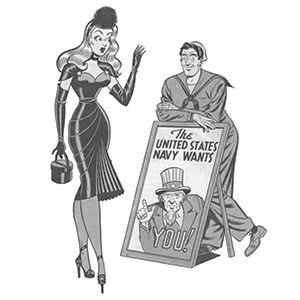
Good girl art (GGA) is found in drawings or paintings which feature a strong emphasis on attractive women no matter what the subject or situation. GGA was most commonly featured in comic books, pulp magazines and crime fiction. When cited as an art movement, it is usually capitalized as Good Girl Art.
The term describes the work of illustrators skilled at creating sexy female figure art; it is ‘girl art’ which is ‘good.’ Popular culture historian Richard A. Lupoff defined it as: ‘A cover illustration depicting an attractive young woman, usually in skimpy or form-fitting clothing, and designed for erotic stimulation. The term does not apply to the morality of the ‘good girl,’ who is often a gun moll, tough cookie or wicked temptress.’
read more »
Posted in Art, Sex |
Leave a Comment »
August 8, 2013

Women have been portrayed in comic books since the medium’s beginning, and their portrayals are often the subject of controversy. Sociologists with an interest in gender roles and stereotyping have outlined the role of women as both supporting characters and as potential leaders finding limited success at being accepted as equals.
Another point of study has been the depiction of women in comics, in which, as in other forms of popular culture, body types are unrealistically portrayed.
read more »
Posted in Art, Politics, Sex |
1 Comment »
July 14, 2013
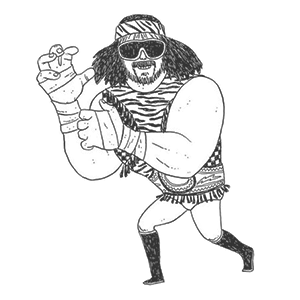
Machismo [mah-cheez-moh] is a negative descriptor of, for example, sexism, misogyny, chauvinism and hypermasculinity and hegemonic masculinity.
Scholars characterize such macho men as violent, rude, womanizing, and prone to alcoholism; domineering through intimidation, seducing and controlling women and children through violence and intimidation. However, some societies and academics place traditional gender roles – social norm for certain communities, followed by others by admiration or convention – as the most important component of machismo.
read more »
Posted in Politics, Sex, World |
1 Comment »
July 14, 2013

Hypermasculinity [hahy-per-mas-kyuh-lin-i-tee] is a psychological term for the exaggeration of male stereotypical behavior, such as an emphasis on physical strength, aggression, and sexuality . This term can be pejorative, though it is also used when examining the behavior (as adaptive or maladaptive) dispassionately.
One of the first studies of hypermasculinity was conducted by pyschologists Donald L. Mosher and Mark Sirkin in 1984. Mosher and Sirkin have operationally defined hypermasculinity or the ‘macho personality’ as consisting of the following three variables: a) ‘callous sexual attitudes toward women,’ b) ‘the belief that violence is manly,’ and c) ‘the experience of danger as exciting.’ They developed the Hypermasculinity Inventory (HMI) designed to measure the three components. Research has found that hypermasculinity is associated with sexual and physical aggression against women. Prisoners have higher hypermasculinity scores than control groups.
Posted in Language, Sex |
Leave a Comment »
July 14, 2013
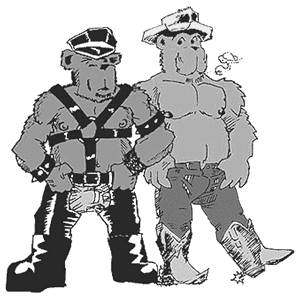
The Natural Bears Classification System (NBCS), also called the ‘bear code,’ is a set of symbols using letters, numbers and other characters commonly found on modern, Western computer keyboards, and used for the self-identification of those who self-identify as ‘bears’ in the sense of a mature gay or bisexual man with facial or substantial body hair.
These codes are used in email, Usenet, and Internet forum postings to identify the physical type and preferences of the poster.
read more »
Posted in Language, Sex |
Leave a Comment »
July 14, 2013
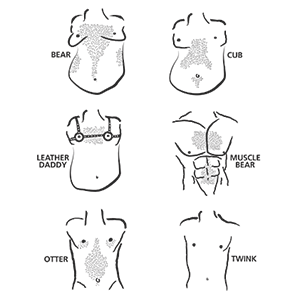
In gay culture, a Bear is a large, hairy man who projects an image of rugged masculinity. As a rising subculture in the gay and bisexual male communities, Bears are one of many LGBT communities with events, codes, and a culture-specific identity.
The term was popularized by Richard Bulger, who, along with his then partner Chris Nelson (1960–2006) founded ‘Bear Magazine’ in 1987. There is some contention surrounding whether Bulger originated the term and the subculture’s conventions. Author George Mazzei, for example, wrote an article for ‘The Advocate’ in 1979 called ‘Who’s Who in the Zoo?,’ that characterized homosexuals as seven types of animals, including bears.
read more »
Posted in Language, Sex |
1 Comment »
July 14, 2013
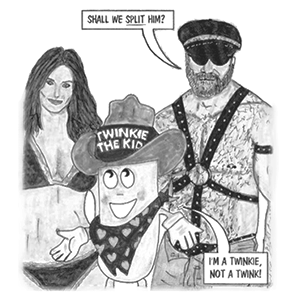
Twink [twingk] is a gay slang term describing a young or young-looking man with a slender, ectomorph build (long and thin), little or no body hair, and no facial hair. In some societies, the terms ‘fox,’ ‘plum,’ ‘chick,’ or ‘chicken’ are preferred. The related term ‘twinkle-toes,’ which implies that a man is effeminate, tends to be used in a derogatory manner. The terms can be complimentary or pejorative. The opposite of a twink in gay slang is a ‘bear,’ a large, hairy man who projects an image of rugged masculinity.
The term’s namesake is the ‘golden-colored phallic-shaped snack cake’ Hostess Twinkie, commonly regarded as the quintessential junk food: ‘little nutritional value, sweet to the taste and creme-filled.’ In ‘Queering Pornography: Desiring Youth, Race and Fantasy in Gay Porn,’ essayist Zeb J. Tortorici notes that gay twink porn thrives on the production and performance of ‘consumable and visually/anally receptive masculinity.’
read more »
Posted in Language, Sex |
Leave a Comment »
June 10, 2013

In psychoanalytic theory, the term Oedipus [ed-uh-puhs] complex denotes the emotions and ideas that the mind keeps in the unconscious, via dynamic repression, that concentrates upon a child’s desire to sexually possess the parent of the opposite sex. Sigmund Freud, who coined the term believed that the Oedipus complex is a desire for the parent in both males and females; Freud deprecated the term ‘Electra complex,’ which was introduced by Carl Gustav Jung in regards to the Oedipus complex manifested in young girls.
The Oedipus complex occurs in the third — phallic stage (ages 3–6) — of five psychosexual development stages: (i) the oral, (ii) the anal, (iii) the phallic, (iv) the latent, and (v) the genital — in which the source of libidinal pleasure is in a different erogenous zone of the infant’s body.
read more »
Posted in Health, Sex |
1 Comment »
June 7, 2013

Really Big Coloring Books, Inc (RBCB) is an American publisher based in St. Louis, Missouri. The company develops, publishes and distributes children’s coloring and activity books, many of which are over two feet tall. Some of their products have been controversial due to their political content.
The company was established in 1981 by publisher Wayne Bell. The company is best known for its politically themed coloring books, covering subjects such as Barack Obama, the Tea Party Movement, and Occupy Wall Street.
read more »
Posted in Art, Politics, Sex |
Leave a Comment »
June 5, 2013

Lookism is a term used to refer to the positive stereotypes, prejudice, and preferential treatment given to physically attractive people, or more generally to people whose appearance matches cultural preferences.
The pejorative term ‘body fascism’ is also used as a synonym and educator and activist Warren Farrell has proposed the term ‘genetic celebrity’ to describe adoration of the attractive.
read more »
Posted in Language, Politics, Sex |
Leave a Comment »
May 30, 2013
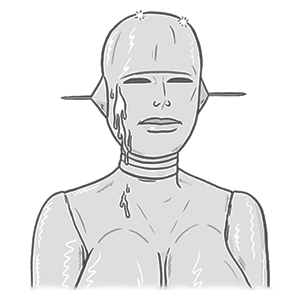
A facial is a term for the sexual activity in which a man ejaculates semen onto the face of one or more sexual partners. A facial is a form of non-penetrative sex, though it is generally performed after some other means of sexual stimulation. Facial cum shots are currently regularly portrayed in pornographic films and videos, often as a way to close a scene.
Many sex experts consider the act demeaning and do not promote it. In response to an inquiry from a reader, sex columnist Dan Savage wrote: ‘Facials are degrading—and that’s why they’re so hot.’
read more »
Posted in Health, Politics, Sex |
1 Comment »
May 30, 2013
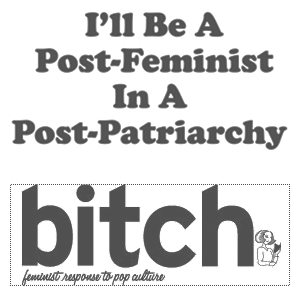
Post-feminism is a reaction against some perceived contradictions and absences of second-wave feminism (a period of feminist activity that first began in the early 1960s in the United States, and eventually spread throughout the Western world). The term post-feminism is ill-defined and is used in inconsistent ways.
However, it generally connotes the belief that feminism has succeeded in its goal of ameliorating sexism, making it fundamentally opposed to the third-wave intention of broadening feminist struggle by focusing on diversity and change.
read more »
Posted in Language, Politics, Sex |
1 Comment »


 The Daily Omnivore