November 20, 2012
A fetish (from Latin ‘facticius,’ ‘artificial’ and ‘facere,’ ‘to make’) is an object believed to have supernatural powers, or in particular, a man-made object that has power over others. Essentially, fetishism is the emic (intracultural) attribution of inherent value or powers to an object. Initially, the Portuguese developed the concept of fetishism to refer to the objects used in religious cults by West African natives.
The concept was popularized in Europe circa 1757, when French scholar Charles de Brosses used it in comparing West African religion to the magical aspects of ancient Egyptian religion. Later, French philosopher Auguste Comte employed the concept in his theory of the evolution of religion, wherein he posited fetishism as the earliest (most primitive) stage, followed by polytheism and monotheism.
read more »
Posted in Philosophy, Sex |
Leave a Comment »
November 17, 2012

The Feminist Sex Wars, were acrimonious debates among feminists in the late 1970s and early 1980s. The sides were characterized by anti-porn and pro-sex groups with disagreements regarding sexuality, sexual representation, pornography, sadomasochism, the role of transwomen in the lesbian community, and other sexual issues.
The debate pitted anti-pornography feminism against sex-positive feminism, and the feminist movement was deeply divided as a result. The Feminist Sex Wars are sometimes viewed as part of the division that led to the end of the second-wave feminist era.
read more »
Posted in Politics, Sex |
Leave a Comment »
November 17, 2012

Sex-positive feminism is a movement that began in the early 1980s to promote sexual freedom as an essential component of women’s freedom. Some became involved in the sex-positive feminist movement in response to efforts by anti-pornography feminists, such as Catharine MacKinnon and Andrea Dworkin, to put pornography at the center of a feminist explanation of women’s oppression.
This period of intense debate and acrimony between sex-positive and anti-pornography feminists during the early 1980s is often referred to as the ‘Feminist Sex Wars.’ Other less academic sex-positive feminists became involved not in opposition to other feminists but in direct response to what they saw as patriarchal control of sexuality.
read more »
Posted in Philosophy, Politics, Sex |
2 Comments »
November 17, 2012

Feminist pornography is pornography produced by and with feminist women. It is a small but growing segment of the pornography industry. Since 2006, there has been a Feminist Porn Awards held annually in Toronto, sponsored by a local feminist sex toy shop, Good for Her.
They have three guiding criteria: A woman had a hand in the production, writing, direction, etc. of the work; It depicts genuine female pleasure; and It expands the boundaries of sexual representation on film and challenges stereotypes that are often found in mainstream porn.
read more »
Posted in Money, Politics, Sex |
Leave a Comment »
November 7, 2012

The gay lisp is a stereotypical manner of speech associated with gay males, particularly in English-speaking countries, that involves their pronunciation of sibilant consonants (fricatives, made by directing a stream of air with the tongue towards the sharp edge of the teeth, which are held close together) and sometimes others verbal features.
The phenomenon of the ‘gay lisp’ and its study are poorly understood, similar to other secondary external attributes or verbal and non-verbal mannerisms of both gay and straight people. These attributes have proven difficult to define and quantify but seem somewhat independent of other variables in the phonology of the English language, such as accent and register.
read more »
Posted in Language, Sex |
Leave a Comment »
November 6, 2012

A wedge issue is a social issue, often of a divisive or controversial nature, which splits apart a population or political group. Wedge issues can be advertised or publicly aired in an attempt to weaken the unity of a population; with the goal of enticing polarized individuals to give support to an opponent. The use of wedge issues gives rise to wedge politics. Wedge issues are also known as ‘hot button’ or ‘third rail’ issues.
Political campaigns use wedge issues to exploit tension within a targeted population. A wedge issue may often be a point of internal dissent within an opposing party, which that party attempts to suppress or ignore discussing because it divides ‘the base.’ Typically, wedge issues have a cultural or populist theme, relating to matters such as crime, national security, sexuality (e.g. gay marriage), or race. A party may introduce a wedge issue to an opposing population, while aligning itself with the dissenting faction of the opposition.
read more »
Posted in Politics, Sex, World |
1 Comment »
November 5, 2012

Hot or Not was a rating site that allowed users to rate the attractiveness of photos submitted voluntarily by others. The site offers a matchmaking engine called ‘Meet Me’ and an extended profile feature called ‘Hotlists.’ It is owned by Badoo Trading Limited (a dating-focused social discovery website, founded in 2006 by Russian entrepreneur Andrey Andreev), and was previously owned by Avid Life Media (who owns a dating web site named ‘Ashley Madison’ that is geared toward married individuals looking for an additional relationship).
‘Hot or Not’ was a significant influence on the people who went on to create the social media sites Facebook and YouTube. The site was founded in 2000 by James Hong and Jim Young, two friends and Silicon Valley-based engineers. Both graduated from the University of California, Berkeley in electrical engineering, with Young pursuing a Ph.D at the time.
read more »
Posted in Money, Sex, Technology |
Leave a Comment »
October 28, 2012

Alt porn tends to involve members of such subcultures as goths, punks, or ravers and is often produced by small and independent websites or filmmakers. It often features models with body modifications such as tattoos, piercings, or scarifications, or temporary modifications such as dyed hair.
The term indie porn is also sometimes used, though this term is more generally used as a synonym for independent pornography, regardless of affinity with any kind of alternative subculture. While pornography specifically oriented toward alternative culture did not arise until the 1990s, the work of Gregory Dark, David Aaron Clark, Michael Ninn, and Stephen Sayadian are seen by some as predecessors of alt porn. ‘The Cinema of Transgression’ of Richard Kern and Nick Zedd (as well as Kern’s later photographic work) can also be viewed as early examples of alt porn.
read more »
Posted in Language, Sex |
2 Comments »
October 27, 2012
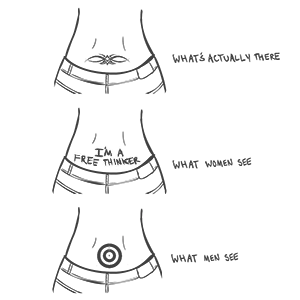
Lower-back tattoos (often referred to as tramp stamps) are a form of body art that became popular among women in the 2000s and gained a reputation as a feminine type of tattoo. Although historically men comprised the majority of tattoo recipients, in the early 1990s, the practice gained popularity among women. In the early to mid-20th century, women with tattoos were heavily stigmatized, and were rarely found in middle-class society. Lower-back tattoos were popularized in the early 2000s, in part owing to the influence of celebrities, including Britney Spears, Christina Ricci, and Pamela Anderson. The popularity of low-rise jeans and crop tops may have also spurred the increase in lower-back tattoos.
Another appeal of tattooing the lower back is that there is little fat there, lessening the chance that images will become misshapen over time. Also, the lower back is often concealed, providing women the choice of when to reveal their tattoo. Medical practitioners who administer anesthesia have questioned whether epidural analgesia should be provided to women with lower-back tattoos. Concerns have emerged that epidural catheters may cause tattoo pigment to enter interspinous ligaments and other areas, potentially leading to health problems. There is general consensus that epidural catheters should not be placed through irritated or infected tattoos. However, harm has not been clearly documented when placing epidural catheters through healthy tattooed skin.
Posted in Art, Health, Sex |
Leave a Comment »
October 24, 2012

Harm reduction refers to a range of public health policies designed to reduce the harmful consequences associated with human behaviors, even if those behaviors are risky or illegal. Examples of behaviors targeted for harm reduction policies include recreational drug use and prostitution. Criticism of harm reduction typically centers on concerns that tolerating risky or illegal behavior sends a message to the community that these behaviors are acceptable.
In the case of recreational drug use, harm reduction is put forward as a useful perspective alongside the more conventional approaches of demand and supply reduction. Many advocates argue that prohibitionist laws criminalize people for suffering from a disease and cause harm, for example by obliging drug addicts to obtain drugs of unknown purity from unreliable criminal sources at high prices, increasing the risk of overdose and death.
read more »
Posted in Drugs, Politics, Sex |
Leave a Comment »
October 24, 2012

The orgasmatron is a fictional device that appears in the 1973 movie ‘Sleeper,’ which also shows the effects of a related device, an orgasmic orb. Similar devices have appeared in other fictional works. The term has also been applied to a non-fictional device capable of triggering an orgasm-like sensation using electrodes implanted at the lower spine. Author Christopher Turner has suggested that the orgasmatron was a parody of Wilhelm Reich’s ‘orgone accumulator,’ a device which claims to concentrate ‘orgone,’ a bioenergy theorized by Reich.
The orgasmatron is a fictional device in the fictional future society of 2173 in the Woody Allen movie ‘Sleeper.’ It is a large cylinder big enough to contain one or two people. The orgasmatron was made by decorating an elevator in the home where the movie was filmed. Once entered, it contains some (otherwise undescribed) future technology that rapidly induces orgasms. This is required, as almost all people in the ‘Sleeper’ universe are impotent or frigid, although males of Italian descent are considered the least impotent of all groups.
read more »
Posted in Humor, Sex, Technology |
Leave a Comment »
October 24, 2012


Orgone [awr-gohn] energy was a hypothetical universal life force originally proposed in the 1930s by Austrian psychiatrist Wilhelm Reich. In its final conception, developed by Reich’s student Charles Kelly after Reich’s death, Orgone was conceived as the anti-entropic principle of the universe, a creative substratum in all of nature comparable to Mesmer’s animal magnetism, the Odic force of Carl Reichenbach and Henri Bergson’s élan vital.
Orgone was seen as a massless, omnipresent substance, similar to luminiferous aether, but more closely associated with living energy than inert matter. It could coalesce to create organization on all scales, from the smallest microscopic units—called bions in orgone theory—to macroscopic structures like organisms, clouds, or even galaxies. Reich’s theories held that deficits or constrictions in bodily orgone were at the root of many diseases—including cancer—much as deficits or constrictions in the libido could produce neuroses in Freudian theory.
read more »
Posted in Health, Science, Sex |
Leave a Comment »


 The Daily Omnivore