October 16, 2015


Scam baiting is a form of Internet vigilantism, where the vigilante poses as a potential victim to the scammer in order to waste their time and resources, gather information that will be of use to authorities, and publicly expose the scammer. It is primarily used to thwart advance-fee fraud scams (e.g. ‘Nigerian Prince’ scams) and can be done out of a sense of civic duty (activism) by documenting scammers tools and methods, warning potential victims, or taking down fake websites.
A bait is very simply initiated, by answering a scam email, from a throwaway email account, i.e. one that is only used for baiting and untraceable back to the actual owner. The baiter then pretends to be receptive to the financial hook that the scammer is using, but requires increasingly ridiculous forms of security from the scammer before turning over funds. Scam baiters typically use jest in their attacks. However, some scam baiters have been accused of abject mockery, racism, and homophobia, and even scamming themselves.
Posted in Money, Politics, Technology |
Leave a Comment »
October 4, 2015

Sukkah [sook-uh] City was a 2010 architectural design competition and work of installation art planned in New York City’s Union Square Park. A sukkah is the name given to a structure described in Torah (Jewish Bible). The Children of Israel were instructed to annually commemorate their Exodus from Egypt by dwelling for seven days every autumn in temporary structures reminiscent of those in which they lived during their 40 years of wandering in the desert before settling in the Land of Israel. Many Jews continue this practice to this day, and Sukkah City aims to re-imagine the sukkah in contemporary design.
A committee of art critics and architects selected 12 winners from a field of over 600 entries. The twelve winning sukkot were constructed at Brooklyn’s Gowanus Studio Space, and driven by truck to Union Square Park for display on September 19 and 20 from dawn to dusk. The design chosen as ‘the people’s choice,’ entitled ‘Fractured Bubble’ by Long Island City architects Henry Grosman and Babak Bryan, stood for the requisite seven days of the Jewish holiday of Sukkot. The competition was the brainchild of journalists Joshua Foer and Roger Bennett. It was sponsored by Reboot, an organization that aims to catalyze innovation in Jewish culture, rituals, and traditions.
read more »
Posted in Philosophy, Technology |
1 Comment »
September 30, 2015
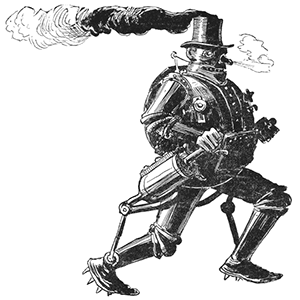
Edisonade is a modern term, coined in 1993 by John Clute in his and Peter Nicholls’ ‘The Encyclopedia of Science Fiction,’ for fictional stories about a brilliant young inventor and his inventions. This subgenre started in the Victorian and Edwardian eras and had its apex of popularity during the late 19th and early 20th centuries, and was common in ‘scientific romance,’ an archaic term for the genre of fiction now known as ‘science fiction.’
The term ‘Edisonade’ originated in the 1850s to describe both fiction and elements of scientific writing, but has since come to refer to the science fiction of the late nineteenth and early twentieth century, primarily that of Jules Verne, H. G. Wells, and Arthur Conan Doyle. In recent years, the term has come to be applied to science fiction written in a deliberately anachronistic style, as a homage to or pastiche of the original scientific romances.
read more »
Posted in Art, Language, Technology |
Leave a Comment »
September 22, 2015

The X-Seed 4000 is the tallest building ever fully envisioned, meaning that the designs for construction have been completed. Developed by architect Peter Neville, its proposed 4-km height, 6-km wide sea-base, and 800-floor capacity could accommodate 500,000 to 1,000,000 inhabitants. Requiring over 3,000,000 tons of reinforced steel, the construction was estimated to cost US$300–900 billion, in 2006 dollars. It was designed for Tokyo by the Taisei Corporation in 1995 as a futuristic environment combining ultra-modern living and interaction with nature.
Unlike conventional skyscrapers, the X-Seed 4000 would be required to actively protect its occupants from considerable air pressure gradations and weather fluctuations along its massive elevation. Also, the proposed area is situated on the Pacific Ring of Fire, which is the most active volcano range in the world so the structure would be subject to tsunamis and earthquakes. The X-Seed 4000 ‘is never meant to be built,’ says Georges Binder, managing director of Buildings & Data, a firm which compiles data banks on buildings worldwide. ‘The purpose of the plan was to earn some recognition for the firm, and it worked.’
Posted in Technology, World |
Leave a Comment »
September 20, 2015

A ghost light is an electric light that is left lit on the stage of an unoccupied theater. It typically consists of an exposed bulb mounted in a wire cage on a portable light stand near center stage. Ghost lights are also sometimes known as ‘equity lights’ or ‘equity lamps,’ possibly indicating their use was originally mandated by the Actors’ Equity Association. A ghost light enables one to navigate the theater to find the lighting control console and to avoid accidents such as falling into the orchestra pit or damaging set pieces. Aside from its obvious practical purpose, there are a number of superstitions associated with the origin and purpose of ghost lights.
A popular legend holds that every theater has a ghost. Some theaters have traditions to appease ghosts that reach far back into their history. For example, the Palace Theatre, London keeps two seats in their balcony permanently bolted open to provide seating for the theater ghosts. Similar superstitions hold that ghost lights provide opportunities for ghosts to perform onstage, thus appeasing them and preventing them from cursing the theater or sabotaging the set or production. The use of ghost lights might also be a throwback to the 1800s when theaters were lit with gas lamps. Leaving a flame burning would prevent the buildup of pressure in the gas lines which could cause an explosion.
Posted in Art, Philosophy, Technology |
Leave a Comment »
September 16, 2015


The smart cow problem refers to the fact that when a group of individuals is faced with a technically difficult task, only one of their members has to solve it. When the problem has been solved once, an easily repeatable method may be developed, allowing the less technically proficient members of the group to accomplish the task.
The concept is relevant to copyright protection schemes such as DRM (Digital Rights Management), where, due to the rapid spread of information on the Internet, it only takes one individual’s defeat of a DRM technology to render the method obsolete. The term ‘smart cow’ is thought to be derive from the expression: ‘It only takes one smart cow to open the latch of the gate, and then all the other cows follow.’
Posted in Money, Politics, Technology |
Leave a Comment »
August 29, 2015


Stewart Brand (b. 1938) is an American writer, best known as editor of the ‘Whole Earth Catalog,’ a counterculture magazine and mail order catalog. He founded a number of organizations, including The WELL (one of the oldest virtual communities in continuous operation), the Global Business Network (a scenario planner and forecaster for companies, NGOs, and governments), and the Long Now Foundation (a nonprofit that promotes very long-term projects, e.g. a 10,000 year clock). He is the author of several books, most recently ‘Whole Earth Discipline: An Ecopragmatist Manifesto.’
Brand attended Phillips Exeter Academy. He studied biology at Stanford University, graduating in 1960. His first marriage was to Lois Jennings, an Ottawa Native American and mathematician. As a soldier in the Army, he was a parachutist and taught infantry skills; he later expressed the view that his experience in the military had fostered his competence in organizing. A civilian again in 1962, he studied design at San Francisco Art Institute, photography at San Francisco State College, and participated in a legitimate scientific study of then-legal LSD, in Menlo Park, California.
read more »
Posted in Language, Politics, Technology |
Leave a Comment »
August 11, 2015

Phantom vibration syndrome or ‘phantom ringing’ is the mistaken feeling that one’s mobile phone is vibrating or ringing. Other terms for this concept include ringxiety (a portmanteau of ‘ring’ and ‘anxiety’) and ‘fauxcellarm’ (a play on ‘false alarm’). It is a form of pareidolia, a psychological phenomenon involving a stimulus (such as an image or a sound) wherein the mind perceives a familiar pattern where none actually exists. Phantom ringing may be experienced while taking a shower, watching television, or using a noisy device. Humans are particularly sensitive to auditory tones between 1,000 and 6,000 hertz, and basic mobile phone ringers often fall within this range.
In the comic strip ‘Dilbert,’ cartoonist Scott Adams referenced such a sensation in 1996 as ‘phantom-pager syndrome.’ The earliest published use of the term dates to a 2003 article in the ‘New Pittsburgh Courier,’ written by Robert D. Jones. In the conclusion of the article, Jones writes, ‘…should we be concerned about what our mind or body may be trying to tell us by the aggravating imaginary emanations from belts, pockets and even purses? Whether PVS is the result of physical nerve damage, a mental health issue, or both, this growing phenomenon seems to indicate that we may have crossed a line in this ‘always on’ society.’
Posted in Health, Science, Technology |
Leave a Comment »
August 3, 2015
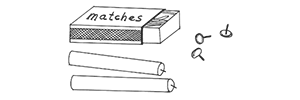
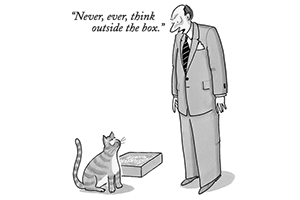
Functional fixedness [fiks-ed-nes] is a cognitive bias that limits a person to using an object only in the way it is traditionally used. The concept originated in Gestalt Psychology, which emphasizes holistic processing (e.g., ‘the whole is greater than the sum of its parts’). German American psychologist Karl Duncker defined functional fixedness as a ‘mental block against using an object in a new way that is required to solve a problem.’ This ‘block’ limits the ability of an individual to use components given to them to complete a task, as they cannot move past the original purpose of those components.
For example, if someone needs a paperweight, but they only have a hammer, they may not see how the hammer can be used as a paperweight. Functional fixedness is this inability to see a hammer’s use as anything other than for pounding nails; the person couldn’t think to use the hammer in a way other than in its conventional function. When tested, five year old children show no signs of functional fixedness. At that age, any goal to be achieved with an object is equivalent to any other goal. However, by age seven, children have acquired the tendency to treat the originally intended purpose of an object as special.
read more »
Posted in Education, Health, Technology |
1 Comment »
July 16, 2015
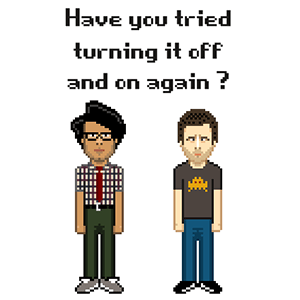
A user error is an error made by the human user of a complex system, usually a computer system, in interacting with it. Related terms such as PEBCAK (Problem Exists Between Chair And Keyboard), ID-10T error (idiot error), and other similar phrases are also used as slang in technical circles with derogatory meaning. A highly popularized example of this is a user mistaking their CD-ROM tray for a cup holder, or a user looking for the ‘any key.’
This usage implies a lack of computer savvy, asserting that problems arising when using a device are the fault of the user. Critics of the term argue that the problems are caused instead by a device that doesn’t take into account human limitations and is thus designed in a way that induces errors.
read more »
Posted in Humor, Technology |
Leave a Comment »
July 13, 2015

‘The Truth Machine‘ is a 1996 science fiction novel by James L. Halperin about an infallible lie detector. Soon, every citizen must pass a thorough test under a Truth Machine to get a job or receive any sort of license. Eventually, people begin wearing them all the time, thus eliminating dishonesty in all parts of human interaction, including most crime, terrorism and a great deal of general social problems.
The novel focuses on the life story of the machine’s inventor, Pete Armstrong, a child prodigy whose life has been defined by the tragic murder of his younger brother, Leonard, by an ex-convict who was believed to be capable of committing violent crimes again, but who could not be incarcerated on mere suspicions. Armstrong claimed that as long as it was employed universally (and not just by government officials), the ‘truth machine’ could revolutionize humanity and take it to that next evolutionary step. However, the protagonist places a back door in the device, allowing him to avoid detection when he repeats fragments of Walt Whitman’s poem ‘O Captain! My Captain!’ in his mind.
Posted in Language, Politics, Technology |
Leave a Comment »
June 23, 2015
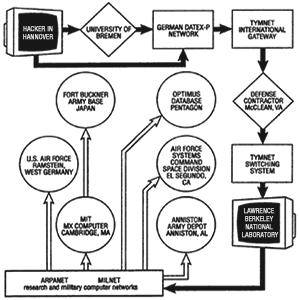
‘The Cuckoo’s Egg: Tracking a Spy Through the Maze of Computer Espionage’ is a 1989 book written by Clifford Stoll, an astronomer turned systems administrator of the computer center of the Lawrence Berkeley Laboratory (LBL) in California. It is his first-person account of the hunt for a computer hacker who broke into a computer at the lab.
In August of 1986 his supervisor asked him to resolve a US$0.75 accounting error in the computer usage accounts. He traced the error to an unauthorized user who had apparently used up nine seconds of computer time and not paid for it, and eventually realized that the unauthorized user was a hacker who had acquired root (high-level) access to the LBL system by exploiting a vulnerability in the movemail function of the original GNU Emacs (an open-source computer program that moves a user’s mail to another file).
read more »
Posted in Language, Technology, War |
Leave a Comment »


 The Daily Omnivore