June 22, 2015

Vimāna [vi-mah-nuh] is a mythological flying palace or chariot described in Hindu texts and Sanskrit epics. The Pushpaka Vimana of the demon king Ravana is the most quoted example. Vimanas are also found in Jain texts. The word literally means ‘measuring out, traversing.’
Oxford Sanskrit scholar Monier Monier-Williams defined it as ‘a car or a chariot of the gods, any mythical self-moving aerial car (sometimes serving as a seat or throne, sometimes self-moving and carrying its occupant through the air; other descriptions make the Vimana more like a house or palace, and one kind is said to be seven stories high).’ It may denote any car or vehicle, especially a bier (a wheeled altar for transporting coffins), or a ship as well as a palace of an emperor, especially with seven stories.
read more »
Posted in Philosophy, Technology, World |
Leave a Comment »
June 16, 2015

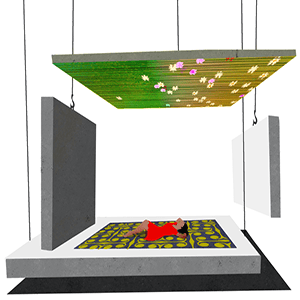
The Lowline, formally known as the Delancey Underground, is a proposal for the world’s first underground park. The subterranean public space would be located under the eastbound roadway of Delancey Street on the Lower East Side of Manhattan (adjacent to the Essex Street station).
Co-founders James Ramsey and Dan Barasch have suggested natural light would be directed below ground using fiber optics—described in the proposed plan as ‘remote skylights’—to provide an area in which trees and grass could be grown beneath the city streets.
read more »
Posted in Technology, World |
Leave a Comment »
May 21, 2015
The tiny house movement is a popular description for the architectural and social movement that advocates living simply in small homes. In the US the average size of new single family homes grew from 1,780 square feet in 1978 to 2,479 in 2007, despite a decrease in the size of the average family. Reasons for this include increased material wealth and prestige. The small house movement is a return to houses less than 1,000 square feet, some as small as 80 square feet.
Sarah Susanka has been credited with starting the recent countermovement toward smaller houses when she published ‘The Not So Big House’ in 1997. Earlier pioneers include Lloyd Kahn, author of ‘Shelter’ in 1973.’ Tiny houses on wheels were popularized by Jay Shafer who designed and lived in a 96 sq ft house and later went on to offer the first plans for tiny houses on wheels, initially founding ‘Tumbleweed Tiny House Company,’ and then ‘Four Lights Tiny House Company’ in 2012.
read more »
Posted in Money, Technology, World |
1 Comment »
May 18, 2015


Presence is the illusion that a virtual experience is real. Today, it often considers the effect that people experience when they interact with a computer-mediated or computer-generated environment. This use of the term derives from the word ‘telepresence,’ coined by MIT professor Marvin Minsky in 1980, which he described as the manipulation of objects in the real world through remote access technology. For example, a surgeon may use a computer to control robotic arms to perform minute procedures on a patient in another room. Or a NASA technician may use a computer to control a rover to collect rock samples on Mars.
As technologies progressed, the need for an expanded term arose. Thomas Sheridan (also of MIT, and a pioneer of robotics and remote control technology) extrapolated Minsky’s original definition. Using the shorter ‘presence,’ Sheridan explained that the term refers to the effect felt when controlling real world objects remotely as well as the effect people feel when they interact with and immerse themselves in virtual reality or virtual environments.
read more »
Posted in Games, Language, Technology |
Leave a Comment »
May 16, 2015

Flip-flops (also called thongs, jandals, pluggers, go-aheads, slaps, slides, step-ins, chankla or a variety of other names throughout the world) are a type of open-toed sandal typically worn in casual situations. They consist of a flat sole held loosely on the foot by a Y-shaped strap that passes between the first and second toes and around either side of the foot. They may also be held to the foot with a single strap over the top of the foot rather than a thong. The name is an onomatopoeia for the sound that is made when the sole slaps the ground while walking in flip-flops.
This style of footwear has been worn by the people of many cultures throughout the world, originating as early as the ancient Egyptians. The modern flip-flop descends from the Japanese zōri, which were popularized in the US after WWII by soldiers returning from the Pacific theater. They are common summer footwear for both genders, and some varieties have even found their way into more formal attire, despite criticism.
read more »
Posted in Health, Technology, World |
Leave a Comment »
May 12, 2015

Recursive [ri-kur-siv] self-improvement is the speculative ability of a strong artificial intelligence computer program to program its own software continuously. This is sometimes also referred to as ‘Seed AI’ because if an AI were created with engineering capabilities that matched those of its human creators, it would have the potential to autonomously improve the design of its constituent software and hardware. Having undergone these improvements, it would then be better able to find ways of optimizing its structure and improving its abilities further. It is speculated that over many iterations, such an AI would far surpass human cognitive abilities.
This notion of an ‘intelligence explosion’ was first described by British cryptographer I.J. Good in 1965, who speculated on the effects of superhuman machines: ‘Let an ultraintelligent machine be defined as a machine that can far surpass all the intellectual activities of any man however clever. Since the design of machines is one of these intellectual activities, an ultraintelligent machine could design even better machines; there would then unquestionably be an ‘intelligence explosion,’ and the intelligence of man would be left far behind. Thus the first ultraintelligent machine is the last invention that man need ever make.’
read more »
Posted in Technology |
1 Comment »
April 22, 2015


The StingRay is an IMSI-catcher (International Mobile Subscriber Identity), a controversial cellular phone surveillance device, manufactured by the Harris Corporation. Initially developed for the military and intelligence community, the StingRay and similar Harris devices are in widespread use by local and state law enforcement agencies across the US. Stingray has also become a generic name to describe these kinds of devices.
The StingRay has with both passive (digital analyzer) and active (cell site simulator) capabilities. When operating in active mode, the device mimics a wireless carrier cell tower in order to force all nearby mobile phones and other cellular data devices to connect to it. The devices can be mounted on cars, airplanes, helicopters, and unmanned aerial vehicles, as well as carried by hand. They are primarily used for surveillance, but can also conduct denial of service attacks (radio jamming).
read more »
Posted in Politics, Technology, War |
Leave a Comment »
April 21, 2015

Project Blue Book was one of a series of systematic studies of unidentified flying objects (UFOs) conducted by the United States Air Force. It started in 1952, and it was the third study of its kind (the first two were projects ‘Sign’ in 1947 and ‘Grudge’ in 1949). A termination order was given for the study in 1969. Project Blue Book had two goals: To determine if UFOs were a threat to national security, and To scientifically analyze UFO-related data. Thousands of UFO reports were collected, analyzed and filed.
As the result of the ‘Condon Report’ (1968), which concluded there was nothing anomalous about UFOs, Project Blue Book was ordered shut down in 1970. Ultimately, Project Blue Book stated that UFOs sightings were generated as a result of: hysteria, fraud, hoaxes, and misidentification. The Air Force continues to provide the following summary of its investigations: ‘There was no evidence indicating that sightings categorized as ‘unidentified’ were extraterrestrial vehicles.’
read more »
Posted in Humor, Technology, War |
Leave a Comment »
April 20, 2015

In medieval and early modern kitchens, the spit was the preferred way of cooking meat in a large household. A servant known as the ‘spit boy’ or ‘spit jack’ sat near the spit turning the metal rod slowly to cook the food evenly. Mechanical turnspits (‘roasting jacks’) were later invented and were first powered by dogs on treadmills (and then by steam power and mechanical clockwork mechanisms, and presently by electric motors). The Turnspit Dog was a short-legged, long-bodied dog bred to run on a wheel, called a ‘turnspit’ or ‘dog wheel.’
It is mentioned in ‘Of English Dogs’ in 1576 under the name ‘Turnespete.’ English naturalist William Bingley’s ‘Memoirs of British Quadrupeds’ (1809) also talks of a dog employed to help chefs, known as the ‘Kitchen Dog,’ the ‘Cooking Dog,’ the ‘Underdog,’ and the ‘Vernepator.’ In Swedish zoologist Carl Linnaeus’ 18th century classification of dogs it is listed as ‘Canis vertigus’ (‘spinning dog’). The breed was lost since it was considered to be such a lowly and common dog that no record was effectively kept of it. Some sources consider the Turnspit a kind of Glen of Imaal Terrier, others make it a relative of the Welsh Corgi.
read more »
Posted in Food, Technology |
1 Comment »
April 19, 2015
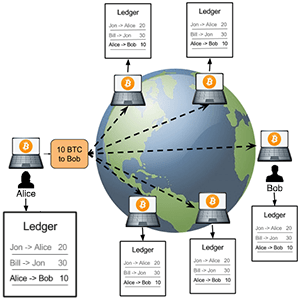
Bitcoin is a cryptocurrency, an online payment system secured by cryptography, released by the pseudonymous Satoshi Nakamoto in 2009. The system is peer-to-peer; users can transact directly without needing an intermediary. Transactions are verified by network nodes containing a public ledger called the block chain. Bitcoin nodes use the block chain to distinguish legitimate Bitcoin transactions from attempts to re-spend coins that have already been spent elsewhere. Bitcoin ‘mining’ is a record-keeping service. Miners keep the block chain consistent, complete, and unalterable by repeatedly verifying and collecting newly broadcast transactions into a new group of transactions called a ‘block.’
A new block contains information that ‘chains’ it to the previous block thus giving the block chain its name. It is a cryptographic hash (scrambled code that represents the block). Miners compute the hash functions to verify them for the network, a task that is intentionally designed to be resource-intensive and computationally difficult so that the number of blocks found each day remains steady. Mining is also the mechanism used to introduce new coins into the system: Miners are paid transaction fees as well as a ‘subsidy’ of newly created coins. This both serves the purpose of disseminating new coins in a decentralized manner as well as motivating people to provide security for the system.
Posted in Money, Technology |
1 Comment »
April 16, 2015


‘The Mosquito’ or Mosquito alarm is an electronic device used to deter loitering by young people by emitting sound at high frequency that older people have lost the ability to hear. It has two frequency settings, one of approximately 17.4 kHz that can generally be heard only by young people, and another at 8 kHz that can be heard by most people. The maximum potential output sound pressure level is stated by the manufacturer to be 108 decibels. The range of the sound is 140 feet with the sound baffle, and 200 feet without.
The sound can typically only be heard by people below 25 years of age, as the ability to hear high frequencies deteriorates with age (a phenomenon known as presbycusis). Crafty teenagers turned the sounds into a mobile phone ringtone, which could not be heard by older teachers if the phone rang during a class. Mobile phone speakers are capable of producing frequencies above 20 kHz. This ringtone became informally known as ‘Teen Buzz’ or ‘the Mosquito ringtone’ and has since been sold commercially.
read more »
Posted in Health, Politics, Technology |
Leave a Comment »
April 15, 2015
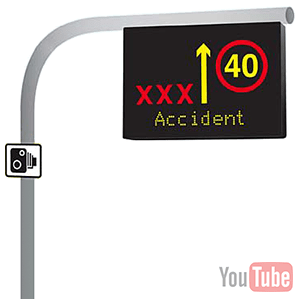
Active traffic management (ATM, also known as, ‘smart lanes’ or ‘managed motorway’) is method of increasing peak capacity and smoothing traffic flows on busy major highways. Techniques include variable speed limits, hard-shoulder running (use of the shoulder as a travel lane during congested periods) and ramp-metering (traffic lights at entrance ramps regulating the flow of incoming traffic). Drivers are alerted to changing conditions by overhead, electronic signs.
It is currently in operation in Birmingham, England. The scheme had initially been criticized by some due to possible safety and environmental concerns, however a Highways Agency report into the first six months of the scheme showed a reduction in the number of accidents and the system was expanded to other highways in the UK. It is seen as a less expensive alternative to widening a road.
read more »
Posted in Politics, Technology, World |
Leave a Comment »


 The Daily Omnivore